
You ask your child to sit down and do their homework. Fifteen minutes later you walk past and find them staring at the ceiling, doodling in the margin of their notebook, or somehow on an entirely different floor of the house. The homework is untouched.
You try again after dinner. Twenty minutes in, they need water. Then the bathroom. Then they cannot find the right pen. Then the ceiling again.
You are not imagining it. And your child is not being deliberately difficult. But something is getting in the way of sustained focus and if you can understand what that something is, you can actually do something about it.
This is not a blog about diagnosing attention disorders. It is not about medication or clinical intervention. It is about the ordinary, everyday reality of raising a school-age child in a world that is working very hard, in very sophisticated ways, to fragment their attention and what you can do, practically and consistently, to push back.
These strategies work across the full school age range. Where the approach differs for a seven-year-old versus a fifteen-year-old, we will say so. Because attention span is not a fixed trait. It is a skill. And like every skill, it responds to the right conditions, the right practice, and the right support.
Why Is Attention Span Getting Harder to Build?
Before we talk about solutions, it helps to understand the problem clearly. Because it is not simply that children today are lazy or undisciplined. The environment they are growing up in is genuinely more demanding of their attentional resources than any previous generation has faced.
The average smartphone delivers hundreds of micro-stimulations per day: notifications, scroll loops, autoplay content, likes, messages, each one releasing a small burst of dopamine that trains the brain to expect novelty at extremely short intervals. A brain conditioned by this environment does not find a maths worksheet boring because maths is boring. It finds the worksheet boring because the worksheet does not update every eight seconds.
This is not a personal failing. It is a neurological response to a neurological environment. And it affects children at every age, though it tends to become most acute in the middle and upper school years, when smartphones become a constant presence.
The good news is that the brain is plastic. Attentional capacity can be rebuilt. The habits, environment, and daily conditions that surround a child have a direct and measurable impact on their ability to focus. None of what follows requires perfection. It requires consistency, which is a different and more achievable thing.
The Foundations of Better Focus: Sleep, Movement, and Nutrition
Sleep is the non-negotiable
The research on sleep and cognitive function is among the most consistent in all of developmental science. Children who are chronically undersleeping and most school-age children in academically pressured environments are, have measurably impaired working memory, reduced impulse control, and significantly shorter attention spans than children who are well-rested. The guidelines are clear: children aged six to twelve need nine to twelve hours of sleep per night. Teenagers need eight to ten.
If your child cannot focus, check their sleep before anything else. A child who is getting seven hours when their brain needs ten will struggle to concentrate regardless of what study techniques they use, what tutors they see, or how much pressure is applied.
Movement is attention's closest ally
This surprises many parents. The instinct, when a child cannot concentrate, is to keep them at the desk. The research points in exactly the opposite direction. Physical movement, particularly aerobic exercise, increases blood flow to the prefrontal cortex, raises levels of dopamine and norepinephrine, and directly improves sustained attention for the hours that follow. A child who has spent forty-five minutes outside before sitting down to study will focus more effectively than one who has moved from the sofa to the desk.
For younger children in Grades 1 to 5, this means active outdoor play before homework, not as a reward, but as preparation. For older students in Grades 6 to 10, it means some form of physical activity built into the afternoon before the evening study session begins. Even a twenty-minute walk produces measurable attentional improvement.
Food and hydration are not trivial
How to Create a Study Environment That Improves Concentration
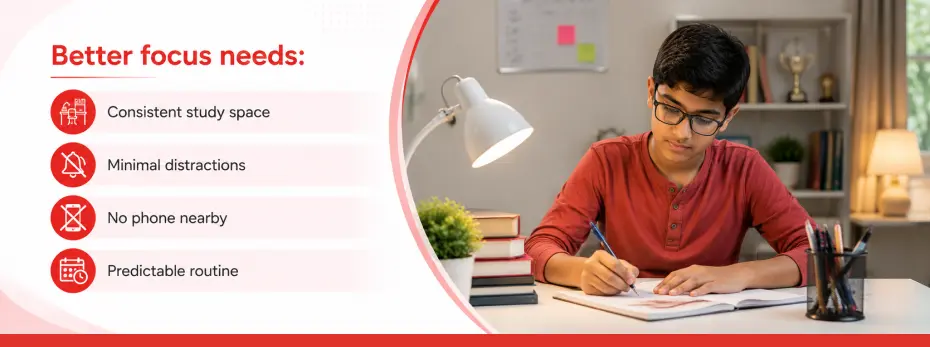
Remove the phone from the room
This is the single most evidence-backed attention intervention available to parents of children in Grades 5 and above, and it is the one most consistently resisted. A 2017 study by the University of Texas found that the mere presence of a smartphone on a desk, even face-down, even switched off, reduced available cognitive capacity measurably. The brain was using working memory to resist checking it. A phone in another room does not create that drain.
This is not about trust. It is about neuroscience. Make it a household norm rather than a punishment, and the resistance reduces significantly. Many families find that doing this together, parents included, during the homework hours removes the sense of singling anyone out and models what focused time actually looks like.
Create a consistent study space
The brain builds associations between environments and mental states. A child who always does homework at the same desk, in the same chair, with the same lamp on, begins to associate that space with focused work, in the same way they associate their bed with sleep. Shifting between the sofa, the kitchen table, and the bedroom floor prevents that association from forming.
The space does not need to be elaborate. It needs to be consistent, reasonably quiet, free from screens that are not being used for the work, and used for nothing other than study during study time.
Manage auditory distraction thoughtfully
Some children, particularly in the upper grades, focus better with background music than in complete silence. The research on this is genuinely mixed, but what is clear is that music with lyrics competes directly with language processing. If your child insists on music while studying subjects that involve reading, writing, or language work, instrumental music is a less costly compromise. For mathematics and science, the effect is less significant.

Best Strategies to Improve Focus in Children
Use time in chunks, not marathons
The idea that focus is built by sitting for longer is wrong. Focus is built by sitting completely for a bounded, achievable period and then stopping deliberately. The Pomodoro technique, widely used in adult productivity but equally effective for school-age children, involves twenty-five minutes of completely focused work followed by a five-minute break. For younger children in Grades 1 to 3, fifteen minutes on, five off is more appropriate. For upper school students, thirty to forty-five minutes with a ten-minute break.
The break is not a failure. It is the mechanism. A brain that knows rest is coming focuses more effectively during the work period than one facing an undefined stretch of required attention.
Reduce the task to its smallest useful component
One of the most common causes of attentional avoidance in school-age children is not unwillingness to work but genuine overwhelm at the scale of what is in front of them. A child who opens a history essay and sees “write 800 words” is facing something that requires sustained effort over an extended and uncertain period. A child who opens the same essay and is asked to write just the opening paragraph first is facing something manageable.
Breaking tasks into the smallest possible components, particularly for children in Grades 3 to 8, who are developing independence but not yet fully self-regulating, reduces the cognitive cost of starting. Starting is usually the hardest part. Once a child is in the work, momentum does the rest.
Teach them to notice when they have drifted without shame
Attention naturally wanders. In every brain, at every age, focus does not hold indefinitely, it lapses, recovers, lapses again. The difference between a child with good attentional skills and one without is not that the first never drifts. It is that the first notices the drift more quickly and returns to the task without a significant emotional cost.
This skill, noticing, returning, continuing can be taught and practised explicitly. When you catch your child staring into space during homework, rather than expressing frustration, try something neutral: where did your brain go just then? Name the drift as a normal thing, not a character flaw. Help them develop the habit of noticing and returning, rather than the habit of hiding the fact that they drifted.
For older students in Grades 8 to 10, this connects directly to metacognition, the ability to think about their own thinking, which is one of the strongest predictors of academic achievement in secondary school and beyond.
Give them a reason to focus that is bigger than the grade
This is particularly important for students in Grades 6 to 10, who are old enough to disengage from external motivators but may not yet have developed strong internal ones. A child who cannot find a reason to care about the subject they are studying will not focus on it, regardless of the conditions you create.
This does not mean every subject needs to be made thrilling. It means helping your child find their own thread of genuine interest within even the subjects they find difficult. What part of this connects to something they actually care about? What would they want to know if nobody was asking them to know it? These questions take time to answer. They are worth asking anyway.
Common Mistakes Parents Make When Children Can’t Focus
Everything above applies to students across all grades. But for parents of children in Grades 8 to 10, there is one more thing worth saying directly.
Teenagers whose attention is significantly impaired are often teenagers who are dealing with something beyond study habits. Social anxiety, low mood, friendship difficulties, academic pressure that has tipped from motivating to paralysing, all of these show up as inability to concentrate before they show up as anything more recognizable.
If your teenager’s attention difficulties are sudden in onset, significantly worse than before, or accompanied by withdrawal, sleep disruption, or loss of interest in things they previously enjoyed, do not reach for a study strategy. Reach for a conversation. Ask what is going on. Listen without a plan. And if the conversation reveals something heavier than distraction, involve the school’s pastoral team. That is exactly what they are there for.
How Dhruv Global School Supports Attention and Learning
At Dhruv Global School, we think about attention not as a prerequisite for learning but as something we actively build through the way we teach.
Our lessons are structured to work with the natural attentional arc of school-age children, varying pace, building in movement and reflection, alternating between high-demand cognitive tasks and lower-demand consolidation. We do not ask children to sustain peak focus for forty minutes at a stretch, because the research tells us clearly that this is not how attention works in any brain, at any age.
We also talk to students directly about how their own attention works. What helps them focus? What derails them. What they notice about their own best conditions for learning. This conversation, treating students as participants in their own education rather than recipients of it, is one of the most effective attentional interventions available. A student who understands their own brain is a student who can begin to work with it.
Our pastoral team works closely with families when attention is becoming a significant concern. Because the most effective support for a child whose focus is struggling is never the school alone, or the family alone. It is both, working with the same information, toward the same goal.
Final Thoughts
Attention is not a talent some children are born with and others are not. It is a capacity that grows or shrinks in response to the conditions around it.
The child sitting at the desk, staring at the ceiling, is not a child who cannot focus. They are a child whose focus has not yet found the right conditions to develop. The environment they are working in, the sleep they are getting, the movement in their day, the way the task is framed, the presence or absence of a phone in the room, all of it is shaping a skill that will determine not just their academic outcomes but the quality of their thinking, their relationships, and their inner life for decades to come.
That is worth taking seriously. Not with anxiety, but with the calm, consistent attention that as it happens is exactly what we are trying to help them build.