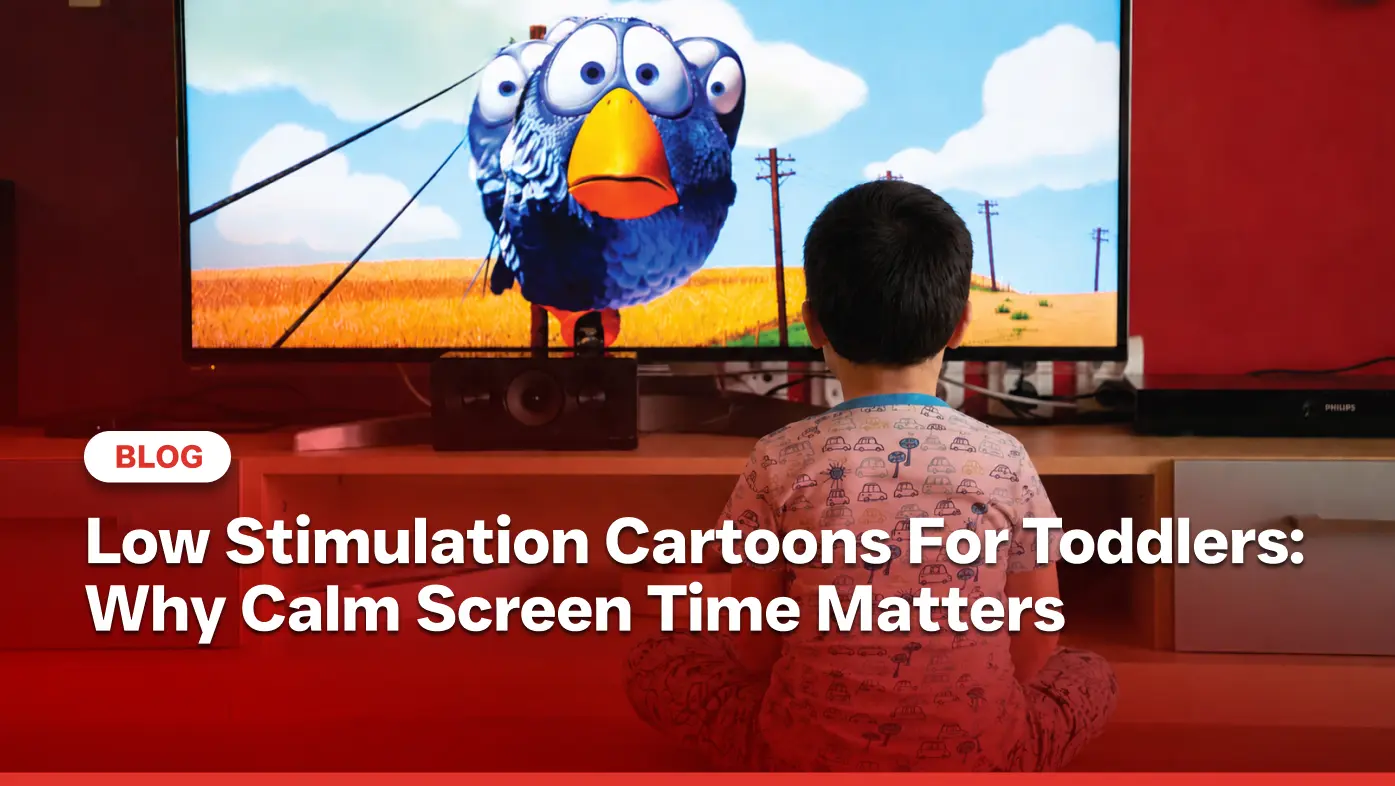
It starts innocently enough. You need ten minutes. The dinner is burning, the phone is ringing, your toddler has been attached to your leg since seven in the morning. You hand over the tablet.
Twenty minutes later you look over. The cartoon on screen is flashing between scenes every three seconds. There are five characters talking simultaneously. The background music has not stopped once. Your child’s eyes are completely fixed. They do not blink when you call their name.
You take the tablet away. Within thirty seconds, the meltdown begins.
Most parents have been here. And most parents have felt, somewhere underneath the chaos, that something about what just happened is not quite right, even if they cannot explain why.
The answer has a name. And once you understand it, the way you think about your child’s screen time changes completely.
What High-Stimulation Cartoons Do to a Toddler’s Brain
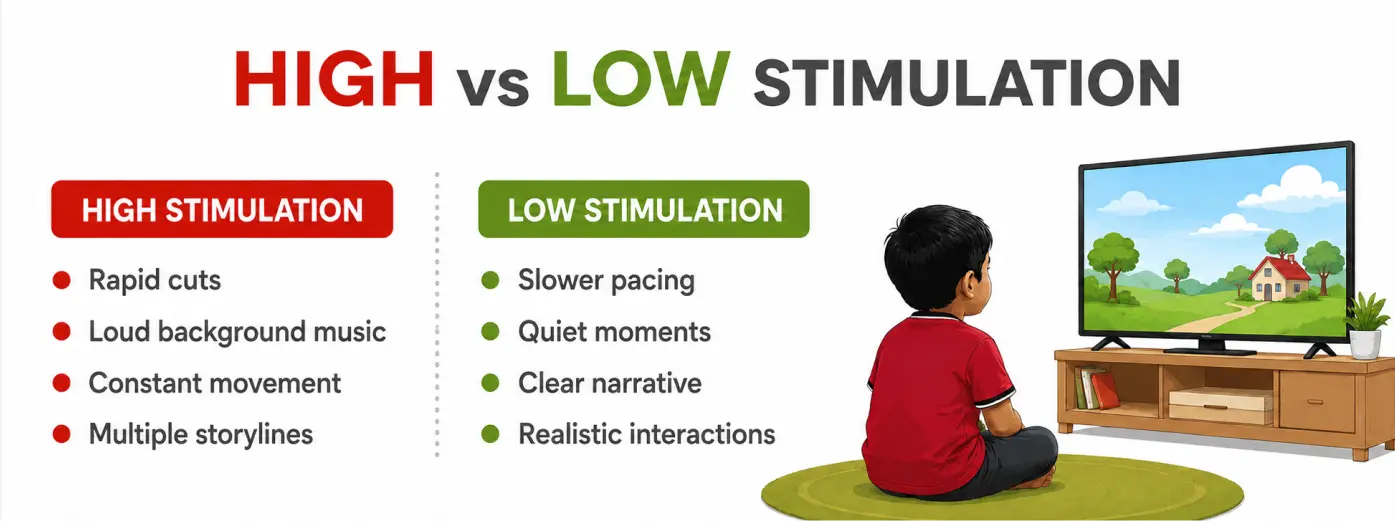
Children’s television has changed dramatically over the last two decades. Where programmes once moved slowly, with long pauses and simple narratives, modern cartoons are frequently engineered for maximum engagement, rapid scene cuts, bright saturated colours, constant sound, multiple simultaneous storylines, and characters who never stop moving or talking.
From a production standpoint, this works. Children watch. They do not look away. From a developmental standpoint, something more complicated is happening.
The brain of a child aged two to five is not a smaller version of an adult brain. It is a brain in the middle of its most significant period of development, forming neural connections, building the capacity for attention, learning to regulate emotion, and developing language. It is, in the truest sense, a brain under construction.
High stimulation content floods that developing brain with more input than it can meaningfully process. The rapid scene cuts, some modern cartoons average a new cut every two to three seconds, do not allow the prefrontal cortex, the part of the brain responsible for attention and executive function, to practise staying with something. Instead, the brain learns to expect constant novelty. It learns that when things slow down, that is a signal to disengage.
Researchers at the University of Virginia found that children who watched nine minutes of a fast-paced cartoon performed significantly worse on tasks requiring attention, self-regulation, and problem-solving immediately afterwards, compared to children who had been drawing or watching a slower-paced programme for the same amount of time. The effect was immediate and measurable.
This is not about screen time being inherently bad. It is about the quality and pace of what children are watching and what that pace is teaching their brains to expect from the world
What Are Low Stimulation Cartoons?
Low stimulation is not a synonym for boring. This is the misunderstanding that stops many parents from making the switch.
A low stimulation cartoon is one that is designed with a young child’s developmental needs in mind rather than maximum engagement metrics. It moves slowly enough for a child to actually follow the narrative. It pauses. It allows silence. It shows a character thinking before speaking, or completing a task from beginning to end without cutting away. It does not reward a child’s attention with constant novelty, it builds a child’s capacity to sustain attention through genuine story.
The difference, when you watch side by side, is immediately obvious. A high stimulation cartoon keeps a child watching by never giving their brain a moment to switch off. A low stimulation cartoon keeps a child watching because something is actually happening that they care about.
One trains passivity. The other builds engagement.
What to Look For in a Low Stimulation Cartoons
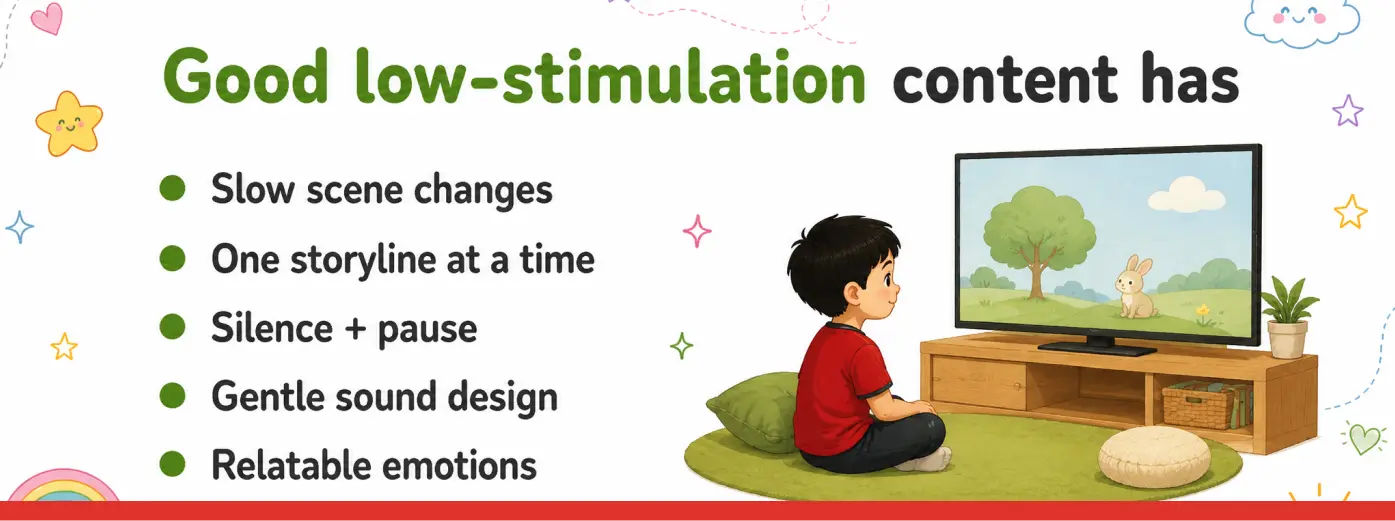
Before we get to specific recommendations, it helps to know what you are looking for. These are the markers that separate genuinely low stimulation content from content that simply markets itself as calm or educational.
Slow scene changes
One narrative thread at a time
Silence and pause
Realistic cause and effect
Low stimulation programmes tend to show things happening in real time. A character plants a seed. They water it. They wait. It grows. This mirrors how the actual world works and builds patience, sequencing, and scientific thinking simultaneously.
Gentle, natural sound design
Relatable, emotionally legible characters
Best Low Stimulation Cartoons for Toddlers and Preschoolers
Bluey
Mister Rogers' Neighbourhood
Numberblocks and Alphablocks
Shaun the Sheep
Molang
Ask the Storybots
How to Transition Your Child Away from High-Stimulation Cartoons
If your child is used to high stimulation content, switching to slower programmes will not feel seamless at first. This is important to know, because the initial resistance is not evidence that low stimulation content is wrong for them. It is evidence of exactly why the switch matters.
A brain accustomed to constant novelty finds slowness uncomfortable. The first few times a child watches a low stimulation programme, they may fidget, lose interest, ask to watch something else. Some children take a week or two to recalibrate. What parents who persevere consistently report, usually within two to three weeks, is that their child is calmer after screen time rather than more agitated, re-engages with play more readily when the screen goes off, and begins to show longer sustained attention in other areas of their life too.
The transition is the work. The other side of it is genuinely different.
A few things that help. Watch with your child in the early stages, rather than using the screen as a substitute for company. Ask questions about what is happening in the programme, not comprehension questions, just curious ones. What do you think he is going to do? Why is she sad? What would you do? This turns passive watching into active thinking, and it is one of the simplest ways to make any screen time more developmentally valuable.
Also and this is the piece parents least want to hear, use it less. The research on screen time for under-fives consistently points to the same conclusion: what matters is not just the quality of what children watch but the total amount. The World Health Organisation recommends no more than one hour of screen time per day for children aged three to five, and nothing at all for children under two. Low stimulation content watched within those limits is a genuinely different proposition from two hours of anything, however slow.
Healthy Screen Time Habits for Toddlers
The capacity for sustained attention is not just a school skill. It is a life skill. It underpins reading, creativity, conversation, friendship, and the ability to sit with difficulty long enough to work through it.
Children who develop strong attentional capacity in the early years arrive at school ready to learn, not just ready to be entertained. They can follow a story to its end. They can wait for a turn. They can tolerate the slow, uncertain, non-immediately-rewarding experience of trying something difficult.
These are not small things. They are the foundations of almost everything that matters in a child’s academic and emotional life.
Screen time, managed well, does not undermine those foundations. Screen time, managed poorly, quietly erodes them, one rapid scene cut at a time.
The good news is that the choice is genuinely available. Not all cartoons are the same. Not all screen time does the same thing to a young brain. The families who understand the difference are the families who make it work.
Tips for Parents: Making Low Stimulation Content Actually Work at Home
Set a consistent screen time window
Watch with your child when you can
Give a two-minute warning before screen time ends
Do not use screen time as a reward or a punishment
Have something ready to do when the screen goes off.
Be honest with yourself about why the screen is going on
Final Thoughts
Nobody is asking you to ban cartoons. That is not the argument here, and it would not be a realistic one even if it were.
The argument is simpler than that. The cartoons your child watches are not neutral. They are doing something to the brain that watches them — shaping attentional habits, emotional regulation, the default speed at which a young mind expects the world to move. Some of them are doing something genuinely good. Others are doing something that makes everything else in your child’s day harder: the settling at bedtime, the patience at the breakfast table, the ability to sit with a puzzle that does not immediately give them what they want.
You have more influence over this than the tablet suggests. The choices are real, the alternatives exist, and the child who comes out the other side of a thoughtful screen time environment carries something into every classroom, every friendship, and every challenge that no curriculum can fully replicate: the capacity to stay.
That capacity starts here. In the small decisions. In what goes on the screen, and for how long, and what happens in the house when it goes off again.
It is worth getting right.