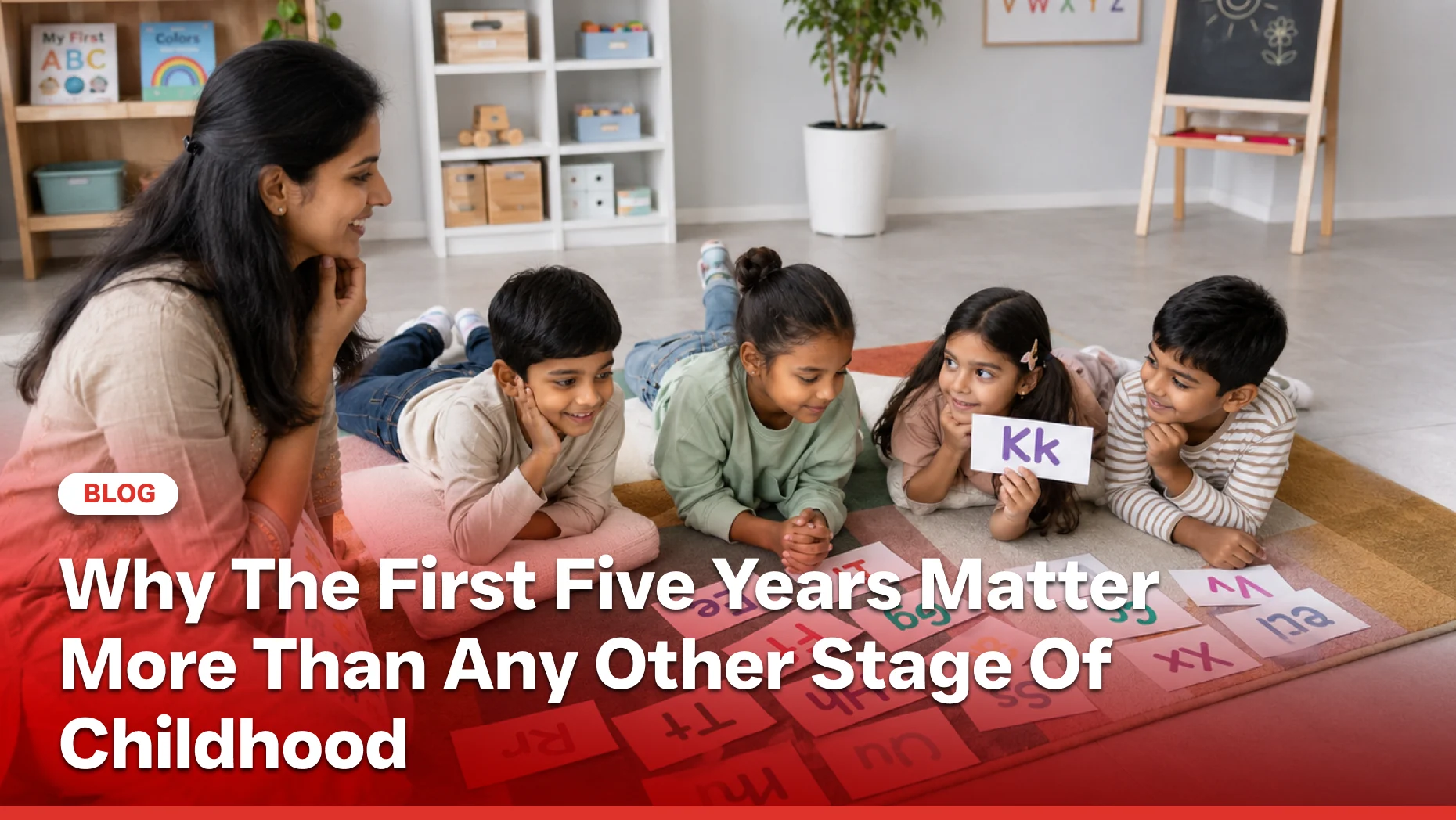
If you have ever felt like the decisions you make for your toddler carry more weight than you expected, what they eat, how they play, whether they nap on time, which preschool you choose, your instinct is correct. The first five years of a child’s life are not simply a warm-up act before “real” school begins. They are, according to decades of neuroscience, the single most important developmental window a human being will ever experience.
This is not a guilt-inducing statement. It is a hopeful one. Because it means the small, ordinary moments happening in your home and in your child’s classroom right now, a shared book, a block tower, a comforting routine, are doing far more than keeping a child occupied. They are quite literally building a brain.
This blog explains what happens in a child’s brain between birth and age five, why this window closes the way it does, and what parents and preschools can do to make the most of it.
What Happens in a Child's Brain During the First Five Years?
A newborn’s brain is only about 25 percent of its adult size. By age five, it has reached almost 90 percent. This is not simply growth, it is an extraordinary period of construction. In the earliest years, a child’s brain forms more than a million new neural connections every second, a rate of connection-building that is never repeated at any other point in life.
Each of these connections, called synapses, is formed through experience. Every time a baby is spoken to, held, sung to, or allowed to explore a new texture, a connection strengthens. This is why early childhood experts often describe the first five years as a critical period of brain development, a stretch of time when the brain is unusually receptive to the input it receives from the world around it.
Not every connection survives. Through a process called synaptic pruning, the brain keeps the connections that are used repeatedly and gradually lets go of the ones that are not. In simple terms: what a child experiences often in these years becomes wired in. What a child rarely experiences tends to fade. This is precisely why consistency, warmth, and rich everyday interaction matter so much more than any flashcard or app.
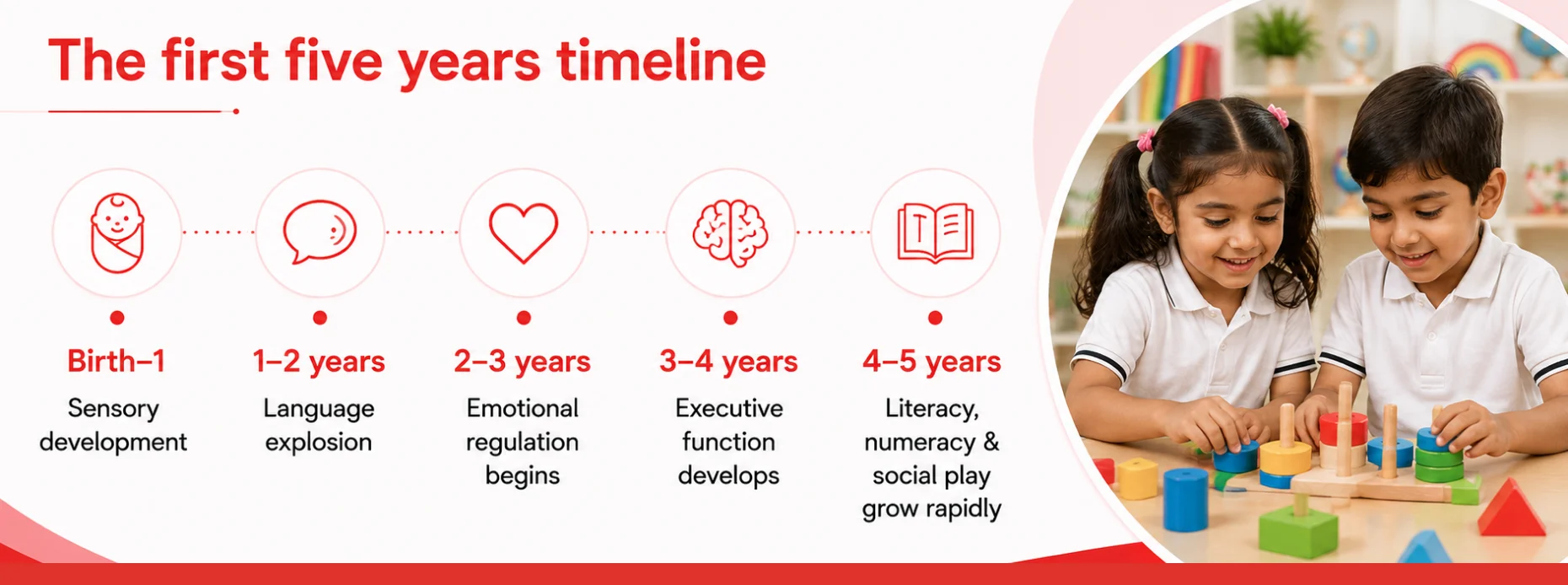
Quick Reference: Brain Development Milestones, Birth to Five
- Birth to 12 months: Rapid sensory wiring; sight, sound, touch, and attachment form the foundation.
- 1 to 2 years: Language explosion begins; motor skills and independence develop quickly.
- 2 to 3 years: Emotional regulation, symbolic play, and early social skills take shape.
- 3 to 4 years: Executive function begins; planning, focus, and impulse control start developing.
- 4 to 5 years: Pre-literacy, early numeracy, and complex social play consolidate rapidly.
Why Early Childhood Development Has a Lifelong Impact
Parents sometimes ask a fair question: if a child misses out on rich stimulation early on, can it not be corrected later with extra effort? The honest answer is more nuanced. The brain remains capable of learning throughout life, this is true. But the foundational architecture built in the first five years shapes how efficiently later learning happens.
Think of it the way you would think about a building. Walls, wiring, and paint can be changed at almost any stage. But the foundation is poured once, early, and everything else is constructed on top of it. A child with a strong early foundation in language, emotional security, and curiosity tends to find later learning: reading, mathematics, friendships, resilience, considerably easier to build upon.
Research from Harvard University’s Center on the Developing Child consistently shows that early experiences, both positive and negative, are built into the body and brain in ways that influence health, learning, and behaviour well into adulthood. This is often described as the concept of serve and return interaction, when a baby or toddler reaches out through babbling, gesture, or expression, and an adult responds, that back-and-forth exchange is one of the most powerful builders of brain architecture available.
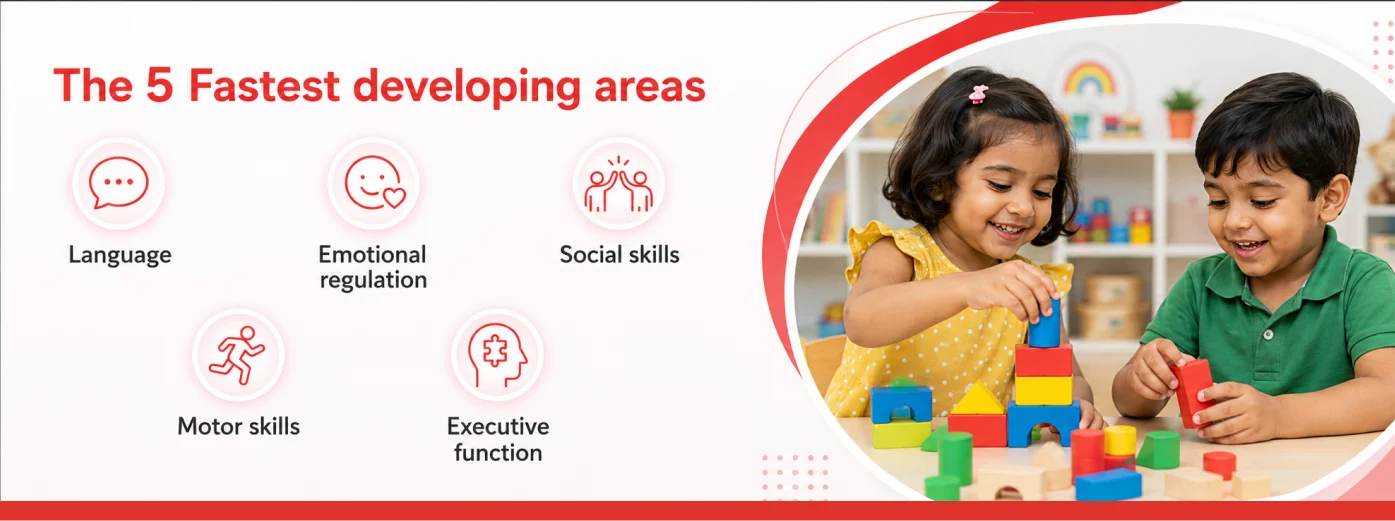
The Five Areas That Develop Fastest in Early Childhood
1. Language Development
Children exposed to rich, varied language in their early years, being spoken to, read to, and encouraged to talk, tend to develop stronger vocabulary and comprehension skills well before school begins. This is not about formal lessons. It is about ordinary conversation: narrating your day, asking open-ended questions, and reading together often.
2. Emotional Regulation
Toddlers are not being difficult on purpose when they struggle to manage big feelings, their brain’s emotional control centre is simply still under construction. Emotional regulation in early childhood develops through repeated, calm co-regulation with a trusted adult: naming feelings, staying steady during a meltdown, and modelling calm.
3. Social Skills
Sharing, turn-taking, and reading another person’s expression are learned skills, not instincts. Group play in the early years, the kind that happens naturally in a good preschool classroom, gives children thousands of small repetitions of these social skills long before they are formally taught.
4. Motor Development
Fine motor skills (holding a crayon, using scissors, buttoning a shirt) and gross motor skills (running, climbing, balancing) both develop rapidly in these years, and both are closely tied to a child’s later confidence and independence.
5. Executive Function
How Parents Can Support Healthy Brain Development at Home
You do not need an elaborate curriculum to support brain development in the early years. Some of the most powerful inputs are also the simplest.
What the Research Says Actually Works
- Talking to your child constantly, in full sentences, even before they can respond in words
- Unstructured, hands-on play with blocks, sand, water, and open-ended toys
- Predictable daily routines that reduce stress and free up mental energy for learning
- Reading together daily, the same book repeatedly is not a problem, it is a benefit
- Warm, responsive relationships with the same few caregivers, rather than constantly changing faces
- Limited screen time in the earliest years, replaced with real-world interaction
What tends to matter far less than parents often assume: the specific brand of educational toy, early exposure to academic drilling, or how early a child is taught to read independently. Rich interaction consistently outperforms structured instruction in these years.
Choosing the Right Preschool for Your Child
Because so much of this development happens through everyday interaction rather than formal lessons, it is easy to underestimate what a good preschool actually does. A strong early years programme is not simply a safe place for a child to spend the day. It is a deliberately designed environment for exactly the kind of rich, repeated, responsive interaction that builds the brain.
The quality of a preschool classroom, how often a teacher talks with a child individually, how much unstructured play is protected in the schedule, how consistently the same teachers are present, how calmly transitions are handled, has a measurable relationship with a child’s later school readiness. This is why early childhood education is increasingly treated by policymakers, including under India’s National Education Policy 2020, as a foundational stage deserving as much attention and investment as the years that follow it.
How Dhruv Preschool Approaches the First Five Years
At Dhruv Preschool, our classrooms are designed around a simple understanding: this is the most important stage of a child’s education, not the least.
Our programme is built on play-based learning, because play is not the opposite of learning in early childhood, it is the primary mechanism through which learning happens. Children build block towers and, in doing so, build early physics and problem-solving. They negotiate over toys and, in doing so, build language and emotional regulation. They pretend to run a shop and, in doing so, build symbolic thinking and social skills.
Our teachers are trained to practise, serve and return interaction throughout the day, responding warmly and consistently to each child’s attempts to communicate, rather than moving through a fixed script. Classrooms are kept small enough that every child receives genuine individual attention, and routines are kept predictable, because a calm, secure environment is what allows the developing brain to focus its energy on learning rather than managing stress.
Across our branches in Aundh, Baner, Kolhapur, Vadodara, Mukundnagar, and KP, the environment looks a little different in each location, but the underlying approach does not change: rich language, warm relationships, generous play, and a genuine belief that these five years matter more than any that follow.
Final Thoughts
You do not need to get every day right. No parent does, and no preschool does either. What matters is the pattern, the accumulation of thousands of small, warm, language-rich, responsive moments across five years. That pattern is what builds a brain capable of learning, connecting, and thriving for a lifetime.
The best time to think seriously about your child’s early years is now, while they are still in them.