
The question often arrives casually. A child comes home from school and says that nearly everyone in the class has a phone. They want one too, perhaps for the school bus, a group project, a coaching class, a sport practice or simply to stay included in a friendship group.
For a parent, it rarely feels casual. A smartphone can make daily logistics easier. It can allow a child to call home, check a timetable, use a map or share a document. It can also bring group-chat conflict, unwanted contact, late-night scrolling and a device that follows a child into every quiet moment.
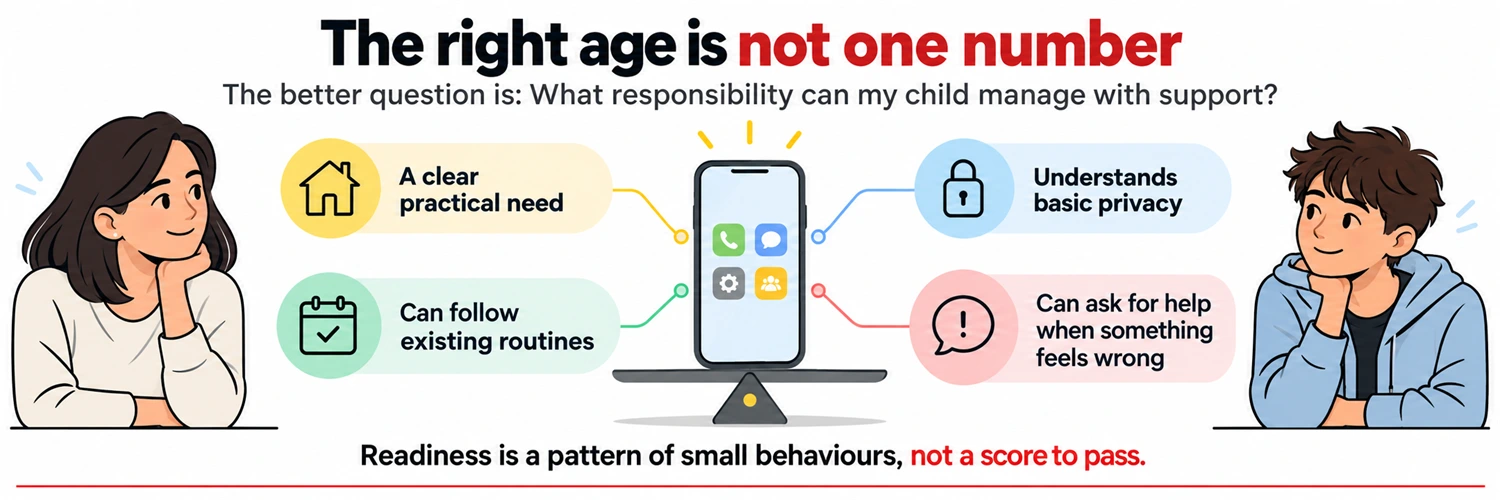
Many parents understandably look for one correct age. There is not one. Middle school is a period of huge variation: one child may handle a device carefully at eleven, while another needs more time at thirteen. The better question is not, “What does everyone else have?” It is, “What responsibility can my child manage with support?”
A first smartphone is not merely a purchase. It is the beginning of an ongoing family conversation.
When Should Kids Get Their First Smartphone?
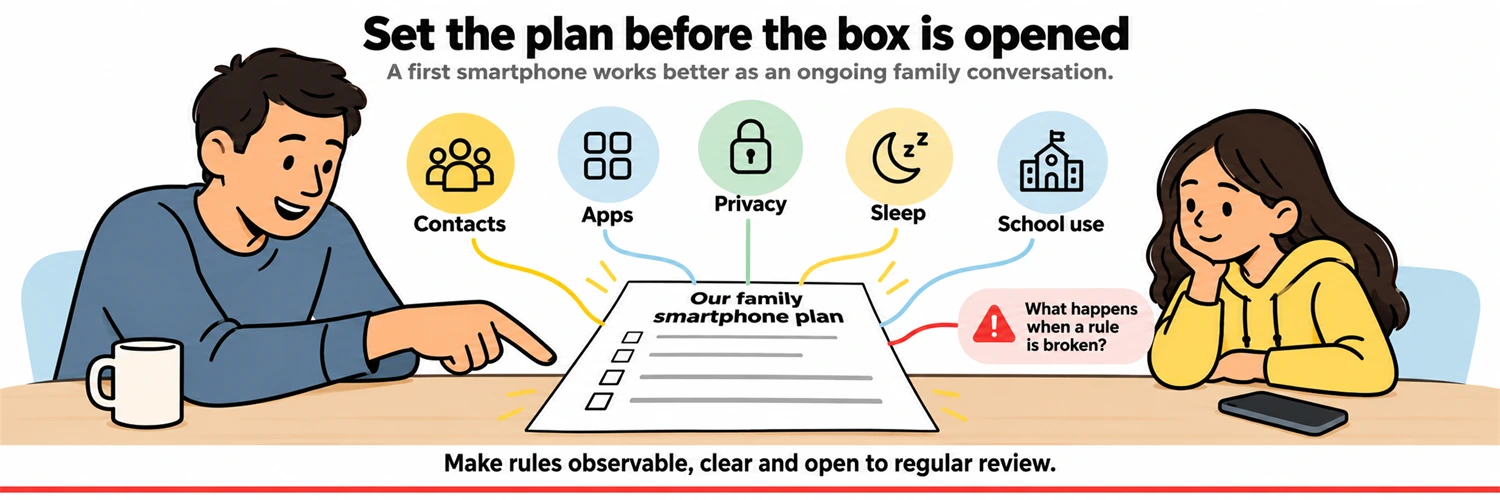
There is no universally right age for a first smartphone. A child is more likely to be ready when there is a clear need, they can follow existing routines, they understand basic privacy and they can ask for help when something online feels wrong. Start with a shared plan covering contacts, apps, privacy, sleep, school use and what happens when rules are broken. Review the plan regularly, not only after an argument.
What Are Parents Really Deciding When They Give Their First Smartphone?
Parents are not choosing between “good technology” and “bad technology”. They are deciding how much access, independence and responsibility a child can hold at this stage.
A phone can be useful. It may make pickups safer, support travel to activities, help with school coordination and allow a child to stay in touch with family. It can also expose them to persuasive design, endless messages, unfamiliar people and content that is not meant for their age.
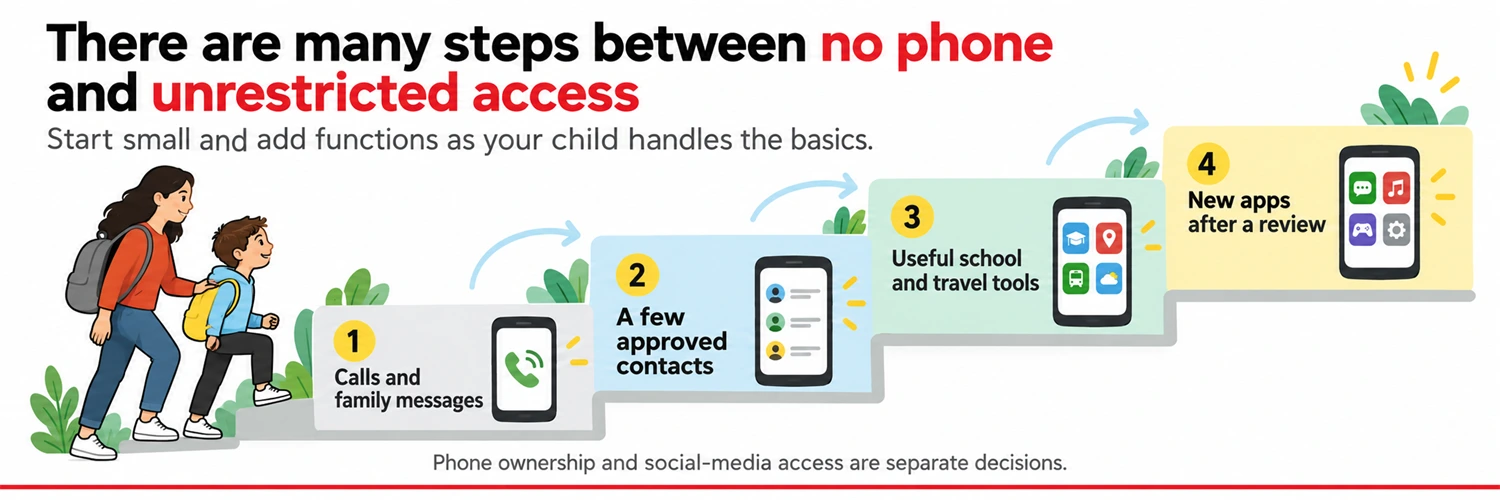
That is why a first smartphone should be a graduated privilege, not a sudden leap into every app and every group chat. The device, the data plan, the app list and the rules can all be adjusted. There are many steps between “no phone” and “unrestricted phone”.
The American Academy of Pediatrics recommends a family media plan that considers a child’s development, creates consistent expectations and keeps conversation open. Its current parent guidance also encourages families to use parental controls for features such as time, downloads, contacts and purchases. These tools can support a plan, but they cannot replace a relationship.
A useful starting question:“What problem will this phone solve for our family?” If the answer is only “everyone else has one”, slow the decision down.
How Do You Know if Your Child Is Ready for a Smartphone?
| Readiness area | What to look for | What support may still be needed |
|---|---|---|
| Everyday responsibility | Brings school items, follows household routines, cares for belongings | A simpler device or shared family device first |
| Emotional regulation | Can pause after a disappointment and talk about it later | More coaching before group chats or social platforms |
| Privacy awareness | Knows not to share passwords, location or private photos casually | Practice identifying personal information together |
| Help-seeking | Tells an adult when something feels confusing or upsetting | Agree on exactly who they can contact and how |
| Balance | Can put another screen aside for meals, sleep and activities | Start with clear time and place boundaries |
No child will tick every box perfectly. Adults do not manage phones perfectly either. The point is to identify the skills you will teach, not to wait for flawless behaviour.
It can help to separate phone ownership from social-media access. A child may need a phone for calls, messages and a family group without needing public social accounts or every popular app. Most major social platforms set a minimum account age of 13, but meeting a minimum age is not the same as being ready. Families can wait longer.
How to Talk to Your Child Before Giving Them Their First Phone
Begin before the box is opened. A good conversation is specific, calm and two-way. Avoid a long lecture in which the parent announces rules and the child nods. Ask what the child thinks a phone will be used for, what might go wrong, and what help they would want if it did.
You might say: “We are considering a phone because you are starting to travel to activities. We also know phones can make sleep, friendships and attention harder. Let’s work out a plan that keeps the useful parts and protects the important parts.”
Then discuss real situations:
- A friend asks for a photo that feels private.
- Someone adds the child to a group chat full of unkind messages.
- A stranger sends a request or asks to move a conversation elsewhere.
- A message arrives late at night and the child feels they must answer.
- The child sees something upsetting, embarrassing or frightening.
The goal is not to make the child anxious. It is to remove secrecy. They should know that asking for help will not automatically mean losing the phone forever. If every mistake leads to humiliation or confiscation, children may hide the next problem.
What Rules Should Parents Set for a Child's First Smartphone?
Written rules are not cold or controlling. They prevent everyone from relying on memory during a disagreement. A short agreement also makes it easier to revise one rule without turning the whole arrangement into a battle.
| Topic | A clear first-phone rule |
|---|---|
| Purpose | The phone is for contact, safety, school coordination and agreed entertainment |
| Bedtime | The phone charges outside the bedroom at a set time |
| Meals and family time | Phones stay away unless there is a genuine reason |
| School | Follow the school’s phone policy; never use the phone to bypass it |
| Apps and downloads | Ask before downloading a new app or joining a new social platform |
| Privacy | Do not share passwords, live location, school details or private images without discussing it |
| Money | No purchases, subscriptions or in-app spending without permission |
| Problems | Tell a trusted adult about unwanted messages, pressure, bullying or upsetting content |
| Review | Revisit the agreement after two weeks, then once a month |
Keep the wording observable. “Use your phone responsibly” is too vague. “Charge it in the kitchen by 9.30 pm on school nights” is clear. Rules should also apply to adults where reasonable. If phones are off the dinner table, parents should not scroll through the meal either.
The Australian eSafety Commissioner advises parents to look beyond total screen time and consider patterns, including late-night use and whether a child is ready for ownership. That is a useful frame. A child may use a phone for a long video call with a grandparent, a school task or a creative hobby; those experiences are not identical to several hours of distressed, late-night scrolling.
What Parental Controls Should You Set Up on Your Child's Smartphone?
Start with the basics:
- Use a strong screen lock that the parent can access in an emergency.
- Turn off public location sharing by default. Review location permissions app by app.
- Use age-appropriate content and download controls.
- Review who can message, add or tag the child in any app that is allowed.
- Disable or restrict purchases and app-store changes.
- DSet a school-night downtime period and notification boundaries.
- Check privacy settings together after major app updates.
How Can Parents Protect Sleep, Attention And Real-World Time?
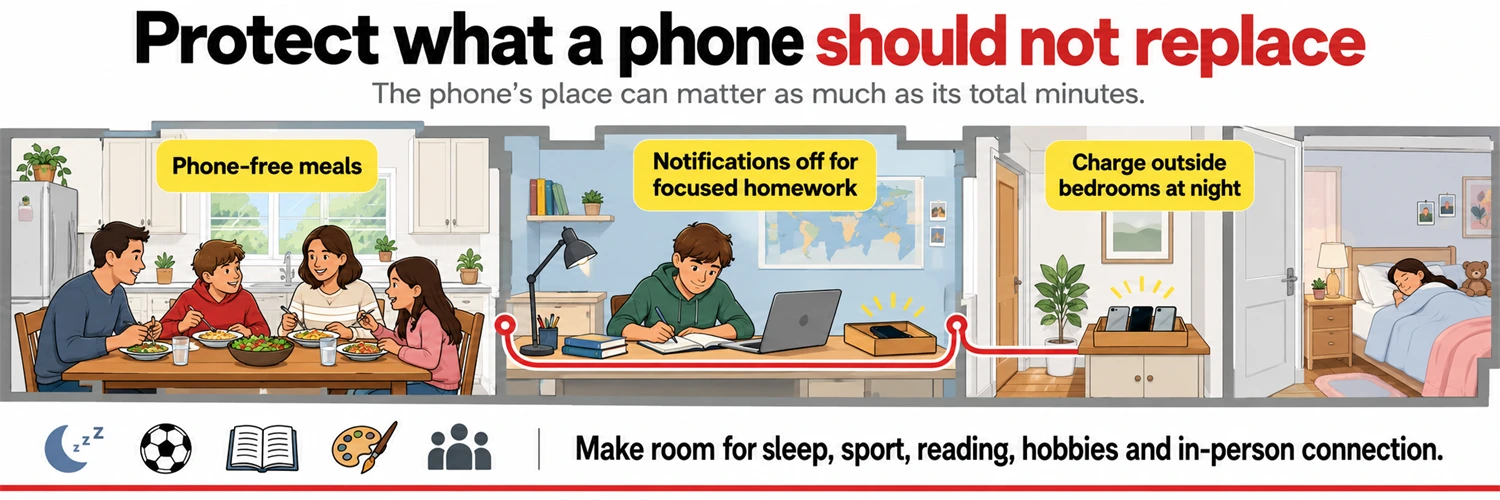
The phone’s place matters as much as its total minutes. A device in the bedroom after lights-out is different from a family video call in the living room. A phone that sits beside homework is different from one placed in another room for twenty focused minutes.
Make the household environment do some of the work. Create phone-free meals. Choose a charging point outside bedrooms. Keep notifications off during homework and sleep. Protect sport, hobbies, reading and unstructured time, not because screens are automatically harmful, but because these parts of a child’s day need room too.
The OECD’s review of children’s digital lives identifies sleep, physical activity, in-person connection, online abuse and exposure to harmful content as areas families should consider. The key word is balance. A good plan protects what a child needs to keep doing offline.
If a rule keeps failing, do not simply make the punishment bigger. Ask what is happening. Is the phone needed for a class group? Is the bedtime unrealistic? Does the child need help leaving an intense group chat? Problem-solving teaches more than a stricter timer alone.
How Can Parents Protect Children From Cyberbullying and Online Risks?
For many middle-school children, the hardest part of a phone is not the device. It is the social world inside it. Group chats can be funny, helpful and connected. They can also move quickly, reward impulsive comments and leave a child feeling excluded.
Teach a few simple habits before trouble begins. Do not forward a message that would hurt someone if read aloud in class. Do not add another child to a group without asking. Pause before replying when angry. Screenshot or save evidence of persistent bullying, then step away and tell an adult. Blocking is not rude when someone is being unsafe or unkind.
Parents should resist demanding to read every message as the default. Middle-schoolers need some privacy. At the same time, privacy is not secrecy when safety is involved. A family can agree that a parent may step in if there are signs of bullying, threats, self-harm content, sexual pressure, fraud or contact from strangers.
Say this clearly: “You will not be in trouble for showing me something that somebody else sent you.”
What Are Common Mistakes Parents Make With a Child's First Phone?
Avoid these traps:
- Starting with every app. Add functions slowly as the child handles the basics.
- Using monitoring as a substitute for conversation. A filter cannot teach a child what to do when someone pressures them.
- Focusing only on minutes. Notice sleep, mood, schoolwork, friendships and the purpose of use.
- Using the phone as the only consequence. Link consequences to the behaviour: a privacy breach may mean tighter sharing settings; late-night use may mean earlier charging.
- Ignoring adult habits. Children notice when adults expect limits they do not model.
How Can Schools And Families Work Together On Phone Habits?
School policies and home rules do not need to be identical, but they should not contradict each other. Read the school’s phone expectations with your child. Discuss why attention, privacy and respectful communication matter during the school day.
Dhruv Global School supports learning that balances curiosity with responsibility. At home, parents can reinforce the same values by asking children how a digital choice affects concentration, relationships and wellbeing. The school’s guide to AI literacy at home offers a helpful companion conversation: children need to ask what they are seeing, who created it and whether it deserves trust.
This is not about creating a “perfect” digital child. It is about helping a young person practise good judgement before the stakes become higher.
Final Thoughts
A first smartphone should not be handed over with the message, “Be careful.” That is too much responsibility packed into two words.
Instead, give your child a plan, a chance to practise, clear boundaries and a reliable route back to you when something goes wrong. The strongest rule is not a setting on the phone. It is the understanding that home is a safe place to talk about what happens online.
FAQs
There is no single best age. Consider a child’s practical need, ability to follow routines, privacy awareness and willingness to ask for help. A basic phone or a limited smartphone can be a sensible first step for some families.
Start with sleep, school, downloads, privacy, money and help-seeking. A fixed overnight charging location, app approval, privacy settings and a clear rule to tell an adult about upsetting contact give families a strong foundation.
Respond calmly and connect the consequence to the behaviour. Review what happened, repair any harm and adjust the relevant boundary. The aim is safer next choices, not a punishment that makes your child hide the next problem.