Every generation of parents has wondered whether the education their child is receiving will prepare them for the world they are actually going to inhabit.
For most of history, that question had a relatively stable answer. The world changed slowly enough that a solid grounding in mathematics, science, language, and history served a person reasonably well across a lifetime.
That stability is gone. The pace of change today is not gradual. It is structural. Artificial intelligence is not a new tool sitting alongside existing ones. It is a force that is fundamentally reorganising what human beings are needed for in medicine, in law, in finance, in engineering, in creative fields, in virtually every sector of the economy.
The World Economic Forum’s most recent Future of Jobs report projects that 85 million jobs will be displaced by automation by 2030, while 97 million new roles will emerge that did not previously exist. The children in school today will spend the majority of their working lives in jobs that either do not yet exist or have not yet taken their final form.
In this context, asking which subjects matter is not a trivial question. It is one of the most consequential questions a parent can ask. And the answer is more interesting and more reassuring than most people expect.
What AI Can Do and What It Still Can't
To understand which subjects matter, you first need to understand what AI is genuinely capable of and where, for now and the foreseeable future, it reaches its limits.
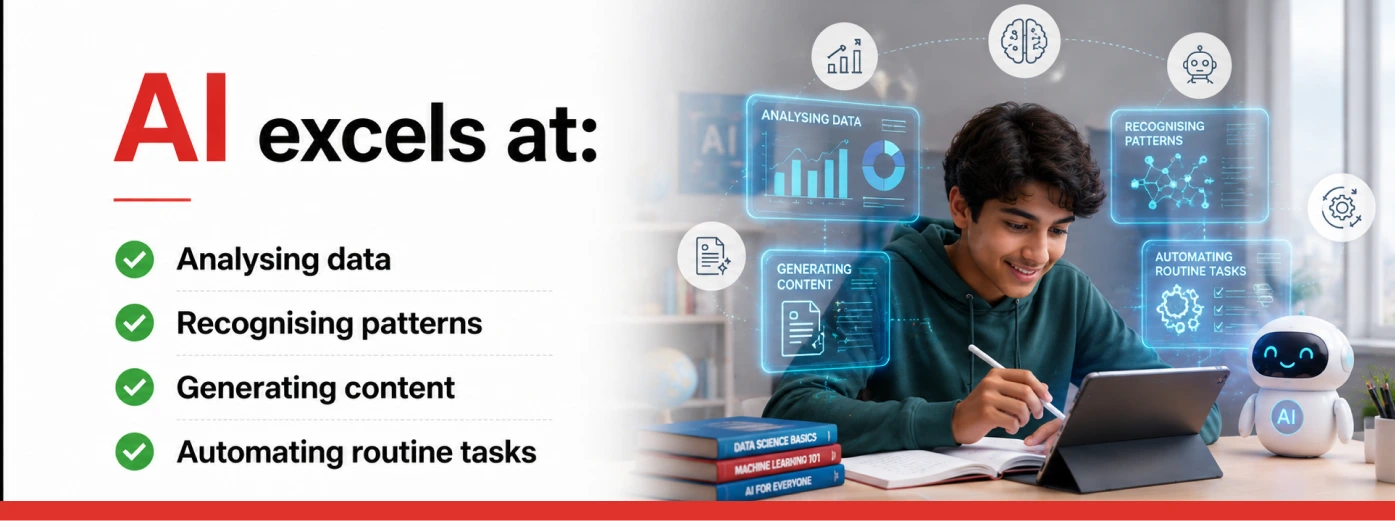
AI is extraordinarily good at pattern recognition, data processing, optimisation, and generating content based on existing information. It can read an X-ray, write a contract, generate code, summarise a legal document, answer a customer service query, and produce a piece of marketing copy,; faster, more cheaply, and often more accurately than a human doing the same task in the same way.
What it cannot do or cannot yet do with anything approaching human reliability is navigate genuine novelty. Ask AI to solve a problem it has not encountered in some form in its training data, and it struggles. Ask it to build trust with a frightened patient. To lead a team through a crisis that has no precedent. To make a genuinely ethical decision in a situation where the values in play are genuinely in tension. To create something that has never existed before, in response to a human need that has never been named before.
These are not peripheral capabilities. They are the capabilities that will define the most consequential human work in the decades ahead.
The subjects that matter most in an AI-driven world are the ones that develop these capabilities. Some of them will surprise you. None of them are replaceable.
The Most Important School Subjects in an AI-Driven World
1. Mathematics But Not the Way Most Schools Teach It
Mathematics is not going anywhere. If anything, its importance is growing. But the dimension of mathematical thinking that matters most in an AI world is not computation, AI handles computation better than any human, but reasoning.
The student who understands why a mathematical process works, who can construct an argument from first principles, who can look at a model and ask whether its assumptions are valid that student is developing something AI cannot replicate. Mathematical reasoning is the foundation of data literacy, of algorithmic thinking, of the ability to evaluate the outputs that AI systems produce and decide whether to trust them.
In a world where AI does the calculation, the human who understands what the calculation is for and what it is missing will be indispensable. That human is built in mathematics classrooms that teach understanding rather than procedure.
2. Computer Science and Computational Thinking
This one is obvious, but the reasoning behind it is worth being precise about.
The most important thing a student gets from Computer Science is not the ability to write code, though that is a genuinely useful skill. It is the ability to think computationally: to decompose a complex problem into manageable parts, to identify patterns, to design systems, and to think about why a solution fails as clearly as about why it works.
Computational thinking is the literacy of the 21st century in the same way that reading and writing were the literacy of the 20th. A student who cannot think computationally is increasingly unable to participate fully in the design of the systems that will shape their world.
At Dhruv Global School, computational thinking is embedded across the curriculum, not confined to a weekly computer lab session, because the thinking is the education, not the technology.
3. The Sciences With a New Emphasis on Interdisciplinary Application
Biology, Chemistry, Physics, and increasingly Environmental Science remain foundational. But the way they need to be taught is changing.
The most significant scientific challenges of the coming decades – climate change, pandemic preparedness, synthetic biology, neurotechnology, do not respect disciplinary boundaries. The scientists who will work on them need to move fluently between fields, to apply knowledge from one domain to problems in another, and to communicate their findings to non-specialists in ways that drive real-world decisions.
This means science education that emphasises inquiry, application, and interdisciplinary connection is considerably more valuable than science education that emphasises syllabus coverage. A student who has genuinely investigated a question, designed an experiment, encountered a result that surprised them, revised their hypothesis, communicated their findings is a student whose scientific thinking is real rather than performed.
4. Language and Communication
Here is the subject many parents underestimate most severely in conversations about the AI-driven future.
AI can generate text. It generates a great deal of it. What it cannot do is communicate with genuine human intention, to build trust, to persuade someone who is uncertain, to find the exact word that opens a conversation rather than closes it, to write something that changes how a person thinks because it was written by someone who understood them.
The ability to communicate with precision, clarity, and genuine human resonance is becoming more valuable, not less, as AI-generated content floods every channel. The student who can write a sentence that lands, that does exactly what it needs to do, nothing more and nothing less is a student with a capability that no language model genuinely replicates.
This means language education that goes far beyond grammar and comprehension. It means students who read widely, who argue in writing, who present to real audiences, who are given genuine feedback on whether their communication actually achieved what they intended. Language is not a soft subject. In an AI-saturated world, it is a hard competitive advantage.
5. History, Philosophy, and Ethics
This is the group of subjects most often dismissed in the future-of-education conversation and the one that deserves, perhaps, the most urgent reconsideration.
AI is already making decisions that have moral consequences. Algorithms determine who receives a loan, who is flagged for further scrutiny by border security, whose medical imaging is prioritised for review, which news story is shown to which person. These systems are built and deployed by human beings and the quality of the ethical thinking those human beings bring to their work is one of the most consequential variables in the AI-driven world.
A student who has studied History understands how technology has been used to serve and to harm across different contexts. A student who has engaged with Philosophy has practised the precise, rigorous thinking about values that ethical AI development demands. A student who has grappled with Ethics, genuinely, not as a checkbox, is a student who will not simply build what they are asked to build without asking what it will do to the people it affects.
These subjects are not ornaments on the edge of a useful education. They are the subjects that produce the judgment, specifically human judgment, that no algorithm can supply and that every AI-driven system desperately needs at its core.
6. Design, Art, and Creative Disciplines
Creativity is one of the most searched terms in every future-of-work report, and one of the most misunderstood.
It is not about being artistic in the conventional sense. It is about the capacity to imagine something that does not yet exist, to make connections between things that appear unrelated, to see a problem from an angle nobody else has tried. These capacities are not the exclusive property of people who paint or sculpt, they are cognitive tools that are developed through creative practice and that transfer across every domain.
AI can generate images. It can produce music. It can write in the style of a known author. What it cannot do is have a genuine creative intention, a reason, rooted in human experience, for making something that has not been made before. The student who has practised making things, who has experienced the discipline of creative constraints, the vulnerability of showing work to an audience, the problem-solving of a design that is not working is a student whose creative thinking is genuinely developed.
Design thinking specifically, the practice of human-centred problem solving that begins with empathy and ends with a tested prototype, is becoming one of the most valued approaches across every sector. A student who has learned to think like a designer approaches every problem differently. They ask who this is for before they ask how to build it.
7. Life Sciences, Psychology, and Human Behaviour
As AI takes over more of the technical work in every field, the distinctly human dimensions of work become more valuable. Understanding how people think, what they need, how they make decisions, what motivates and frightens them, these are not soft observations. They are sophisticated analytical capabilities that underpin every field from medicine to product design to education to governance.
A student with genuine grounding in psychology and human behaviour is a student who understands something that no AI system currently has access to: the subjective, felt, specific experience of being a human being navigating a human life. That understanding is the foundation of every field that works with people, which is to say, almost every field worth working in.
8. Economics and Financial Literacy
The economic landscape that today’s students will graduate into is already significantly different from the one their parents navigated. Automation is redistributing economic value in ways that are not yet fully understood. New forms of work, remote, freelance, portfolio, entrepreneurial are replacing the linear career paths that previous generations assumed.
A student with genuine economic literacy, who understands how markets work, how value is created and destroyed, how incentives shape behaviour, how to evaluate a financial decision with appropriate scepticism, is a student who can navigate this landscape with agency rather than anxiety.
This does not mean every student needs to study economics formally. It means every student needs exposure to economic thinking and every school needs to treat financial and economic literacy as a core educational responsibility rather than an optional extra.
What This Does Not Mean
It does not mean abandoning traditional subjects. Mathematics, science, language, history, these remain the foundation. A student who cannot read carefully, reason quantitatively, and communicate clearly is not served by any amount of coding or ethics education.
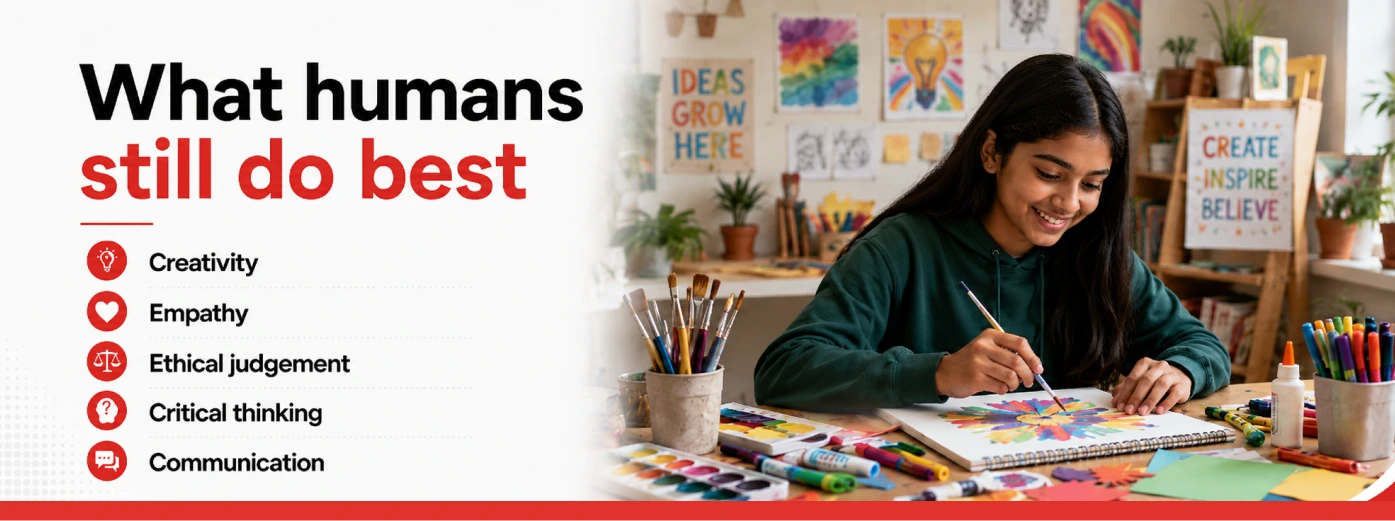
It also does not mean that every child needs to be a technologist. The AI-driven world will need artists, carers, teachers, builders, farmers, doctors, and leaders as urgently as it needs data scientists. What it will need from all of them is specifically human capacities, judgment, empathy, creativity, ethical thinking that AI cannot replicate.
The subjects that develop those capacities are the subjects worth taking seriously. Not instead of the traditional curriculum, but woven through it, across every year of school, as a continuous practice rather than an occasional supplement.
Future-Ready Skills Every Child Needs Beyond School Subjects
Critical Thinking and Problem-Solving
Artificial intelligence can produce answers in seconds. The real advantage belongs to the person who knows which questions to ask.
Children need opportunities to analyse information, question assumptions, evaluate evidence, and solve problems that do not have a single correct answer. Whether they are interpreting scientific data, debating historical events, or designing engineering solutions, critical thinking helps students move beyond memorising facts to genuinely understanding the world around them.
The future will reward people who can solve problems AI cannot anticipate, not those who simply repeat information.
Creativity and Innovation
Creativity is no longer confined to the arts. It is becoming one of the most valuable skills across every profession.
Businesses need people who can imagine better products. Scientists need creative thinkers to develop new solutions. Entrepreneurs need innovative ideas to solve emerging challenges.
Schools that encourage experimentation, design thinking, artistic expression, and project-based learning help children become comfortable exploring new possibilities instead of fearing failure. Innovation begins when children are given the confidence to ask, “What if?”
Communication and Collaboration
Success has never been a solo pursuit, and it will become even more collaborative in the years ahead.
As AI takes over repetitive tasks, distinctly human abilities such as listening, presenting ideas clearly, negotiating, and working effectively with diverse teams will become increasingly valuable.
Children should regularly practise writing, public speaking, debating, collaborating on projects, and learning how to communicate respectfully with people who think differently from them. These are skills that build trust, inspire action, and strengthen leadership.
Emotional Intelligence and Leadership
Technical knowledge may open doors, but emotional intelligence determines how effectively people work with others once they walk through them.
Children who understand their emotions, manage setbacks, show empathy, and build healthy relationships are better equipped to navigate both personal and professional challenges.
Leadership is no longer simply about authority. It is about influence, resilience, ethical decision-making, and the ability to bring people together around a shared purpose. These qualities develop through everyday experiences, reflective learning, teamwork, and meaningful responsibility.
Adaptability and Lifelong Learning
Perhaps the most important skill any child can develop is the willingness to keep learning.
The careers today’s students will pursue may look completely different a decade from now. Technologies will evolve. Industries will change. New opportunities will emerge that do not yet exist.
Children who are curious, adaptable, and confident learners will be able to reskill, embrace change, and continue growing throughout their lives. The goal of education is no longer to prepare children for one career. It is to prepare them for a lifetime of learning.
Final Thoughts
The conversation about future-ready education is often framed around which subjects children should study. A more useful question is: What kind of person is school helping them become?
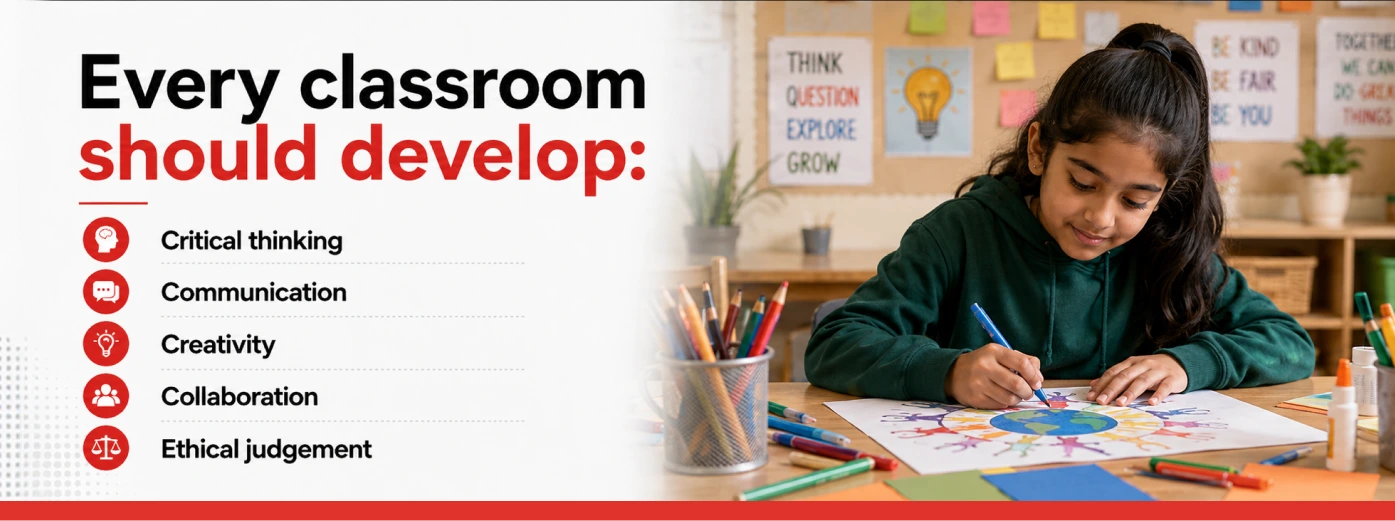
Academic knowledge will always matter. Strong foundations in mathematics, science, language, and the humanities remain essential. But in a world where artificial intelligence can process information faster than any human, it is our distinctly human capabilities, critical thinking, creativity, empathy, communication, ethical judgement, adaptability, and leadership that will set tomorrow’s generation apart.