At some point, most parents have sat across from a teacher and heard some version of the same sentence.
He is not really an academic child. Or: She does well in arts but struggles with the core subjects. Or, more gently but no less definitively: He is trying hard, but the results are not quite there.
What these sentences have in common is a narrow definition of what intelligent means. They assume that intelligence is primarily the ability to perform well in mathematics and language and that everything else a child is gifted at exists outside the real measure of their capability.
Howard Gardner disagreed. And the framework he built to challenge that assumption has, over four decades, changed the way thousands of schools around the world think about teaching, learning, and what it means to be smart.
What Is the Theory of Multiple Intelligences?
In 1983, Harvard developmental psychologist Howard Gardner published a book called Frames of Mind. In it, he argued that the conventional understanding of intelligence, a single, measurable capacity best captured by an IQ score, was both scientifically inadequate and educationally harmful.
His argument was grounded in evidence from neuroscience, developmental psychology, and the study of prodigies, savants, and brain-injured patients. What he found, across all of this evidence, was that human cognitive capability is not one thing. It is many things. Distinct, relatively independent capacities, each with its own developmental trajectory, its own neural substrate, and its own relationship to the cultural contexts that value or overlook it.
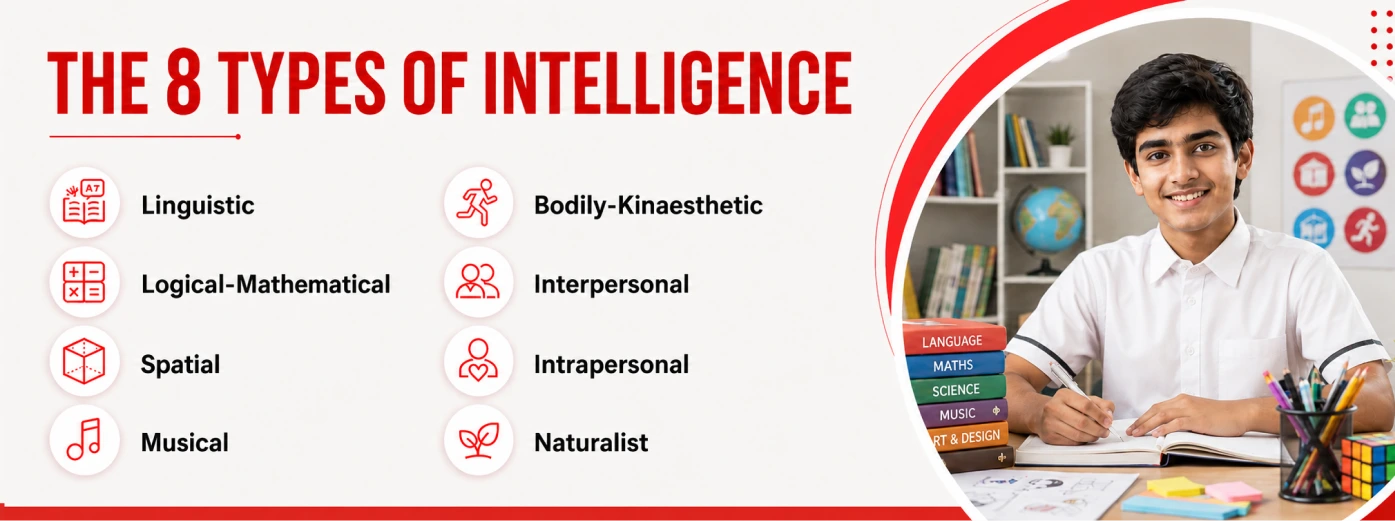
He called these capacities Multiple Intelligences. And he identified, initially, seven of them, later expanding to eight and suggesting a possible ninth.
These are not attitude problems. They are usually symptoms of a child who has encountered repeated experiences of not understanding, not being able to keep up, or not getting the help they needed quickly enough and who has learned, reasonably, to protect themselves from that feeling.
The implications for education were immediate and radical. If intelligence is not one thing but many, then a school that measures only two of them is not measuring intelligence. It is measuring two intelligences and calling the result the whole picture. Every child who scores poorly on that narrow measure is not unintelligent. They are intelligent in ways the instrument cannot see.
The 8 Types of Multiple Intelligences Explained
Linguistic Intelligence
The capacity to use language with precision and power, to read, write, speak, and listen with genuine skill. The child with strong linguistic intelligence is the one who reads voraciously, who chooses words carefully, who can tell a story that makes you feel something. They tend to do well in conventional school assessments because those assessments are almost entirely language-based. This is the intelligence most schools are best at seeing and rewarding.
Logical-Mathematical Intelligence
The capacity for reasoning, pattern recognition, and abstract thought. The child who sees the structure in a problem before anyone else, who loves the elegance of a mathematical proof, who asks why does that rule work? rather than accepting the rule at face value. Alongside linguistic intelligence, this is the other capacity that traditional education primarily rewards.
Spatial Intelligence
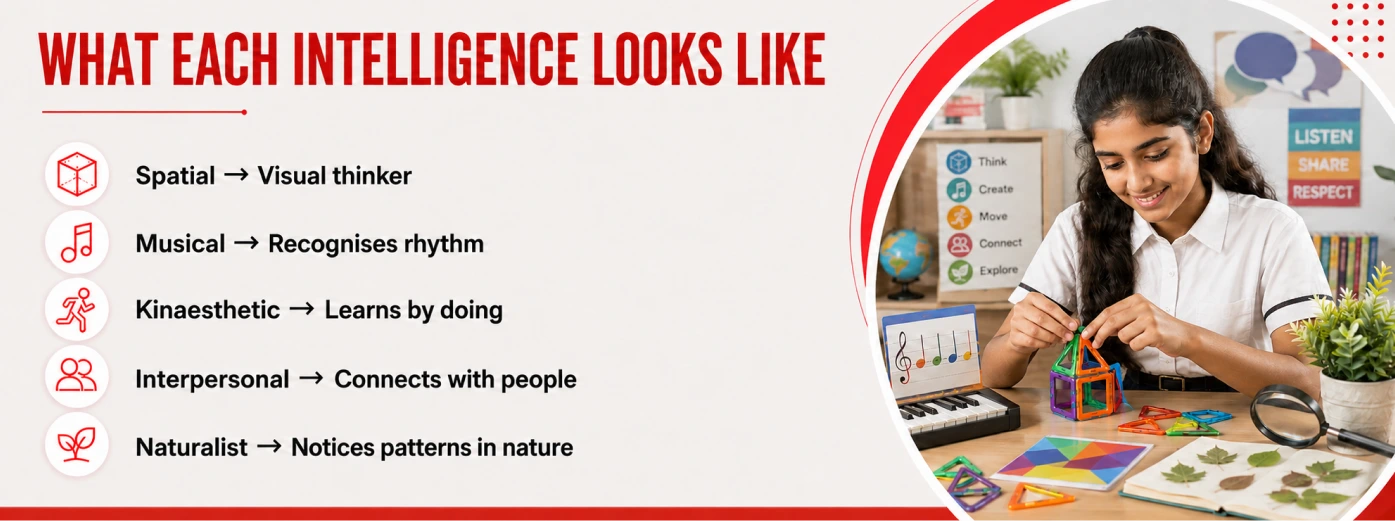
The capacity to think in three dimensions, to visualise and manipulate objects and spaces mentally. The child who builds extraordinary structures, who can look at a flat map and immediately understand the terrain, who draws with a sense of depth and proportion that surprises adults. Architects, surgeons, pilots, designers, and chess players tend to score highly here. Schools rarely know what to do with them.
Musical Intelligence
The capacity to perceive, create, and respond to music, to hear patterns in sound, to carry rhythm accurately, to produce something emotionally resonant with an instrument or a voice. This intelligence is sometimes dismissed as a talent rather than a form of intelligence. Gardner’s argument is that the distinction is artificial. The neural machinery that processes music is as sophisticated as the neural machinery that processes language. A child who is musical is not simply gifted. They are intelligent in a way that deserves genuine recognition.
Bodily-Kinaesthetic Intelligence
The capacity to use the body with skill and precision — in sport, dance, craft, surgery, construction. The child who learns by doing, who cannot sit still not because they are distracted but because their body is the primary instrument of their thinking. These children are often pathologised in traditional classrooms as restless or inattentive. In a classroom that understands kinaesthetic intelligence, they are recognised as physically intelligent and taught accordingly.
Interpersonal Intelligence
The capacity to understand other people, to read social dynamics, to influence and inspire, to resolve conflict, to lead. The child who is instinctively aware of how everyone in the room is feeling. Who brings groups together, who notices the child who is left out and does something about it. These children often become the natural leaders of their peer group long before formal leadership is offered to them. Schools that treat this as a personality trait rather than a cognitive capacity consistently underestimate it.
Intrapersonal Intelligence
Naturalist Intelligence
The capacity to recognise, categorise, and connect with the natural world, patterns in plants, animals, weather, ecosystems. The child who names every bird they see, who notices when the light changes with the season, who is deeply, intuitively at home outdoors. Gardner added this intelligence in 1995, and it has particular relevance in an era of environmental crisis. The children who grow up to care most about the planet and understand it most deeply are often those whose naturalist intelligence was recognised and nurtured early.
How Multiple Intelligences Affect Learning in the Classroom
A traditional classroom assesses two of these eight intelligences with any regularity: linguistic and logical-mathematical. Every other child, the dancer, the builder, the natural leader, the naturalist, the musician, the deeply self-aware introvert, is assessed on a measure that was not designed for them and will not find them.
This has consequences that extend well beyond grades.
A child who is genuinely intelligent in ways their school cannot see does not simply underperform on tests. They develop a story about themselves. That story says: school is not for me. I am not an academic person. The things I am good at do not count here.
That story, told early and repeated often enough, becomes an identity. And an identity formed around not being academic tends to close doors long before a child is old enough to know what they were.
The damage is not only to the child who is overlooked. It is to everyone, because a classroom that only values two kinds of intelligence is a classroom where two kinds of thinking are rewarded, and where the full range of human capability sits, largely untapped, in the chairs.
What a Multiple Intelligences Classroom Looks Like
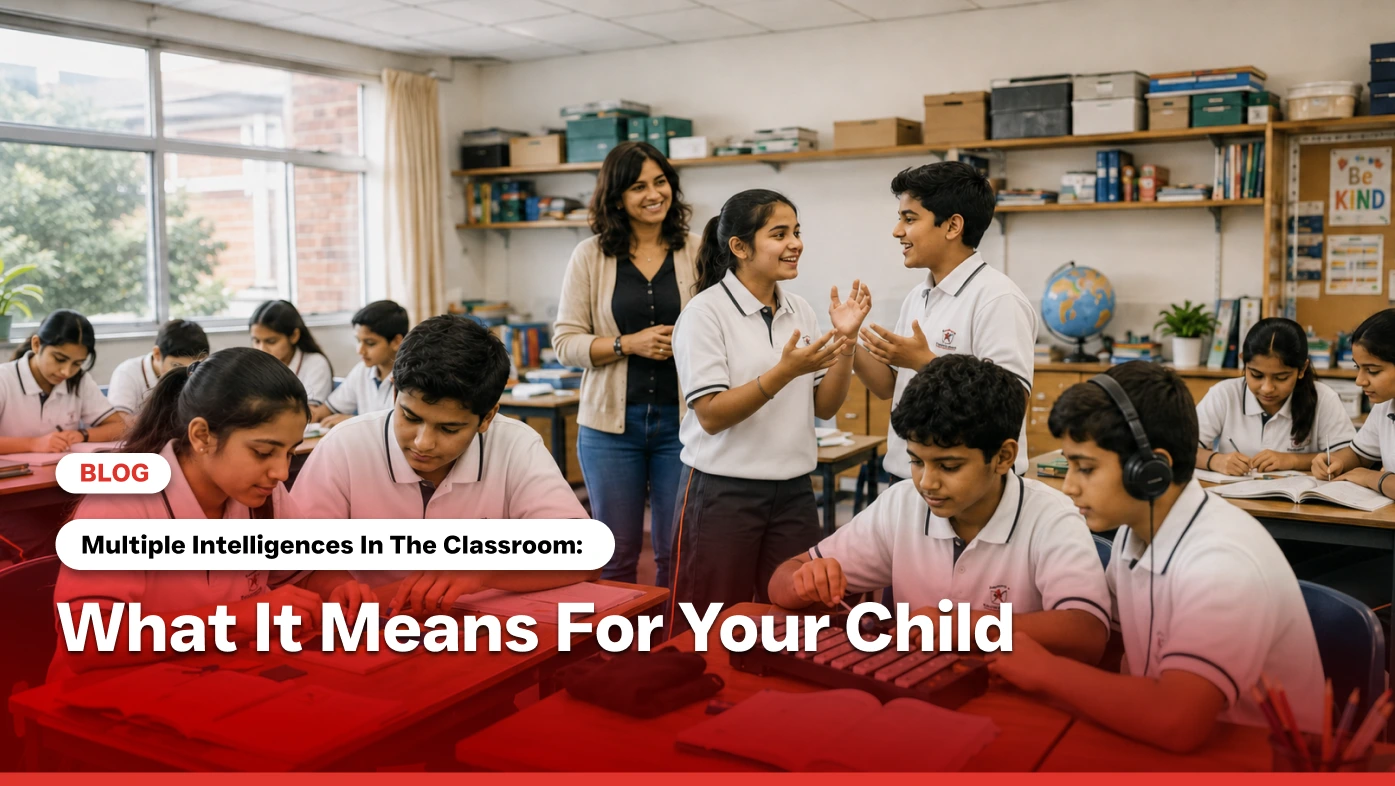
A classroom built on Multiple Intelligences theory does not look like a traditional one. It looks like several things happening at once.
It looks like a project that can be approached differently by different students, one child writing a report, another building a model, another choreographing a presentation, another leading the research team. The learning objective is identical. The pathway to it is not.
It looks like a teacher who has learned to read each child’s strongest capacity and use it as an entry point to the curriculum, not as a concession, but as a genuine pedagogical strategy. A kinaesthetic learner who understands fractions through physical manipulation understands fractions. The route matters less than the destination.
It looks like assessment that goes beyond the written test, that includes portfolios, performances, oral presentations, practical demonstrations, collaborative work, and self-reflection. Assessment that is capable of seeing more than two things.
It looks like a child who was written off in a previous school arriving in a new one and discovering, sometimes within a single term, that they were never unintelligent. They were just in the wrong room.
How Dhruv Global School Puts This Into Practice
Multiple Intelligences is not a philosophy statement at Dhruv Global School. It is a daily pedagogical commitment.
Our teachers are trained to identify each student’s dominant intelligence profiles and to design learning experiences that use those profiles as bridges to the full curriculum. A student whose spatial intelligence is strong does not simply get to draw diagrams as a break from real learning. Their spatial intelligence becomes the doorway through which mathematics, science, history, and language are approached, understood, and made genuinely meaningful.
Our assessment philosophy reflects this commitment. We do not reduce a child’s capability to a single score. We build a picture of each student across multiple dimensions, their thinking, their making, their collaborating, their reflecting and we use that picture to teach them better, not just to measure them more.
And we talk to students directly about their own intelligence profiles. A child who understands that they are strongly kinaesthetic, that their body is how their brain thinks, approaches their own learning very differently from a child who has simply been told they are not academic. They have a framework. They have language. They have the beginning of a relationship with their own mind that will serve them for decades.
That relationship between a child and a genuine understanding of their own capability is one of the most valuable things any school can build. It is something Dhruv Global School takes seriously every day.
Final Thoughts
Every child who has ever been told they are not really an academic child was being told something untrue.
They were intelligent. They were capable. They were simply in a room that only knew how to see two things and could not find them in the two places it was looking.
Multiple Intelligences theory does not lower the bar. It raises the ceiling. It asks us to expect more from education, more variety, honesty, genuine curiosity about what each child can actually do.