
Most parents feel it before they can name it. Your child is working hard, you see it. The hours at the desk, the homework completed, the tests studied for. But something is not adding up. The marks are not reflecting the effort. Or the marks are fine, but you notice your child has stopped asking questions. Or they come home quieter than they used to. Something has shifted, and you cannot quite put your finger on what.
That instinct is worth taking seriously.
The gap between a child who is managing and a child who is genuinely keeping pace with their own potential is not always visible in a report card. It often shows up first in behaviour, in the small things a parent notices before a teacher does. And the earlier that gap is identified, the easier it is to close.
This blog is for parents who have that feeling. It will help you distinguish between normal academic pressure and the signs that a child genuinely needs a different kind of support and what that support can look like when it is done well.
What Falling Behind at School Really Looks Like
The phrase ‘falling behind’ suggests something sudden and obvious, a child who fails a test, whose grades collapse, who clearly cannot keep up. In reality, most academic struggles develop quietly over months. By the time they appear on a report card, they have usually been visible in other ways for quite a while.
Academic difficulty in children almost always shows up in three places before it shows up in marks: in their relationship with school, in their behaviour at home, and in how they talk about themselves as learners.
A child who used to enjoy going to school and now drags their feet every morning is telling you something. A child who used to talk about what they learned and now deflects every question is telling you something. A child who has stopped putting their hand up in class, according to their teacher, is telling you something.
These are not attitude problems. They are usually symptoms of a child who has encountered repeated experiences of not understanding, not being able to keep up, or not getting the help they needed quickly enough and who has learned, reasonably, to protect themselves from that feeling.
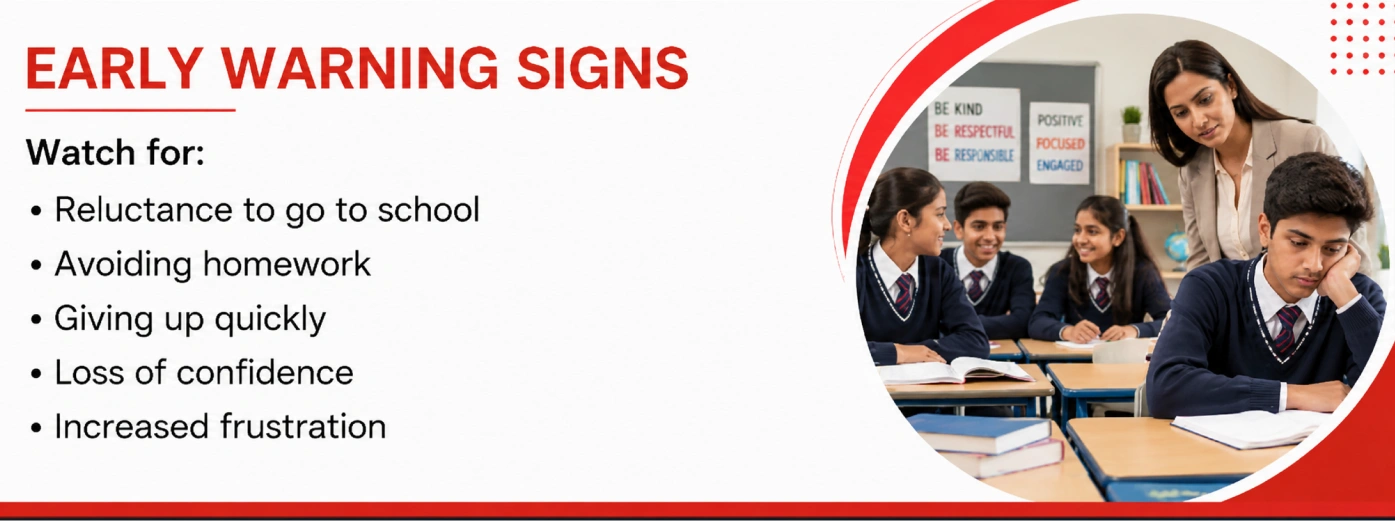
Signs Your Child May Need Extra Academic Support
Academic signs
- Marks are consistently below what their effort level would predict
- Strong performance in some subjects paired with unexplained weakness in others
- Test scores that do not reflect what the child could demonstrate verbally in conversation
- Difficulty completing homework independently, not because of laziness, but because the core concept has not been understood
- A pattern of making the same type of mistake repeatedly, without being able to identify why
- Rushing through work to finish rather than working to understand
Behavioural and emotional signs
- Increased anxiety, irritability, or tearfulness specifically around schoolwork or test time
- Avoidance behaviour, suddenly ‘not feeling well’ on exam mornings, or finding reasons not to start homework
- Loss of confidence in a subject they previously enjoyed
- Comparing themselves negatively and repeatedly to classmates
- Stopping participation in class, hand no longer goes up, even when the child knows the answery
- Complaints that school is ‘boring’ or ‘pointless’, which can sometimes indicate that a child has disconnected because they feel unable to succeed
Signs at home
- Homework that takes significantly longer than it should for the age group
- A child who cannot explain what they studied, only what they memorised
- Resistance to reading, or reading that seems effortful and joyless
- Difficulty organising their work, losing materials, forgetting assignments, unable to plan ahead for a deadline
One question that often reveals more than a report card
- Ask your child to explain a topic they studied recently, not recite it, but explain it, in their own words, as if they were teaching it to you. A child who truly understands a concept can do this. A child who has memorised without understanding will quickly run out of words. The gap between those two responses tells you a great deal about what kind of support they actually need.
Normal Pressure vs. A Genuine Gap: How to Tell the Difference
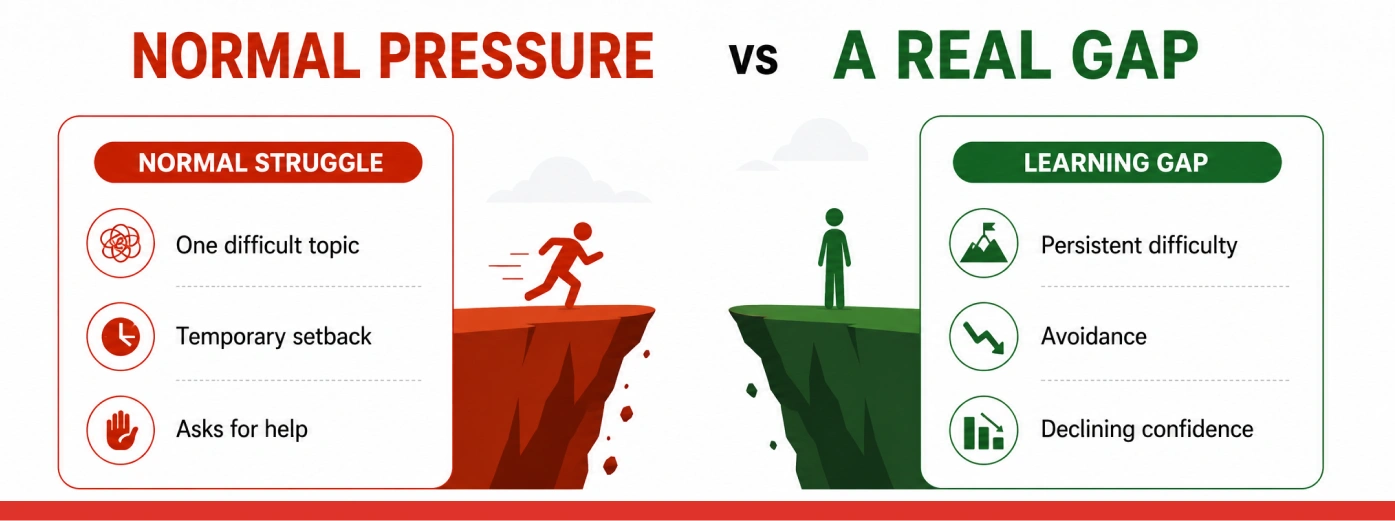
Every child struggles with something at some point. That is part of learning. The question is whether the struggle is a temporary difficulty with a specific concept, the kind that clears with a bit of extra explanation and practice or a more persistent gap in understanding that is compounding over time.
| Normal Academic Pressure | A Gap That Needs Attention |
|---|---|
| Difficulty with one topic or unit | Consistent difficulty across a subject or multiple subjects |
| A dip in marks after a hard test | A sustained downward trend over a term or more |
| Anxious before exams, but recovers quickly | Anxiety that extends to daily homework and class participation |
| Asks for help when stuck | Avoids asking for help; hides confusion |
| Can explain concepts in own words | Can only reproduce what was memorised verbatim |
| Setbacks affect effort temporarily | Setbacks affect self-belief persistently |
Why Early Academic Intervention Matters
There is a well-known phenomenon in education: academic gaps tend to widen rather than resolve on their own. A child who does not fully grasp a foundational concept in Class 4 will find Class 5 harder, because the next year’s content is built on what was not properly understood this year. By Class 7, what began as a confusion about fractions has become an inability to engage with algebra.
This is not because the child is not capable. It is because the gap was never properly addressed and the curriculum moved on without them.
The research on this is consistent. Benjamin Bloom’s landmark 1984 study on mastery learning found that students who received targeted one-on-one or small-group instruction performed, on average, two standard deviations better than peers learning through conventional classroom teaching. Not marginally better, dramatically better. The label given to this finding was the ‘2 Sigma problem’: the challenge of providing that level of personalised attention at scale.
The research on this is consistent. Benjamin Bloom’s landmark 1984 study on mastery learning found that students who received targeted one-on-one or small-group instruction performed, on average, two standard deviations better than peers learning through conventional classroom teaching. Not marginally better, dramatically better. The label given to this finding was the ‘2 Sigma problem’: the challenge of providing that level of personalised attention at scale.
What Good Academic Support Actually Looks Like
Not all academic support is equal. There is a meaningful difference between a child sitting with a tutor who re-explains the same concepts in the same way, and a child receiving support that is genuinely tailored to how they specifically learn, where their specific gaps are, and what their specific pace of progress looks like.
The most effective support tends to share a few characteristics.
It starts with diagnosis, not assumption.
It is specific, not general.
It involves the child as an active participant.
Children who understand what they are working on and why, who have a sense of their own progress, engage differently with support than children who are simply sent to extra classes by parents. Self-awareness about one’s own learning is itself a skill, and it is one that good academic support actively develops.
It rebuilds confidence alongside competence.
A child who has been struggling for a while has often also developed a belief that they are ‘not good at’ a subject, sometimes ‘not good at school’ more broadly. Effective support addresses this directly. Progress needs to be visible and acknowledged, so that the child’s sense of themselves as a learner shifts alongside their actual ability.
What Parents Can Do Right Now
If you recognise several of the signs described in this blog, there are some useful first steps, before reaching for a tutor or waiting for the next parent-teacher meeting.
- Have a conversation with your child, not about marks, but about how they feel at school. Ask open questions. Listen more than you respond.
- Speak to their class teacher. Ask specifically: ‘Is my child participating in class? Do they seem to understand concepts during lessons, or are they going through the motions?’ Teachers often notice things that do not make it into a formal report.
- Look at their work, not just their scores. Where exactly are the errors? Are they careless mistakes, or are they consistent in a way that suggests a conceptual gap?
- Resist the instinct to add more hours of the same. If the child has been doing two hours of homework and still struggling, three hours of the same will not fix it. The approach needs to change, not just the quantity.
- Watch the emotional temperature. A child who is academically unsupported tends to become one who is emotionally withdrawn around school. The feelings and the learning are connected.
How Dhruv Global School Approaches Academic Support
At Dhruv Global School, the understanding that every child learns differently is not just a philosophy, it shapes the practical structure of how we support students who need more than the standard classroom provides.
Our approach begins with observation, not assumption. Teachers are trained to identify the early signals, the child who has stopped participating, the one whose written work does not reflect what they can say out loud, the one whose marks have dipped not from laziness but from a gap that has not yet been named. The goal is to find and address these things before they compound.
For students who need more personalised academic attention, we offer structured one-on-one and small-group support through our 2 Sigma Learning Programme, named directly for Bloom’s research finding that targeted individual instruction produces outcomes dramatically beyond what classroom teaching alone can achieve. The programme is not remedial. It is precision support: identifying exactly where a student is, mapping where they need to be, and building a pathway between the two that works for their specific learning profile.
This means some students work on foundational concepts from earlier years before advancing. Others are challenged beyond the standard curriculum because their gap is not in understanding, it is in being sufficiently stretched. The 2 Sigma Programme addresses both ends of the spectrum, because academic underperformance is not always about falling short. Sometimes it is about a student who has learned to coast because nobody has asked enough of them.
Final Thoughts
Most children who struggle academically are not struggling because they cannot do the work. They are struggling because the gap between what they understood and what the curriculum moved on to teach has quietly grown too wide to bridge on their own.
The good news is that gaps close. They close fastest when they are caught early, named accurately, and addressed with support that is actually built around the child, not around a generic idea of what a struggling student needs.
The parents who make the biggest difference in their child’s academic trajectory are rarely the ones who intervened the most, they are the ones who noticed early, asked the right questions, and found the right environment before the gap became a story the child told about themselves.
That last part matters more than any exam score. A child who believes they are capable of learning will keep learning. A child who has decided they are not academic will spend years proving themselves right.
The window to shape that belief is open longer than most parents think, but it is not open forever.