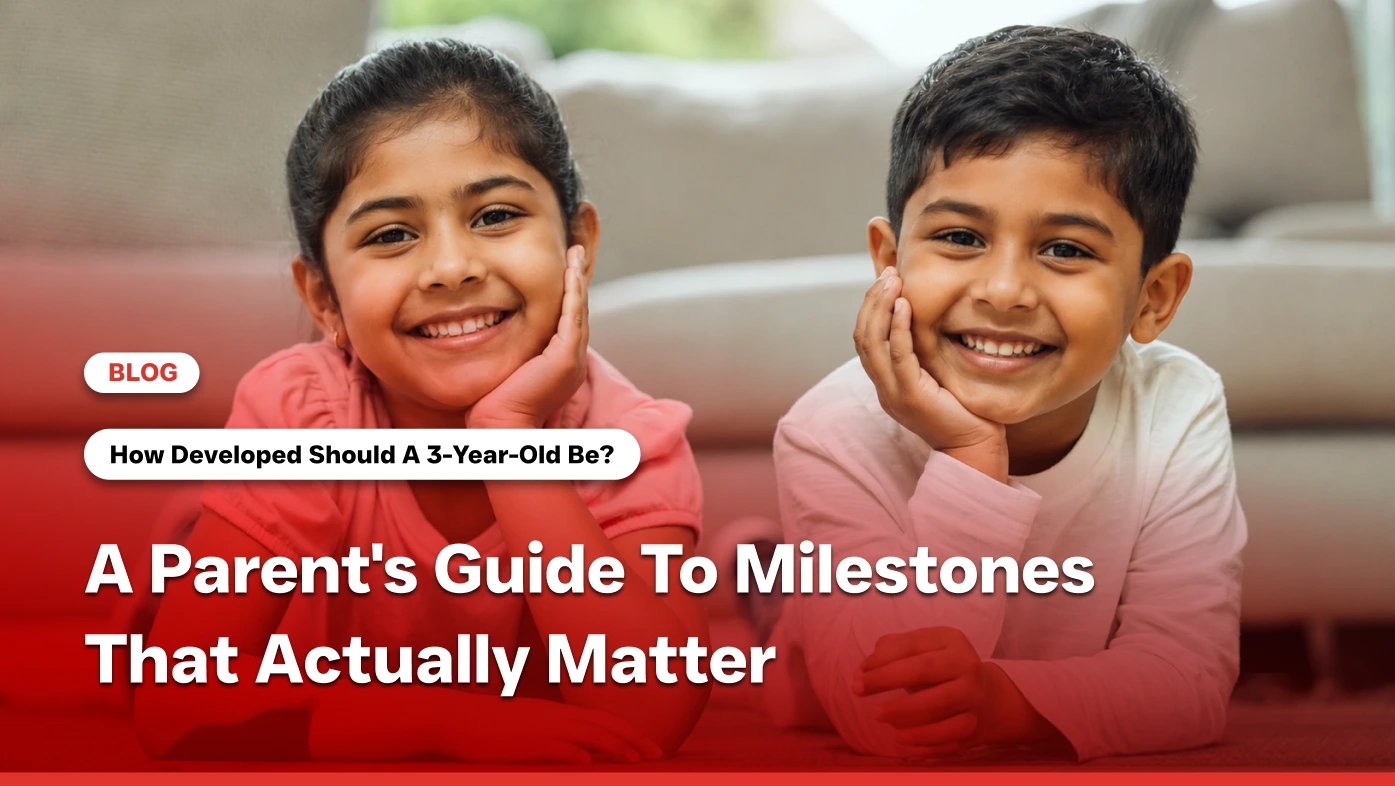
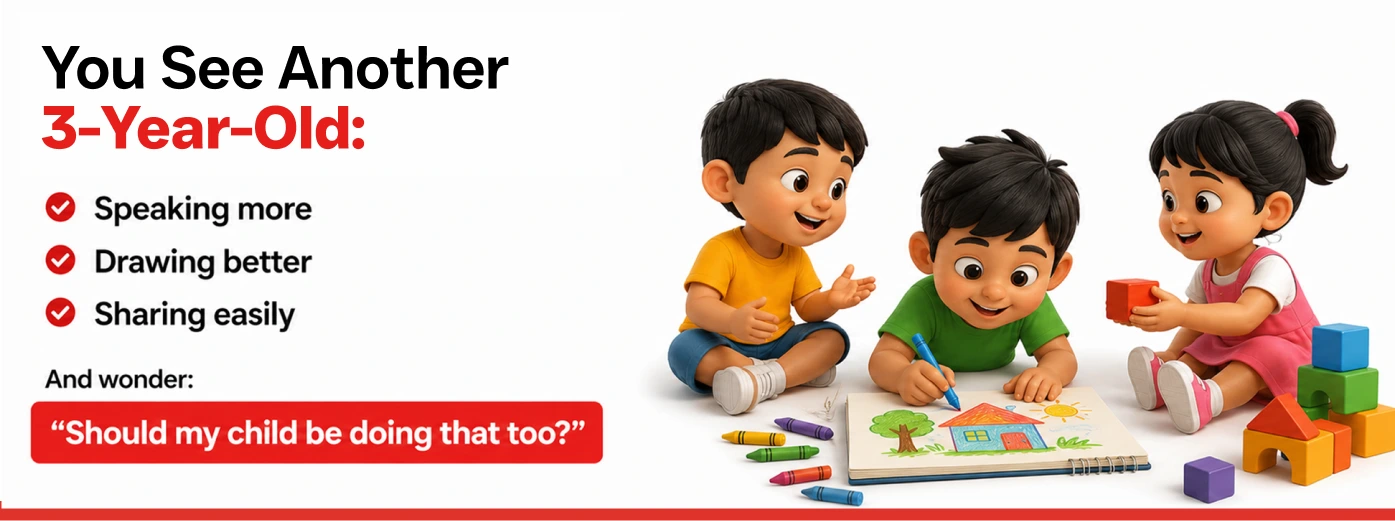
Every parent of a three-year-old has had the moment. You are at a playdate, or a family gathering, or in a preschool waiting room, and you watch another child the same age as yours do something yours cannot yet do. Speak in longer sentences. Draw a recognisable face. Share a toy without being asked. Pedal a tricycle.
And the thought arrives, quiet but persistent: should my child be doing that?
It is one of the most common anxieties in early parenting, and one of the least useful, not because developmental milestones do not matter, but because the way most parents think about them is too narrow. Milestones are not a checklist that every child moves through at identical speed. They are a broad, flexible map of a journey that every child takes differently. Knowing where that map comes from, what it actually measures, and what genuinely warrants attention is far more useful than comparing your child to the one across the room.
This is that guide.
What Are Developmental Milestones?
Developmental milestones are not targets. They are averages, derived from research on large populations of children, identifying the age at which most children in that population had acquired a particular skill.
When a milestone says a child should be doing something by age three, it typically means that somewhere between 75 and 90 percent of children in the study sample had acquired that skill by that point. Which means that ten to twenty-five percent had not and were completely within the range of normal development.
This is important because milestone charts, taken out of context, produce exactly the kind of anxiety that leads parents to conclude their child is behind when they are simply early in the curve. Development does not move at a steady, predictable pace. It moves in spurts and plateaus, in bursts and pauses, across different domains at different rates.
A child who is significantly ahead in language may be slightly behind in fine motor development. A child who has been walking confidently for a year may only just be beginning to manage stairs independently. Neither of these patterns is alarming. Both are typical.
What matters is not whether your child has hit every milestone at the exact average age. It is whether development is happening, across all domains, over time, in a general direction of growth.
Language Development Milestones for 3-Year-Olds
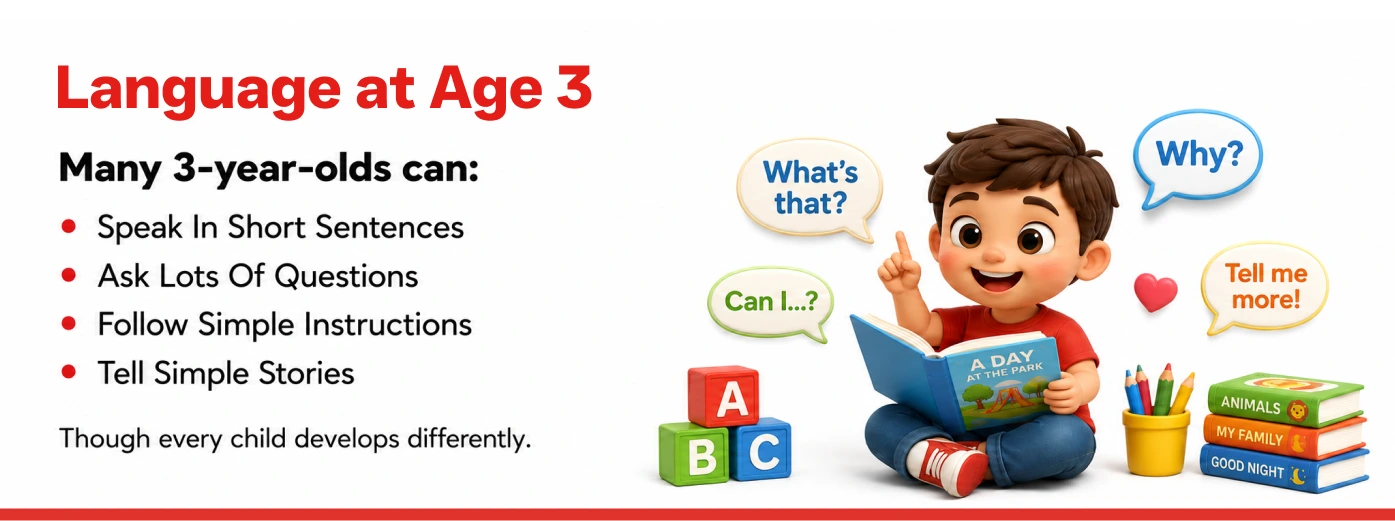
Language development is the domain parents tend to monitor most closely, and with some justification, it is one of the most powerful windows into a child’s cognitive and social development, and delays here are worth taking seriously.
By age three, most children are speaking in sentences of three to four words, often longer. They can be understood by people outside the family at least half the time, though familiar adults understand them more clearly. They know and use between 200 and 1,000 words, the range is genuinely that wide, and both ends of it can be typical.
They can follow two-step instructions. Pick up your shoes and put them by the door. They can answer simple questions, who, what, where. They use language to express needs, to narrate what they are doing, and to initiate conversation. They ask questions, often relentlessly. Why and what appear frequently and with great enthusiasm.
They can engage in simple back-and-forth conversation, though they frequently change topic without warning and expect everyone to follow. They use pronouns, I, me, you, though may still mix them up occasionally. They can tell a simple story about something that happened to them, though the sequencing may be approximate.
What is worth watching: a three-year-old who is not yet combining words into phrases, who cannot be understood by familiar adults most of the time, who does not use language to communicate wants and needs, or who shows very little interest in the back-and-forth of conversation. These are worth raising with a paediatrician, not with alarm, but with the straightforwardness that early identification always warrants.
Physical Development Milestones for 3-Year-Olds
The body of a three-year-old is in the middle of a remarkable transformation. The chubby, slightly unsteady toddler of eighteen months has become, by three, a child with genuine physical confidence, one who runs, jumps, climbs, and throws with increasing competence and obvious delight.
By three, most children run fairly smoothly and can change direction without falling. They jump with both feet leaving the ground simultaneously. They can kick a ball with some accuracy, throw overhand, and catch a large ball with both arms. They can walk up and down stairs, placing one foot on each step, though they may still need the handrail for confidence on the way down.
They can balance briefly on one foot, typically for two to three seconds. They ride a tricycle using the pedals. They climb playground equipment, frames, ladders, low walls with confidence and some self-regulation of risk, though the self-regulation is still a work in progress.
What is worth watching: a three-year-old who is significantly unsteady on their feet, who avoids physical activity or seems to find movement effortful and uncomfortable, who has not yet achieved a smooth running pattern, or who consistently falls much more than peers. Gross motor delays occasionally signal underlying issues with muscle tone, coordination, or sensory processing that respond well to early support.
Fine Motor Skills Every 3-Year-Old Is Developing
Fine motor development at three is quieter than gross motor development, less dramatic, less visible, but in some ways more consequential for the academic demands that lie ahead.
By three, most children hold a crayon or pencil in their fist, the tripod grip, which adults use, typically develops between three and four and should not be expected earlier. They can draw a rough circle and a vertical line. They can copy a simple cross shape when shown one. Their drawing is purposeful, they have an intention, even if the result does not always match it.
They can turn the pages of a book one at a time. They can string large beads onto a lace, manage simple puzzles of three to five pieces, and use child-safe scissors to make snipping cuts, though cutting along a line comes later.
They can manage their own clothes with some adult support, pulling trousers up and down, putting on shoes, though buckles and laces are well beyond this age. They can use a spoon and fork with reasonable reliability and drink from an open cup without spilling most of the time.
What is worth watching: a three-year-old who avoids activities that require hand use, who has significant difficulty with tasks like turning pages or manipulating simple puzzles, or whose grip on a crayon seems extremely tense or unusual. Fine motor delays are among the most responsive to early intervention, occupational therapy at this age can make a significant difference in a short time.
Cognitive Development in 3-Year-Olds
The mind of a three-year-old is one of the most extraordinary things in the natural world. It is building connections at a pace that will never be repeated, absorbing information from every interaction, and constructing an understanding of the world that is simultaneously more sophisticated and more magical than most adults realise.
By three, most children can sort objects by colour, shape, and size. They understand the concept of two, they can reliably identify whether there are two of something or more, though counting accurately beyond five is not typically established until closer to four. They understand concepts like bigger and smaller, more and less, first, next, and last.
They engage in rich pretend play, taking on roles, sustaining a narrative across time, incorporating objects into imaginative scenarios that are genuinely complex. A cardboard box becomes a boat, a rocket, a house, a cave. This imaginative capacity is not trivial. It is directly correlated with language development, social cognition, and the ability to think flexibly, one of the most valuable cognitive tools a child can develop.
They are beginning to understand that other people have thoughts and feelings different from their own, the early development of what psychologists call theory of mind. They can predict simple emotional responses in others. She is crying because she is sad. He is happy because he got the ball. This understanding is still developing and will continue to deepen throughout the preschool years.
They have a working memory sufficient to follow a simple three-step sequence and to remember a story across several readings. They are deeply curious, questions are constant and they are beginning to understand cause and effect in a meaningful way.
Social and Emotional Development Milestones at Age Three
Social and emotional development at three is where the most significant and the most easily overlooked growth is happening. Because it happens primarily through play, through the negotiations, the conflicts, the repairs, the alliances, and the imaginative collaborative worlds that children build together, it is easy to miss how genuinely demanding and genuinely important this development is.
By three, most children are beginning to move from parallel play, playing alongside other children, toward genuinely cooperative play, where the activity requires both children to participate meaningfully. They are developing the ability to take turns, though they need support and reminders to do so consistently. They are beginning to notice and respond to how other children are feeling, the child who is crying, the child who is alone.
They are developing a sense of their own identity, I am a girl, I like dogs, my favourite colour is yellow, I am good at running and beginning to understand themselves as a consistent person across different contexts.
Emotionally, three is a genuinely demanding age. Big feelings arrive fast and leave slowly. A three-year-old who melts down over the wrong colour cup or the broken biscuit is not being manipulative. Their prefrontal cortex, the part of the brain that regulates emotional responses, is still in early development. They feel things with extraordinary intensity and have limited capacity to manage those feelings without adult support.
What is worth watching: a three-year-old who shows very little interest in other children, who does not engage in any form of imaginative play, who has significant difficulty recovering from emotional upsets even with patient adult support, or who seems very rigid in their need for routine in a way that causes significant daily distress. Any of these, sustained over time, is worth a conversation with a developmental professional.
Preschool Readiness Milestones for 3-Year-Olds
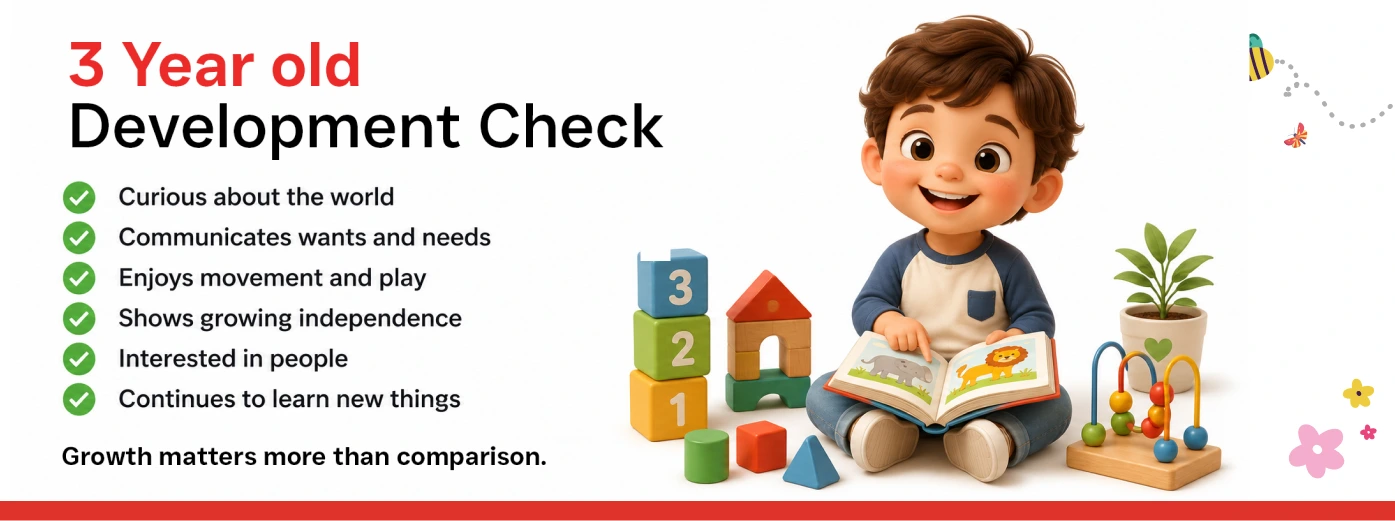
Development is not a race. The child who speaks in full sentences at two and a half is not going to be a better reader at eight than the child who took until three. The child who could not pedal a tricycle at three and a half was not going to be a less coordinated adult. The skills that matter most, curiosity, resilience, the capacity for genuine connection, the love of learning are not captured by any milestone chart, and they are built over years in the quality of the environment and relationships a child inhabits.
What you are looking for, at three, is not a checklist ticked. It is a child who is growing, in all directions, at their own pace, with their own particular combination of strengths and not-yet-strengths. A child who is curious. A child who tries things. A child who is, underneath the big feelings and the constant questions and the exhausting energy, developing into someone who will surprise you. That child is on track. Even on the days when it does not feel like it.
When Should Parents Be Concerned About Development?
Developmental ranges are wide, and most variation within those ranges is entirely typical. But there are specific patterns that warrant a conversation with a paediatrician or developmental specialist sooner rather than later.
A three-year-old who is not yet combining words into short sentences. A child who cannot be understood by familiar adults most of the time. A child who does not engage in any pretend play. A child who does not make eye contact or show interest in other people. A child who has lost skills they previously had — regression in language, social engagement, or motor ability. A child whose behaviour is so rigid or so extreme that it is significantly affecting daily family life.
None of these is a diagnosis. All of them are reasons to ask the question — early, calmly, and with the confidence that asking early is always the right decision.
At Dhruv Preschool
At Dhruv Preschool, we meet every child exactly where they are. Not where the milestone chart says they should be, and not where the child at the next table is. Where they actually are, with their particular strengths, their particular pace, and their particular way of moving through the world.
Our teachers are trained in early childhood development. They observe continuously, document carefully, and communicate honestly with families about what they are seeing, the growth that is happening, the areas where a little more support might help, and the things that are simply a child being exactly who they are at exactly the right time.
If you have questions about your three-year-old’s development, whether they are ready for preschool, whether something you have noticed is worth attention, or simply what the year ahead might look like, we are here for that conversation.