
When most people hear the word yoga, they picture a mat. A pose. A specific way of sitting or stretching that belongs in a studio or a morning routine.
What they picture far less often is a classroom. A fifteen-year-old navigating an argument with a friend. A ten-year-old sitting with the frustration of a problem they cannot yet solve. A student who has failed at something and is deciding, in that moment, who they want to be about it.
And yet these are precisely the situations that yogic values were developed to address. Not the postures, those are a small and relatively recent branch of a much older tradition. The values. The philosophical framework that has guided human beings through difficulty, relationship, learning, and growth for thousands of years.
At Dhruv Global School, yogic values are not an add-on to the curriculum. They are not an assembly theme or a poster on the wall. They are the lens through which we think about what education is actually for and the daily practice through which our students develop the inner qualities that academic achievement alone cannot build.
This is what those values are. And this is what they actually do for the students who live by them.
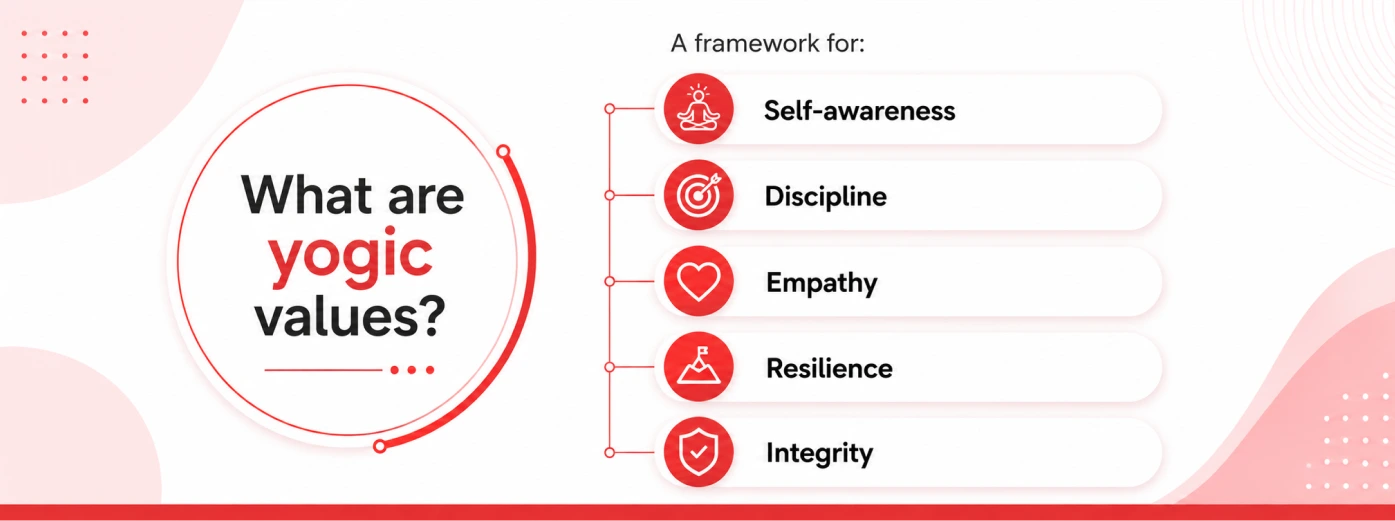
What Are Yogic Values?
Yogic philosophy has its roots in ancient Indian thought, particularly in texts like the Yoga Sutras of Patanjali, the Bhagavad Gita, and the Upanishads. These are not primarily texts about physical practice. They are texts about how to live, how to navigate the relationship between the self and the world, how to act with integrity under pressure, how to cultivate a mind that is steady enough to see clearly.
The framework most relevant to education comes from Patanjali’s Yoga Sutras, written somewhere around 400 CE, which outlines eight limbs of yoga, eight interconnected dimensions of practice. The first two limbs, the Yamas and Niyamas, are entirely concerned with values and personal conduct. They describe how a person should relate to others and to themselves and they are as precise and as practical today as they were when they were written.
Understanding these values does not require accepting any particular spiritual framework. They work as a secular ethical system, a clear, coherent, deeply considered answer to the question that every school must eventually answer: what kind of person are we trying to help this child become?
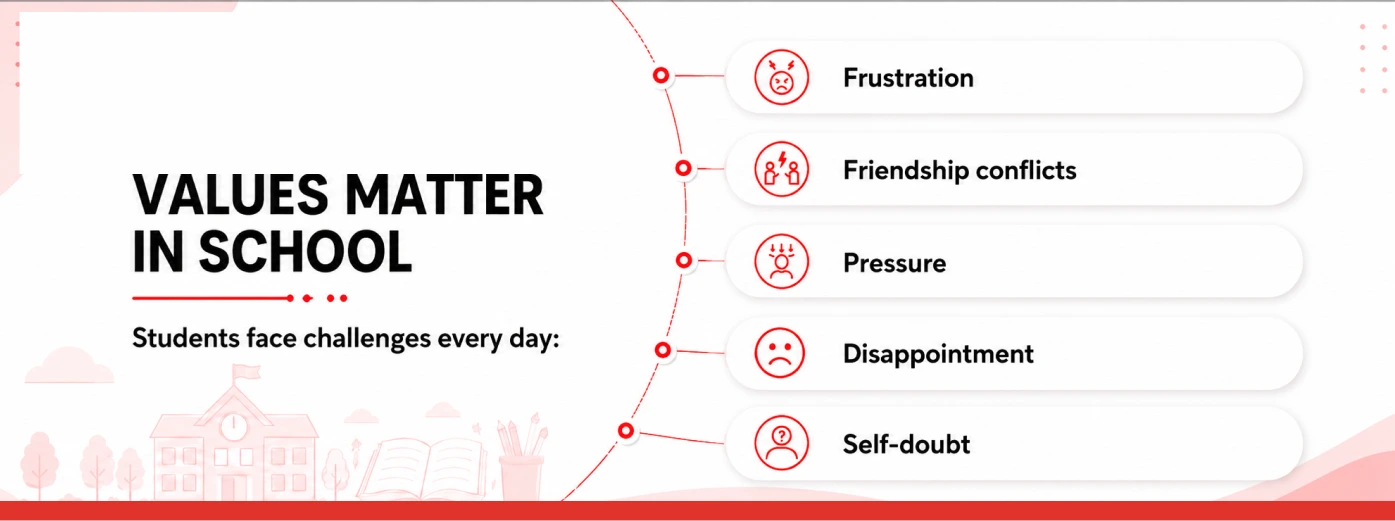
The Five Yamas: Values That Shape How Students Relate to Others
Ahimsa — Non-violence, Non-harm
Ahimsa is the most fundamental of the Yamas and the one with the widest application. It means, at its most basic level, not causing harm. Not physical harm, though that is part of it. But harm in thought, in speech, and in action. The unkind word said behind someone’s back. The contempt that passes across a face in a moment of impatience. The internal violence of self-criticism that tells a child they are stupid, worthless, incapable.
For students, ahimsa is simultaneously an ethical principle and a cognitive tool. A student who practises ahimsa in their internal life, who learns to notice self-critical thought and respond to it with something more measured, is a student whose relationship with failure changes. Failure stops being evidence of fundamental inadequacy and becomes simply information. That shift, from self-violence to self-honesty, is one of the most significant things that can happen in a young person’s academic and emotional life.
In the school community, ahimsa is the foundation of every genuine anti-bullying effort, every culture of inclusion, every classroom where it is safe to be wrong. It is not taught through a single lesson. It is cultivated through every interaction between student and student, student and teacher, and teacher and teacher, across every day of the school year.
Satya — Truthfulness
Satya means truth, but not merely the absence of lying. It means a commitment to honest perception, honest expression, and honest relationship with what is actually happening, both inside oneself and in the world.
For students, satya is the value that makes genuine learning possible. A student who is committed to truthfulness cannot sustain the comfortable fictions that block growth: I already understand this. I am not capable of better than this. That grade was unfair. Satya requires a student to look clearly at their own work, their own thinking, their own contribution to a situation, and respond to what they actually see rather than what they wish were true.
It is also the value that makes honest relationships possible. A friendship built on satya, on genuine, kind honesty rather than comfortable agreement, is a fundamentally different and more sustaining kind of friendship than one built on performance. Students who learn to practise satya in their relationships develop a quality of connection that sustains them through the inevitable difficulties of school life.
Asteya — Non-stealing
Asteya is most literally translated as not taking what is not yours. In the school context, this is obviously relevant to academic honesty, plagiarism, cheating, taking credit for others’ work. But the deeper application of asteya is more interesting and more useful.
Asteya also applies to time. To attention. To the contribution of others in a group. A student who dominates a collaborative project, who takes credit for shared work, who uses more than their fair share of a teacher’s attention, is practising a subtle form of stealing that most ethical frameworks do not name clearly. Asteya names it, and in naming it, makes it visible and therefore addressable.
For students learning to work collaboratively, which is one of the most important and most difficult skills of modern education, asteya provides a precise ethical framework for what genuine contribution and genuine fairness actually look like.
Brahmacharya — Right use of energy
Brahmacharya is perhaps the most misunderstood of the Yamas, often narrowly translated in ways that make it seem irrelevant to young people. In its fuller meaning, brahmacharya is about the wise, purposeful use of one’s energy, physical, mental, and emotional.
For students, this is one of the most practically useful values in the entire framework. The school years are years of enormous energy, physical vitality, intellectual hunger, emotional intensity, social drive, all arriving simultaneously and demanding direction. A student who has no framework for where to put that energy tends to scatter it. A student who understands brahmacharya learns to channel it, to bring full engagement to what matters, to rest genuinely when rest is needed, and to recognise the difference between activity that depletes and activity that builds.
In academic terms, brahmacharya is the value behind good study habits, sustainable effort, and the capacity to work hard without burning out. In social terms, it is the value behind choosing one’s battles, recognising that not every conflict deserves full emotional investment and that some energy is better conserved.
Aparigraha — Non-grasping, Non-possessiveness
Aparigraha is the practice of holding things lightly. Not accumulating beyond what is genuinely needed. Not clinging to outcomes, to identities, to grades, to the approval of others.
This is the value that most directly addresses the academic anxiety that is one of the defining crises of contemporary schooling. A student gripped by aparigraha’s opposite by the desperate accumulation of marks, rankings, achievements, and external validation, is a student for whom the experience of school is chronically stressful, regardless of how well they are actually performing. The A* that arrives is immediately insufficient. The praise that comes today does not quiet the fear of tomorrow.
Aparigraha does not ask students not to care about their work. It asks them to do the work fully and then release attachment to the outcome. This is, paradoxically, the mental posture of the highest performers in any field, the athlete who gives everything in training and then competes freely, the artist who labours on the work and then lets it go. Learning it at school is learning it at exactly the right time.
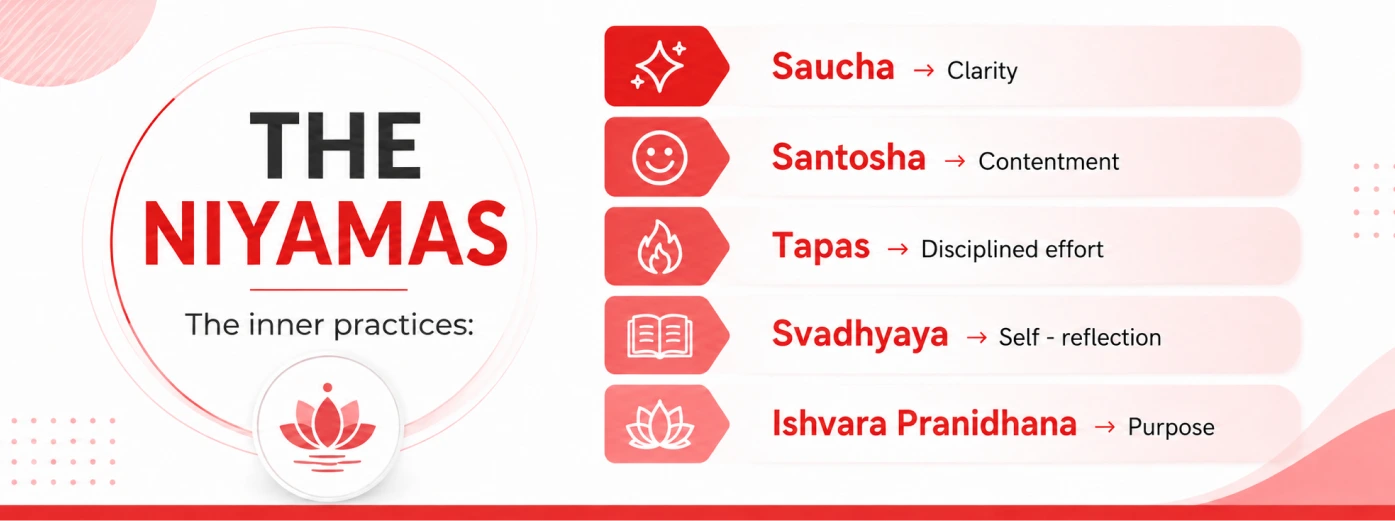
The Five Niyamas: Values That Shape How Students Relate to Themselves
The Niyamas are five values that govern a person’s relationship with themselves, the inner practices that create a stable, honest, growing inner life.
Saucha — Cleanliness, Purity
Saucha is most literally about cleanliness, of body, of environment, of mind. For students, the most relevant dimension is the clarity of mind that comes from an uncluttered internal environment. A student who practises saucha in their thinking, who regularly examines and releases the mental habits that are not serving them, who approaches each learning experience freshly rather than through layers of accumulated assumption, is a student who can genuinely learn, rather than one who is defending a fixed image of themselves.
Santosha — Contentment
Santosha is the practice of genuine contentment, not complacency, not resignation, but the capacity to be fully present with what is, without chronic reaching for something else.
For students in a highly competitive academic environment, santosha is quietly radical. It does not ask students to stop striving. It asks them to find satisfaction in the effort itself, independent of the outcome. The student who can feel genuine satisfaction after giving their best to a difficult problem, regardless of whether they solved it, has access to a kind of motivation that is far more sustainable than the motivation that depends on constant success.
Tapas — Discipline, Sustained effort
Tapas means heat, the heat generated by sustained, disciplined effort. It is the value that most directly connects yogic philosophy to academic practice, because it describes precisely the quality of effort that produces genuine learning.
Tapas is not about suffering. It is about the willingness to stay with something difficult, to keep working at a problem past the point of easy comfort, to practise a skill past the point of initial competence, to engage with a subject at a depth that requires real effort. Students who develop tapas are students who do not give up when things get hard. They have a relationship with difficulty that is fundamentally different from the student whose engagement depends on ease.
Svadhyaya — Self-study, Self-reflection
Svadhyaya is the practice of honest self-examination, the willingness to look at oneself clearly, to study one’s own patterns, motivations, strengths, and blind spots, and to use that understanding in service of growth.
For students, svadhyaya is the value behind metacognition, the ability to think about one’s own thinking, which is one of the strongest predictors of academic achievement across all subjects and age groups. A student who regularly asks themselves how did I approach that problem, what worked, what did not, what would I do differently, is a student who is learning from their own experience rather than simply accumulating it. That reflective capacity is one of the most valuable things any education can build.
Ishvara Pranidhana — Surrender to something larger than oneself
The final Niyama is the most philosophical and the one that requires the most nuanced interpretation in a school context. At its core, Ishvara Pranidhana is about recognising that one is part of something larger than oneself and orienting one’s actions in service of that larger whole rather than solely in service of personal gain.
For students, this value is the foundation of genuine community participation, of service, of the capacity to contribute to a group or a cause with genuine selflessness. It is what transforms a student from someone who is at school for their own advancement into someone who understands their education as a resource that carries responsibilities, to their community, to their society, to the world they will eventually inhabit as an adult.
What This Looks Like at Dhruv Global School
These values do not live in a philosophy class at Dhruv Global School, though they are studied there. They live in how the school day is structured, how teachers respond to difficulty, how students are expected to treat each other, and how the school as a whole understands what it is building.
A student who receives a disappointing grade at Dhruv Global School is not simply told to work harder. They are guided through a process of honest self-examination, satya, that helps them understand specifically what happened and what they can do differently. That guidance is offered with ahimsa, without cruelty, without shame, with the genuine care for the student’s wellbeing that makes honest feedback possible to receive.
A student who is struggling socially is not simply managed. They are supported in developing the self-awareness, svadhyaya, to understand their own role in a situation, the empathy to understand another’s perspective, and the patience, santosha, to work toward resolution rather than demanding it immediately.
A student who is academically anxious is not simply reassured. They are helped to develop a relationship with their own effort that is grounded in tapas and released from the grasping, aparigraha, that makes every outcome feel like a verdict on their worth.
These are not quick fixes. They are long, patient, daily practices. The kind that, by the time a student leaves Dhruv Global School, have become not external values they have been taught but internal qualities they have built. Qualities that will serve them in every environment, every relationship, and every challenge they encounter for the rest of their lives.
A Final Word
Education that builds knowledge without building character produces a graduate who is capable but not necessarily good. Education that builds character without rigour produces a graduate who is warm but not necessarily equipped.
The integration of yogic values into a genuinely rigorous academic environment is not a compromise between these two goals. It is the recognition that they are the same goal, that the student who is honest with themselves, who can stay with difficulty, who is genuinely curious rather than performance-anxious, who treats others with care and themselves with integrity, is also the student who learns most deeply, contributes most generously, and lives most fully.
That is the student Dhruv Global School is trying to help every child become. Not through imposing a set of rules. But through creating the conditions, daily, quietly, consistently, in which those qualities can grow.