Every parent has had some version of this moment. Your child sits down to write, grips the pencil like they are trying to strangle it, and produces something that looks less like letters and more like a seismograph reading during an earthquake. You gently suggest they try again. Things escalate.
Handwriting anxiety is real, for children and for parents. But before you reach for the dotted-line worksheets, it is worth understanding what is actually happening when a young child learns to write, and why the most effective interventions have almost nothing to do with a pencil.
Poor handwriting in early childhood is rarely about effort or attention. It is almost always about readiness, specifically, whether the underlying physical skills have had enough time and practice to develop. The good news is that most of those skills are built through play, not drills.
This guide walks you through what the research says, what age-appropriate handwriting actually looks like, and most importantly, what you can do at home right now to help your child build the foundation.
Why Handwriting Is Harder Than It Looks
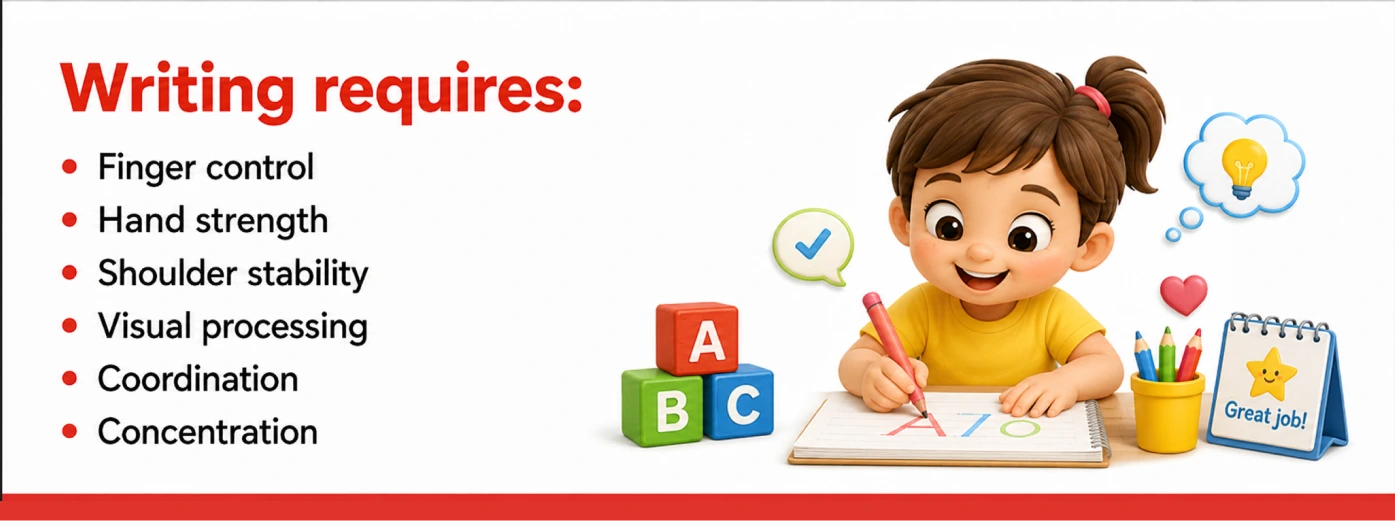
Adults forget how complex handwriting actually is. When a child picks up a pencil and forms a letter, they are simultaneously doing several things that each require their own developed skill set.
They are controlling the fine muscles of their fingers and hand, known as fine motor skills. They are stabilising their wrist and arm, a skill that depends on core and shoulder strength. They are processing how a letter looks and translating that visual information into a physical movement. They are also managing pressure: enough to mark the page, not so much that the pencil tears through or their hand cramps within minutes.
Before all of this is possible, the brain and body need to have laid enough groundwork. Rush the process, and the child learns to compensate, usually through a tense grip, hunched posture, or avoidance. None of these are character flaws. They are the natural result of being asked to do something the body is not yet ready to do.
Handwriting Development by Age: What’s Normal?
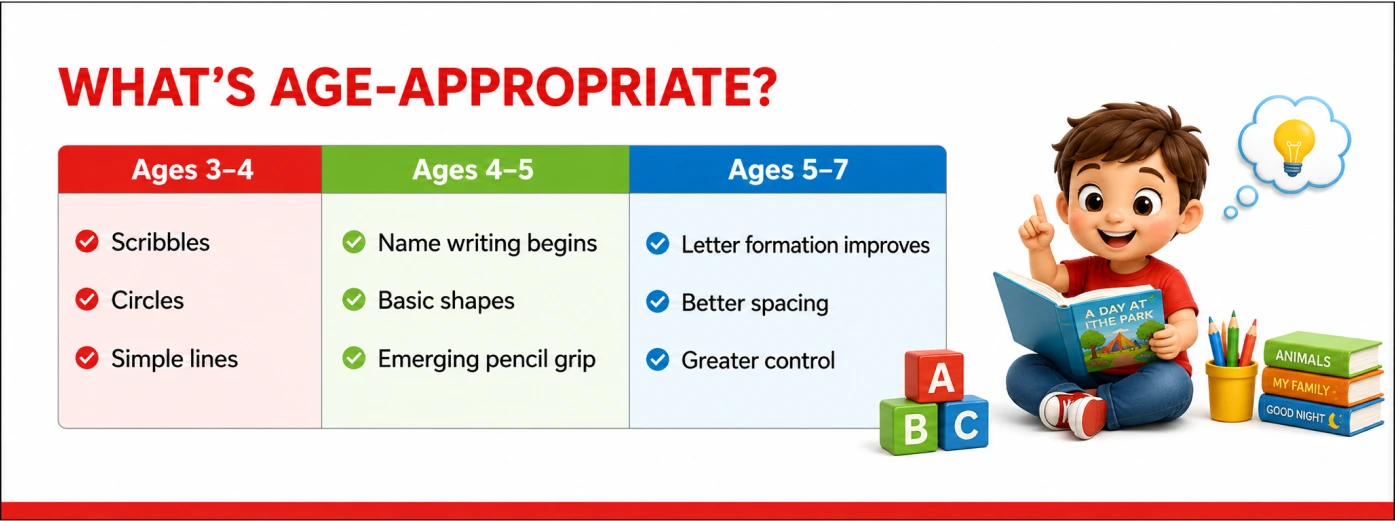
3 to 4 years
At this age, most children can hold a thick crayon or marker with a palmar grasp, meaning the whole fist rather than the fingers. Scribbling, drawing circular shapes, and beginning to imitate simple strokes like a vertical line are all developmentally on track. Expecting recognisable letters at this age is too early for most children.
4 to 5 years
Children begin to move toward a tripod grip, holding the pencil between the thumb, index, and middle finger. Some children manage this comfortably; many still use a four-finger grasp and that is entirely normal. Most children can copy simple shapes: circle, cross, square. Writing their own name, or a few familiar letters, typically begins in this window.
5 to 6 years
6 to 7 years
Lowercase letters become more consistent. Children start to develop a personal rhythm of writing, though legibility will still vary depending on tiredness, topic interest, and how much they are concentrating. This is the age at which specific handwriting practice begins to have real impact, because the foundation is now solid enough to build on.
The Best Way to Improve Handwriting Starts Before the Pencil
Here is something most parents are not told: the best preparation for handwriting is not handwriting practice. It is the development of core strength, shoulder stability, and fine motor control, all of which happen through physical play that has nothing to do with paper.
Children who spend time climbing, crawling, building with blocks, kneading dough, doing puzzles, and using scissors develop the underlying muscle control that makes pencil grip possible. Children who sit at tables with worksheets before these foundations are in place will struggle and will often develop compensatory habits that need to be corrected later.
Activities that build handwriting readiness, without a pencil
- > Climbing frames and monkey bars — builds shoulder stability
- > Playdough, clay, and putty — strengthens finger and hand muscles
- > Threading beads or lacing cards — develops the pincer grip
- > Tearing paper into small pieces — builds finger control and coordinatio
- > Painting with a brush — introduces controlled fine movement
- > Building with LEGO or small blocks — develops hand-eye coordination
- > Picking up small objects with tweezers or tongs — directly trains the tripod grip
- > Carrying books or bags — develops core and shoulder strength
How to Help Your Child Develop a Better Pencil Grip
The tripod grip, pencil resting on the middle finger, controlled by the thumb and index finger, is considered the most efficient grip for sustained writing. But it is not the only functional one.
Many children use a four-finger quadropod grip throughout primary school and write comfortably and legibly. Some children grip too tightly, which causes fatigue and pain. Others hold the pencil too loosely, which produces faint, inconsistent marks.
The things to watch for are not which specific fingers are involved, but whether your child’s hand tires quickly, whether they avoid writing activities, or whether their grip seems to cause visible discomfort.
Three simple grip supports you can try at home
- The rubber band method: Loop a rubber band around your child's wrist and over their thumb. It gently guides the thumb into position without any instruction.
- The tissue trick: Ask your child to scrunch a small piece of tissue and hold it under their ring and little finger while they write. This naturally encourages the tripod grip.
- Triangular pencils: The shape of a triangular pencil physically guides small fingers toward a functional grip. For children who are still developing, these are more useful than standard round pencils.
Letter Formation Tips for Young Children
Children who are never taught where to start a letter often develop habits that slow them down later. The letter ‘a’, for instance, should be formed starting at the top of the circle, moving left and around, not starting at the bottom and working up. These things seem small, but incorrect starting points become deeply ingrained and affect both speed and consistency.
When practising letter formation at home, the most effective approach is multisensory, meaning the child traces, writes, and says the letter at the same time.
Multisensory practice ideas that actually work
- > Trace letters in a tray of sand or salt, the feedback is immediate and satisfying
- > Form letters with playdough 'ropes'
- > Write large letters on the child's back and ask them to guess, this builds the muscle memory of the shape
- > Write large letters on the child's back and ask them to guess, this builds the muscle memory of the shape
- > Use a damp paintbrush on a chalkboard, the letter disappears quickly, so there's no pressure
- > Finger-write letters on a fogged bathroom mirror
- > Write letters in the air with the whole arm, this builds the movement pattern before it is miniaturised onto paper
How Posture and Seating Affect Handwriting
Handwriting quality is significantly affected by things that have nothing to do with the child’s effort or ability.
Posture matters more than most parents realise. A child whose feet are dangling does not have a stable base. A child hunched over a table that is too high is fighting their furniture as well as the task. Feet should be flat on the floor, the table should come to roughly elbow height when seated, and the child’s non-writing hand should hold the paper still.
The angle of the paper is also worth adjusting. Most children are taught to place paper flat and parallel to the table edge. But slightly tilting it, with the top corner pointing toward the child’s writing shoulder, actually allows the wrist to move more naturally and reduces the awkward hook shape that many children adopt.
Lighting matters too. A child writing with the light source behind them is working in their own shadow. Natural light from the left side (for right-handed children) and from the right side (for left-handed children) is the ideal setup.
Handwriting Tips for Left-Handed Children
Left-handed children need specific support that is different from what right-handed children receive and they often do not get it, because most teaching defaults to right-handed assumptions.
The paper should tilt in the opposite direction: top-right corner pointing toward the left shoulder. The pencil should be held slightly further from the tip to allow the child to see what they are writing. Left-handed children often develop a hook grip to avoid smudging, this can be prevented by positioning the hand below the writing line rather than above it.
If your child is left-handed and their school has not specifically addressed their grip and paper positioning, it is worth raising with their teacher. A small adjustment early prevents a great deal of frustration later.
What Not to Do
Some of the most common parental responses to handwriting struggles make the problem worse, not better.
Do not correct every letter. A page of red marks teaches a child that handwriting is a place where they fail. Choose one thing to work on at a time.
Do not extend practice when a child is tired. Five focused minutes of handwriting practice is worth more than twenty minutes of resistance and deteriorating quality. Short sessions, positive endings.
Do not compare them to siblings or classmates. Fine motor development has a wide normal range, and comparison creates anxiety without creating improvement.
Do not skip the play. If your instinct is to cut back on physical activity or crafts to make more time for writing practice, resist it. Physical play is writing practice, at this age.
When to Ask for Support
Most handwriting difficulties in early childhood resolve with time, the right tools, and patient practice. But some children benefit from additional professional input, particularly if the difficulty is persistent and affecting their confidence or willingness to engage at school.
Consider speaking to your child’s teacher or a paediatric occupational therapist if your child: avoids all writing and drawing activities, frequently complains of pain or fatigue in their hand, is significantly behind their peers despite consistent practice, or shows difficulty with other fine motor tasks like dressing and using cutlery.
Do not extend practice when a child is tired. Five focused minutes of handwriting practice is worth more than twenty minutes of resistance and deteriorating quality. Short sessions, positive endings.
An occupational therapist can assess whether there is an underlying motor or sensory processing difficulty and provide targeted exercises. The earlier this is addressed, the easier the intervention.
How Dhruv Preschool Builds Strong Foundations for Writing
At Dhruv Preschool in Aundh, Pune, handwriting development is built into the learning environment from the very beginning, but not in the way most parents expect.
Our early years programme prioritises the physical foundations before the formal skill. Children in our classrooms spend time every day with activities designed to build fine motor strength, hand-eye coordination, and bilateral control: kneading clay, working with threading and lacing, building with small manipulatives, and using tools like scissors, tweezers, and paintbrushes. These are not ‘free play’ activities squeezed in between the real work. They are the real work, because a child whose hands are not ready will not benefit from letter formation exercises, however many they complete.
When formal writing begins, our teachers are trained to observe grip and posture, to correct gently and early, and to use multisensory methods that reinforce both the visual pattern of a letter and its physical movement. Left-handed children receive specific guidance from the outset.
Final Thoughts
Handwriting is a skill. Like all skills, it develops at its own pace, responds to the right conditions, and improves with practice that feels manageable rather than overwhelming. The children who become confident writers are usually not the ones who did the most worksheets, they are the ones whose hands and minds were given enough time, the right activities, and a parent who understood that frustration is part of the process, not a reason to push harder.