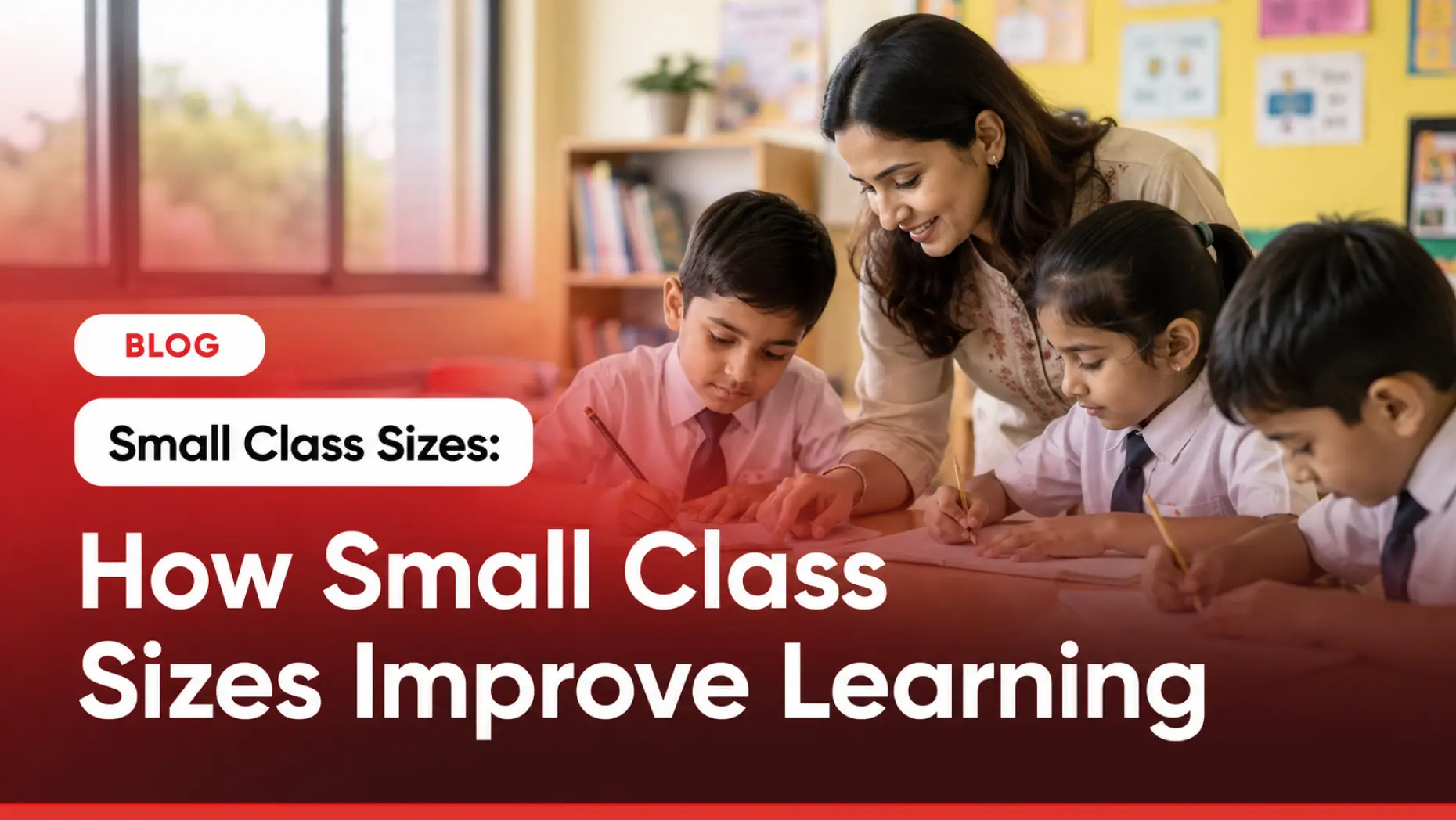
Walk into two classrooms, one with 45 students, one with 22 and within a few minutes you will sense the difference, even before you understand why. The second room feels calmer. Children look up more. The teacher seems to know names, not just faces. This is not a coincidence, and it is not simply a matter of comfort.
Class size is one of the most researched variables in education and one of the most consistently linked to real academic and developmental outcomes. Yet when Indian parents evaluate schools, it is often overshadowed by board results, infrastructure photographs, and rankings. This blog looks at what the research actually says about small class sizes, why the effect is so strong, and what it looks like in a real classroom, day to day.
What Is Considered a Small Class Size?
There is no single global number, but most education researchers place the meaningful threshold for student-teacher ratio somewhere between 15:1 and 20:1 for primary years, allowing for a modest increase in the middle and senior years as students become more independent learners. Above roughly 30 students per teacher, research shows the quality of individual attention drops sharply, not gradually, but as a fairly sharp cliff.
It is worth separating two related but different numbers: class size (the total number of students in the room) and student-teacher ratio (which also accounts for support staff, teaching assistants, and specialist teachers). A school can quote a favourable overall ratio while still running large classrooms if that number includes staff who are not in the room every day. When comparing schools, it is worth asking specifically: how many children are physically in my child’s classroom, with one lead teacher, on a normal day?
Quick Reference: What the Numbers Mean
- Under 20 students: Strong individual attention; teacher can track each child's progress closely.
- 20 to 25 students: Generally still manageable with an engaged, experienced teacher.
- 25 to 30 students: Individual attention becomes harder to sustain consistently.
- 30+ students: Research shows a sharp drop in personalised feedback and behaviour management.
What Research Says About Small Class Sizes
The most frequently cited evidence comes from Tennessee’s Project STAR, a large-scale, long-term study that randomly assigned students to smaller or larger classes from kindergarten onward. Students in smaller classes showed measurable academic gains and, notably, the benefits were largest for children from disadvantaged backgrounds and those who struggled in their early years.
What makes the STAR study particularly convincing is what happened afterward: the academic advantage did not fade once students moved into larger classes in later grades. Researchers found that early exposure to a smaller classroom had a lasting effect, showing up years later in outcomes like higher graduation rates and better performance on standardised assessments.
Closer to home, India’s National Education Policy 2020 explicitly recommends improving student-teacher ratios as one of its foundational reforms, recognising that individual attention in the early years is one of the strongest levers available for improving learning outcomes at scale.
How Small Class Sizes Improve Learning
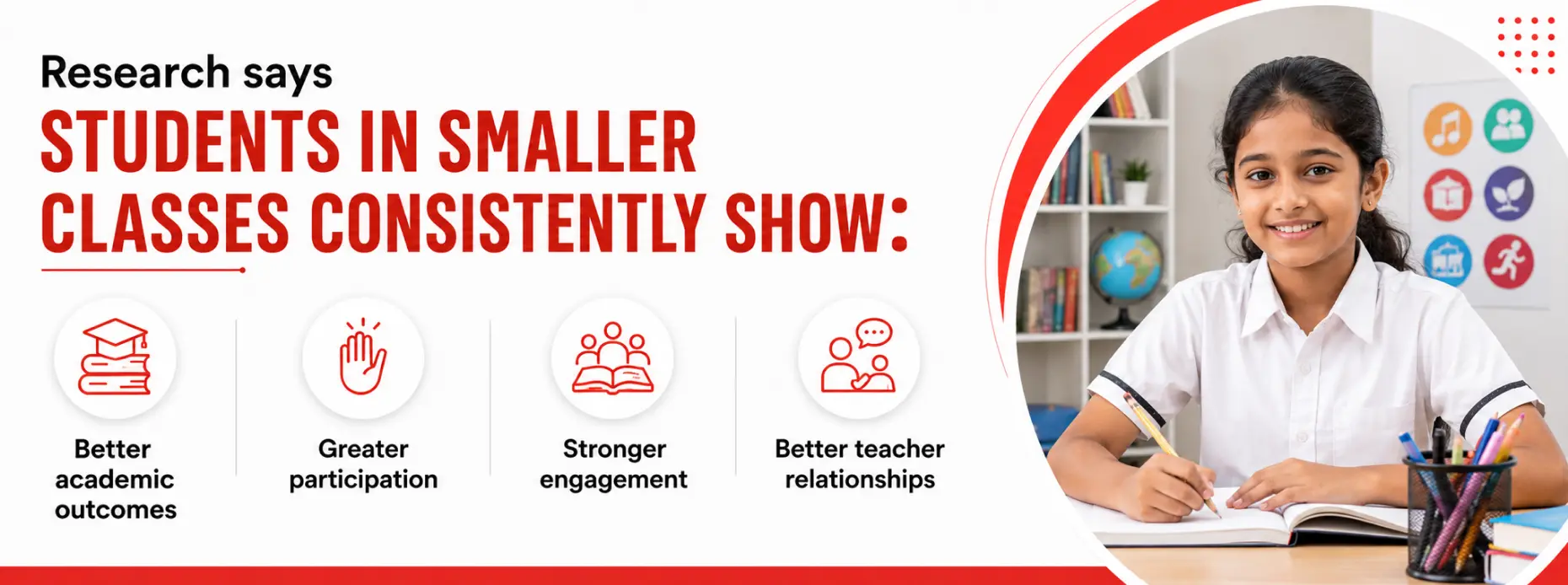
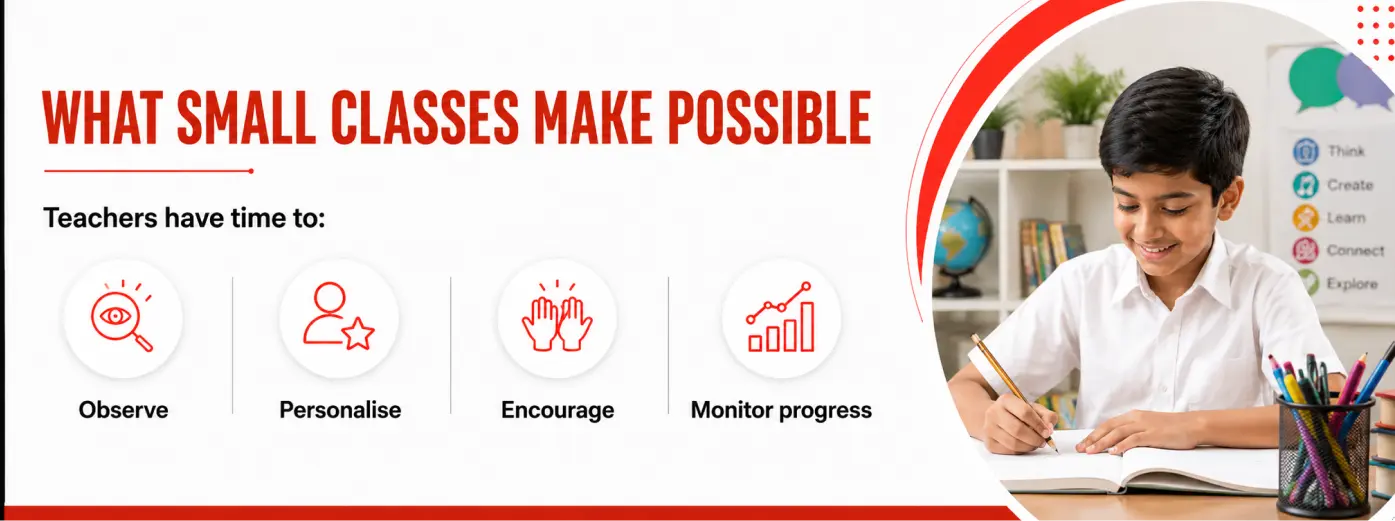
1. More Individual Feedback
2. Faster Identification of Learning Gaps
A child who is quietly falling behind in a large classroom can go unnoticed for weeks, simply because the teacher’s attention is divided in so many ways. In a smaller class, a teacher is far more likely to notice a gap early, while it is still a small, easily corrected issue rather than an accumulated one.
3. More Classroom Participation
Shy or quieter children are statistically far more likely to speak up, ask questions, and participate in discussion in a smaller group. Classroom participation is not just about confidence, it is directly linked to how much a child actually processes and retains from a lesson, rather than passively sitting through it.
4. Stronger Teacher-Student Relationships
Children learn better from adults they trust and feel seen by. A teacher who knows a child’s personality, interests, and struggles can motivate and support that child far more effectively than one who is managing names on a register. This relationship is one of the most consistently cited factors in student engagement research, and it depends heavily on how many students a teacher is realistically able to know well.
How Smaller Classes Improve Classroom Behaviour
There is also a less obvious benefit: behaviour management. Larger classes require more time spent on managing noise, transitions, and disruptions, time that is subtracted directly from instruction. Smaller classes are not just quieter because there are fewer children; they are quieter because a teacher can address a distraction the moment it starts, before it spreads to the rest of the room.
Over the course of a school year, this adds up. Teachers in smaller classrooms consistently report spending a noticeably higher proportion of class time on actual teaching, rather than on classroom management, time that compounds into meaningfully more instruction across a term.
Do Small Class Sizes Matter in Middle and Senior School?
Class size effects are strongest in the early primary years, when foundational skills like reading, number sense, and classroom habits are being formed and when children most need an adult to notice and respond to them individually. But the effect does not disappear in the middle and senior years. Differentiated instruction, tailoring pace, difficulty, and support to different students within the same lesson, becomes increasingly important as academic gaps widen with age, and it is simply harder to do well in a large classroom, regardless of how skilled the teacher is.
For subjects that involve discussion, writing feedback, or project supervision, increasingly common under NEP 2020’s emphasis on competency-based learning, smaller class sizes remain a meaningful advantage right through senior school.
What to Look for When You Visit a School
Class Size — Questions Worth Asking on a School Visit
- How many students are in my child's specific grade section, not just the school average?
- Is the number the same across all sections, or does one section carry significantly more students?
- How many students does a teacher work with across their full teaching day, not just one class?
- Ask to sit in on a lesson, count the number of children, and watch how many the teacher interacts with directly.
- Ask how the school identifies and supports a child who is quietly struggling.
How Dhruv Global School Approaches Class Size
At Dhruv Global School, class sizes are kept deliberately small across our campuses, because we treat individual attention as a foundational part of how learning happens, not a premium extra.
Our teachers are able to track each student’s progress closely, adapt lessons to different learning styles within the same classroom, and step in early when a child needs extra support. This is also central to how we apply Howard Gardner’s theory of multiple intelligences in practice, recognising and responding to each child’s particular strengths requires a teacher who genuinely has the bandwidth to know each child well.
Smaller classrooms also support our yogic values framework, which depends on teachers being able to model calm, attentive engagement, something that becomes very difficult to sustain consistently in an overcrowded room. Whether in a day school classroom in Pune or a residential classroom in Sangamner, the same principle holds: a child who is genuinely known by their teacher learns differently, and better, than one who is simply present in the room.
Final Thoughts
Class size is easy to overlook because it does not show up in a brochure photograph the way a swimming pool or a science lab does. But the research is remarkably consistent: the number of children sharing a teacher’s attention shapes how much feedback a child receives, how quickly gaps are caught, how often a child speaks up, and how well they are known as an individual.
When you evaluate a school, ask about class size with the same seriousness you would ask about board results or facilities. It is, by the evidence, one of the strongest predictors of the classroom experience your child will actually have.