A school campus is not merely a backdrop for lessons. It shapes where children read, experiment, move, make friends, eat, rest and ask for help. That is why facilities matter, but only when they are safe, accessible and genuinely used.
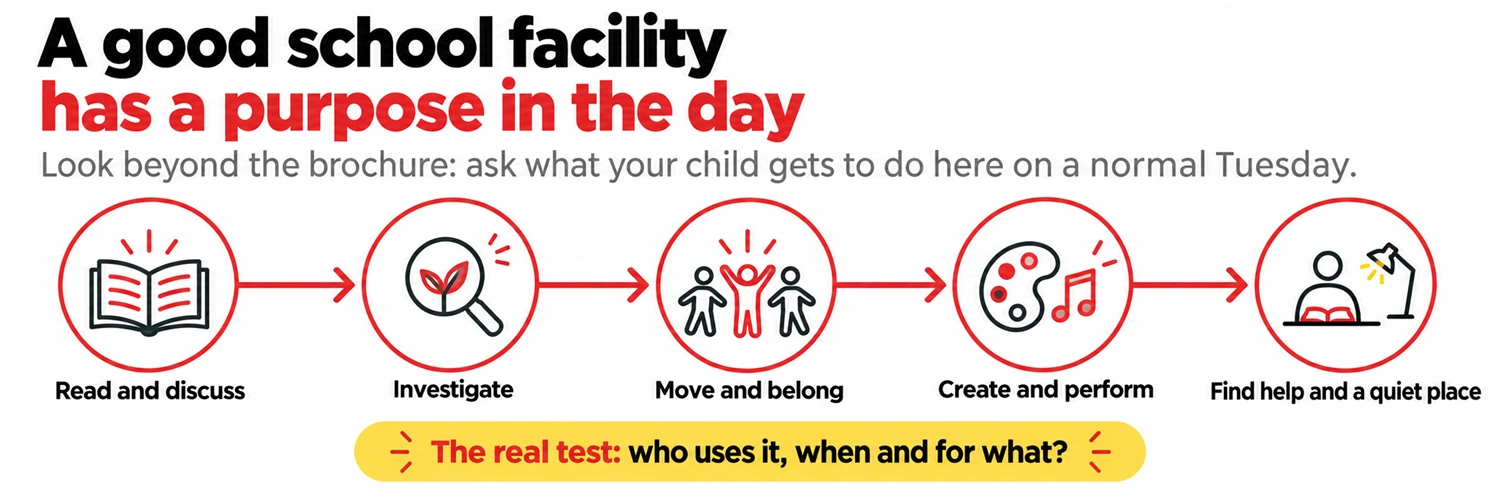
Parents are right to look beyond a polished entrance or a long list of amenities. The useful question is simpler: “What does my child get to do here, on a normal Tuesday?” A library matters when books are borrowed and discussed. A laboratory matters when students investigate. A playground matters when movement is a regular part of the week.
What Facilities Should Parents Look for in a School?
Do School Facilities Really Affect a Child’s Learning?
A useful campus creates choices. A child can find a quiet place to read, a safe place to move, an adult to approach and materials for practical work. The United Nations’ education goal calls for child-, disability and gender-sensitive facilities that provide safe, inclusive and effective learning environments.
CBSE’s infrastructure requirements also make this practical. They cover areas such as libraries, computer-lab cyber safety, spaces for arts and sports, and child-safety guidance. These are not decorative extras. They are part of the conditions that make a school day workable.
What Should Parents Check In Classrooms, Libraries And Labs?
Start with the classroom. Is it bright, orderly and comfortable enough for children to concentrate? Can students see the board, move safely and work in groups when needed? Ask a teacher how the room is used during a typical week, not only how it is arranged for a visit.
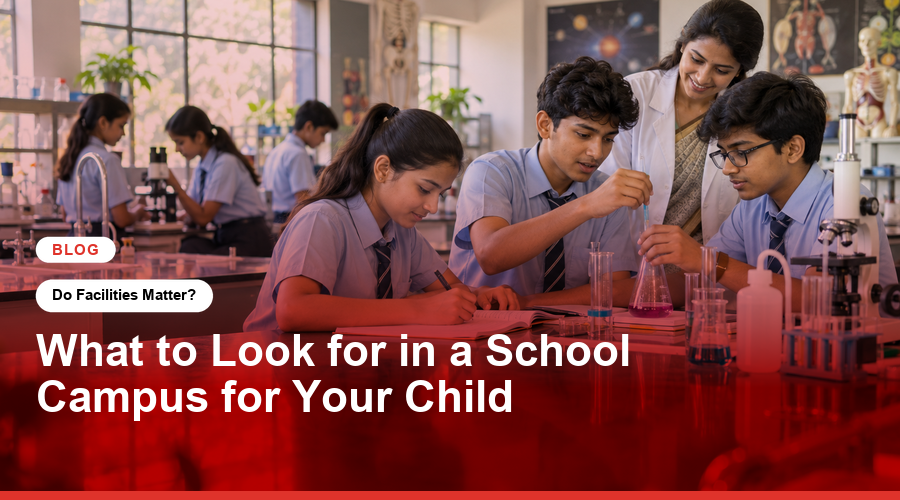
Then look at the library. A room filled with books is encouraging, but the real evidence is use: borrowing routines, reading time, age-appropriate titles and children talking about what they have read. In a laboratory, ask what students do themselves. A practical space should help children test, observe and explain, not simply watch a demonstration.
Why Do Art, Music and Activity Spaces Matter?
Children do not learn only while seated. Sport, movement, music, art and shared activity give them different ways to participate and belong. A multipurpose hall, playing field or arts room is valuable when it is timetabled, supervised and open to a wide range of students, not just a select group.
This matters particularly for children who do not always shine in written work. A child may find confidence on the court, on stage, in a music room or while making something with their hands. That confidence often travels back into the classroom.
How Can Parents Check School Safety and Hygiene?
Notice the details. Are routes easy to follow? Are washrooms clean, private and accessible? Is drinking water visibly available? Where do younger children wait, eat and play? Ask who supervises transitions, outdoor time and arrival or dispersal. A safe environment is visible in routines, not only in cameras and gates.
UNICEF identifies basic services, accessibility and inclusive facilities as parts of a safe and effective learning environment. So do not treat hygiene or access as a side question. They affect a child’s comfort, dignity and readiness to learn.
What Facilities Matter at Different School Ages?
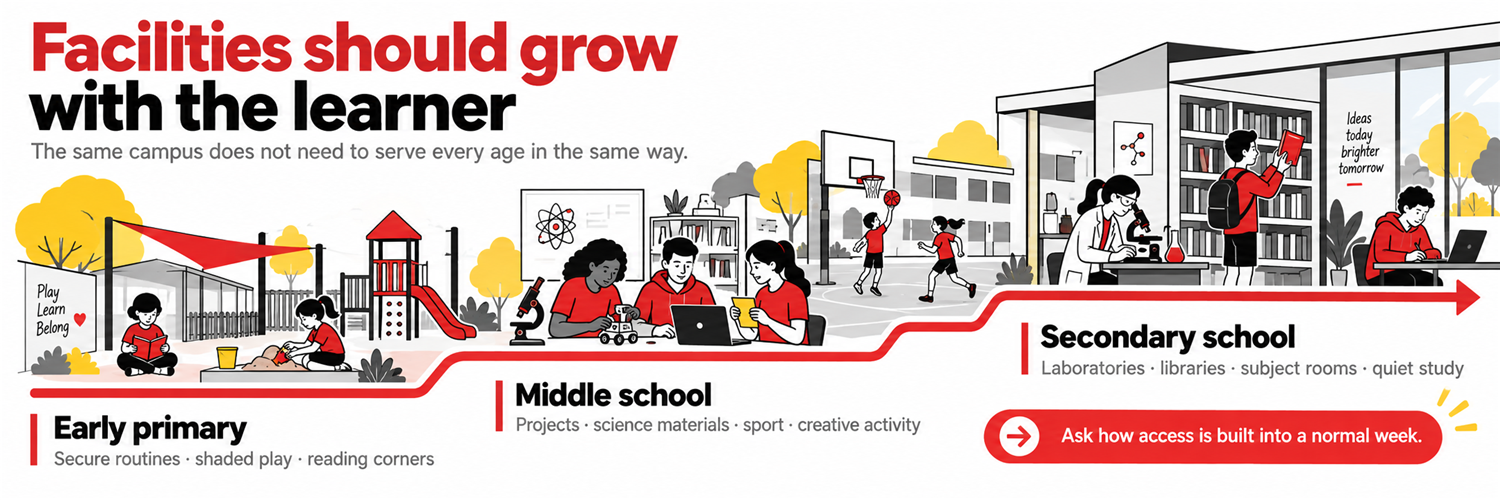
The same campus does not need to serve every age in the same way. For early-primary children, look for secure arrival routines, toilets they can use independently, shaded play, reading corners and classrooms that make it easy to learn through talk, movement and materials. At this age, warmth and supervision matter as much as specialist rooms.
For middle-school learners, the question shifts towards independence. Are there spaces for project work, reading, sport and creative activity? Do students get regular access to science materials, technology and books that stretch their interests? Older children need places where they can take responsibility, not only follow instructions.
By secondary school, practical spaces become especially important. Laboratories, libraries, subject rooms and quiet study areas should support deeper work. Ask how students use these spaces in a normal week and whether access is built into lessons. A facility reserved for an annual event cannot shape daily learning in the same way.
Useful Facility Or Brochure Feature
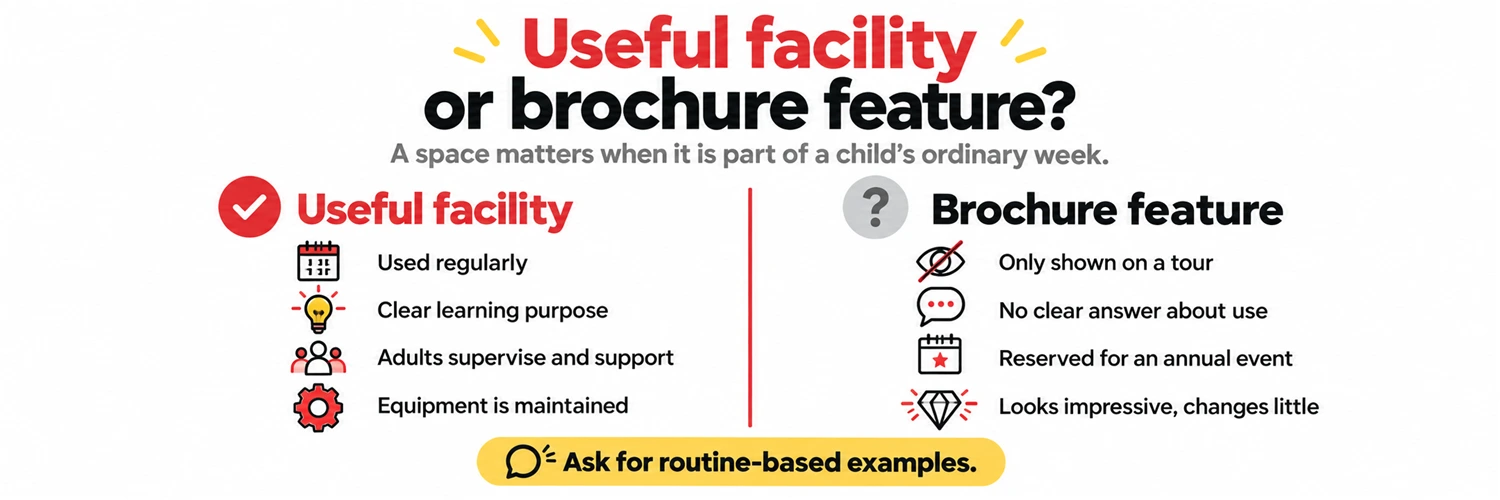
A useful facility has a routine around it. There is an answer to who uses it, when, with what support and for what learning purpose. A brochure feature may look appealing, but no one can explain how it connects to a child’s ordinary timetable. This is not a reason to dismiss a new campus or a developing programme. It is a reason to ask honest, practical questions.
For example, a sports area becomes meaningful when children have regular, inclusive activity time, equipment is maintained and adults supervise safely. A computer lab becomes meaningful when it has working devices, age-appropriate tasks and sensible cyber-safety routines. A library becomes meaningful when children choose, borrow, return and discuss books.
Avoid making a decision from a single impressive room. Watch the corridors at class change, notice whether student work is visible and ask your child what they found interesting. Children often spot the details adults miss: whether there is room to play, whether the bathrooms feel comfortable, whether someone greeted them kindly.
Which Questions Should You Ask Before Choosing A School Campus?
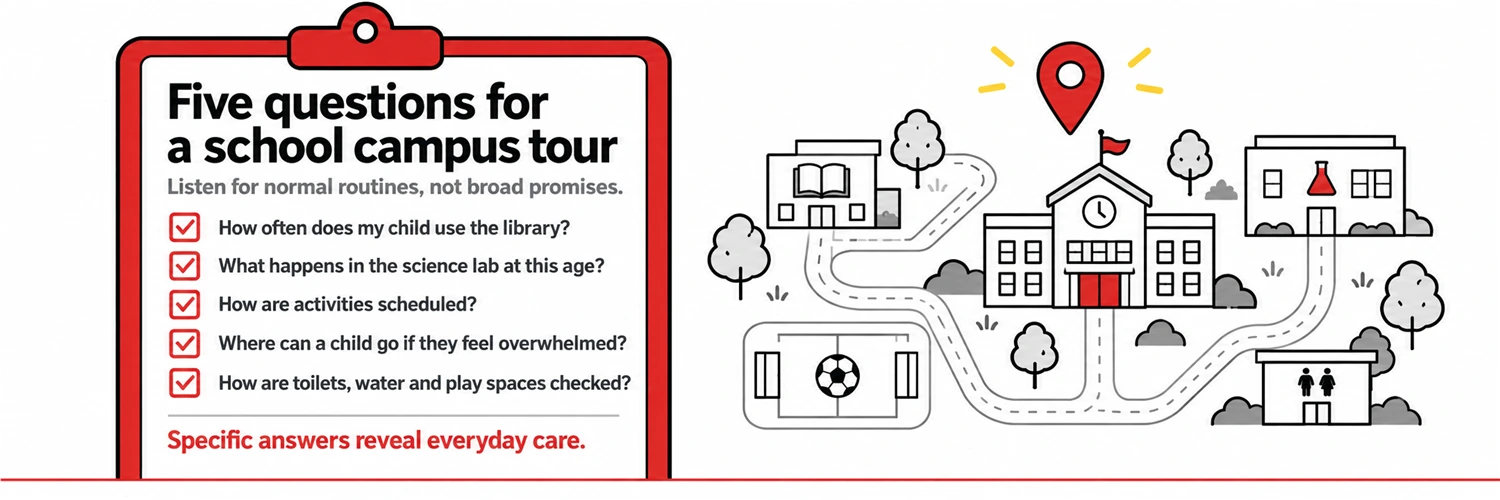
Use a visit to learn how spaces function. Ask: “How often does my child use the library?” “What happens in the science lab at this age?” “How are activities scheduled?” “Where can a child go if they feel overwhelmed?” “How are toilets, water and play spaces checked during the day?”
Listen for examples rather than promises. A clear answer sounds like a normal routine. A vague answer stays at the level of a brochure.
How Does Dhruv Global School Think About A Campus Experience?
Dhruv Global School, a CBSE school with campuses in Nande, Undri and Sangamner, frames education as a balance of academics, sport, music, art, nature and values. For a parent, the most useful next step is a visit: see the spaces, ask how they are used and decide whether the rhythm of the day suits your child. You may also find – How Small Class Sizes Improve Learning helpful as you weigh what supports individual participation.
Final Thoughts
FAQs
1. Do school facilities affect learning?
2. What facilities should a good school have?
3. Should parents visit a school before admission?
Yes. A campus visit lets you see daily routines, ask how spaces are used and judge whether the environment feels safe and welcoming. It also helps you compare schools beyond brochures and photographs.