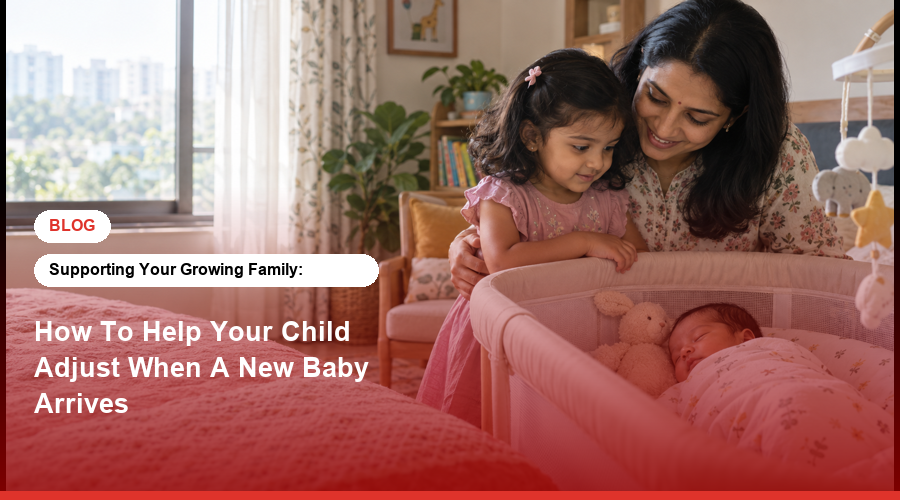
A new baby is coming home. There are tiny clothes to wash, hospital bags to pack and relatives asking whether your child is excited to become an older sibling.
Your child may be excited. They may also be confused, clingy, quiet, cross or completely uninterested.
All of those reactions can be normal.
Here is the most important thing to know: your child does not need to love the idea of a new baby immediately. They need to know that their place in the family is still safe.
For a young child, a new baby changes the people, routines, rooms, sounds and attention they have known. The transition can feel especially big for children aged two to five, who are still learning how to share, wait and explain strong feelings.
Why Can a New Baby Be Difficult for an Older Child?
Adults often focus on what the new baby will add: cuddles, first smiles, a growing family. Your child may focus on what could change: who puts them to bed, why a parent is in hospital, why visitors bring gifts for the baby, or why feeding takes so long.
A child may not say, “I am worried that I will be less important now.”
Instead, they may say:
- “Send the baby back.”
- “I want to be a baby too.”
- “You always hold the baby.”
- “I do not want Daddy.”
- “I cannot do it,” even for something they usually manage.
What is common
- Wanting extra closeness with a parent/li>
- Becoming more emotional, demanding or sensitive
- Acting younger for a period
- Showing both affection and jealousy towards the baby
- Needing extra help with routines they had previously mastered
These reactions do not mean your child will not love their sibling. They mean they are adjusting.
How to Prepare Your Child Before the New Baby Arrives
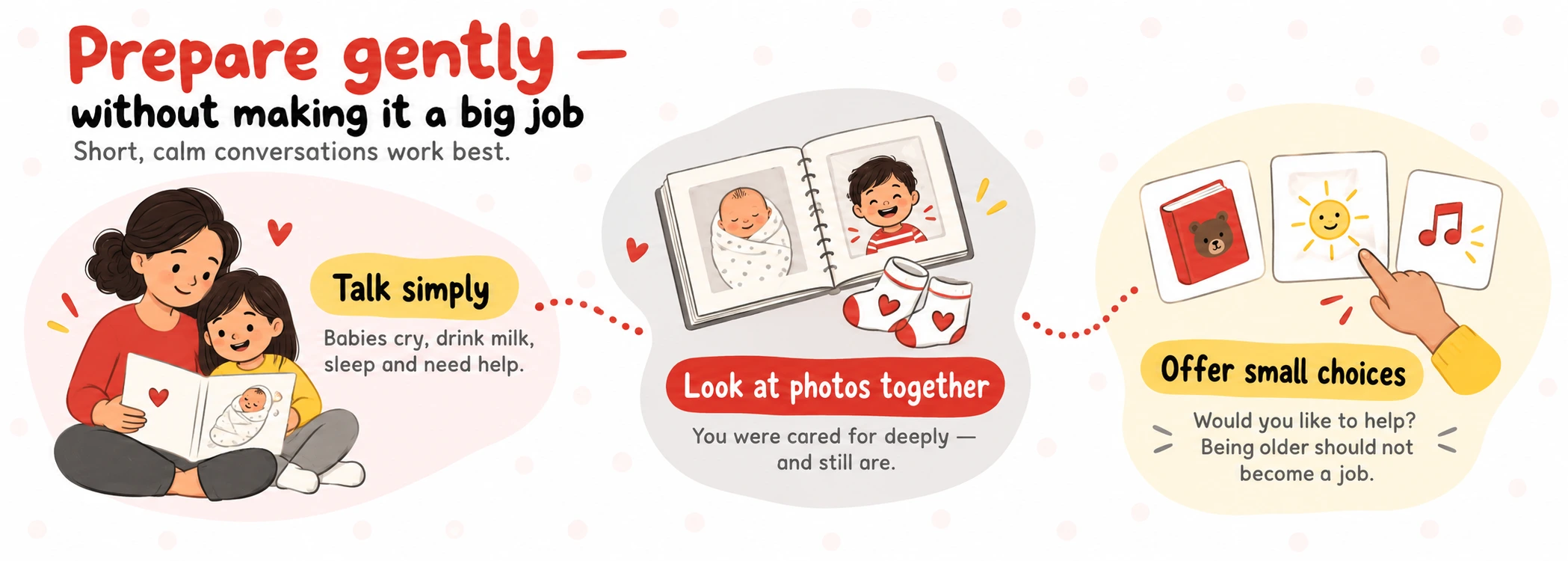
You do not need daily, serious talks about the baby. Short, calm conversations work better.
Use concrete language. “A baby will come to live with us. Babies cry, drink milk, sleep and need a lot of help. They cannot play with blocks yet, but they will grow.”
Avoid promising that the baby will be an instant playmate. For a preschooler, that can feel confusing when the baby mostly sleeps and cries. Instead, explain the reality kindly: “At first, the baby will be very small. We can sing to the baby and show them toys, but it will take time before they can play.”
Read, talk and look at photos
Picture books about becoming a sibling can make the idea easier to understand. Let your child ask questions, even if they repeat the same question many times.
Look at photos from when they were a baby. Tell simple stories:
- “You also cried when you were hungry.”
- “Grandma held you like this.”
- “You wore these tiny socks.”
- “We loved getting to know you.”
The point is not to compare the children. It is to show your child that they were cared for deeply and still are.
Let them be part of the preparation
Offer small choices that matter but do not place responsibility on them.
They might:
- Choose a soft book to read near the baby
- Pick a picture for the baby’s corner
- Help sort baby clothes by colour
- Choose a song to sing at bedtime
- Pack a small bag of activities for the hospital or their caregiver’s home
Say, “Would you like to help?” rather than, “You are the big sibling now, so you must help.”
Being older should not become a job they never applied for.
How to Prepare Your Child for the Hospital Stay
A parent going to hospital can be confusing for a young child. Tell them what will happen in simple steps. Who will stay with them? When will they see you? What might the first meeting with the baby look like?
If they will stay with grandparents or another caregiver, try to spend relaxed time with that person before the due date. Keep familiar comfort items nearby: a favourite soft toy, bedtime book, night light or pyjamas.
If possible, avoid making several big changes at the same time. Moving your child to a new room, stopping a comfort object, beginning toilet training or changing childcare arrangements right before the baby arrives can feel like too much at once.
Major changes are sometimes unavoidable. If so, name them clearly and offer extra support. “You are sleeping in this room now. I know it feels different. We will still read our story together.”
How Should You Introduce Your Older Child to the New Baby?
When your child meets the new baby, let the moment be quiet. They may want to look closely, ask many questions, stand back, smile or walk away to play. Each response is okay.
You can say:
- “This is your baby sister. She is very small.”
- “You can look from here or come closer with me.”
- “Would you like to touch her blanket?”
- “You do not have to hold her today.”
Do not force a hug, kiss or photograph. A child is more likely to grow comfortable when they are allowed to approach at their own pace.
If visitors arrive, encourage them to greet your older child too. A simple “You must be excited to be a big brother” may sound positive, but it can feel like pressure. Better questions include, “What have you been doing today?” or “Would you like to show me your favourite toy?”
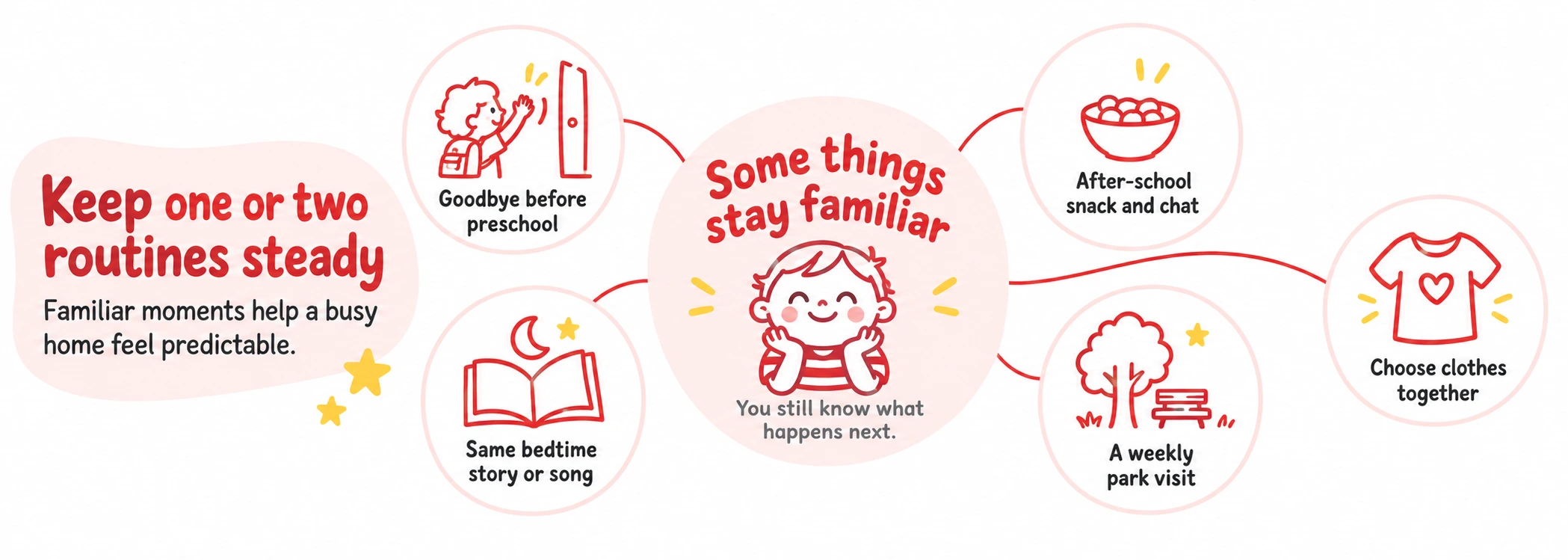
Which Routines Should You Keep After the Baby Arrives?
The first weeks with a newborn can be unpredictable. Still, a few reliable moments can be powerful.
Try to preserve:
- A familiar goodbye before preschool
- The same bedtime story or song
- A small after-school snack and chat
- A weekly park visit with a trusted adult
- A simple morning ritual, such as choosing clothes together
Routines tell a child, “Some things are changing, but I still know what happens next.”
This does not mean every day will run smoothly. It means your child has a few dependable anchors when the household feels busy.
How Much One-to-One Time Does an Older Child Need After a New Baby?
A child does not need hours of exclusive attention every day. Ten focused minutes can matter when it is predictable and protected.
Call it “our time”, “Mummy and me time” or “Papa’s special time”. Let your child choose a simple activity: building blocks, reading, drawing, watering plants, folding laundry together or sitting on the balcony.
During this time, put the phone away if possible. Do not use it to teach, correct or discuss the baby. Follow your child’s lead.
You can say, “Right now, I am only with you.”
If one parent is feeding the baby, the other adult may be able to take over this connection time. Grandparents, an aunt, uncle or trusted family friend can also offer warm attention, but your child still needs regular connection with their parents.
A realistic family plan
- One parent handles the baby while the other spends ten minutes with the older child
- Keep one bedtime ritual with the older child where possible
- Ask visitors to notice and engage the older child
- Protect one familiar activity each week
- Tell your child when you will return if the baby needs you first
Should You Involve Your Older Child in Caring for the Baby?
Small helping roles can create belonging. Your child may enjoy bringing a nappy, choosing a clean muslin cloth, finding a lullaby, putting a toy nearby or reminding an adult where the wipes are.
Praise the specific action: “You brought the clean cloth. That was helpful.” “You used gentle hands.” “You noticed the baby was awake.”
But be careful not to make the older child feel responsible for the baby’s wellbeing. They are still a child. They do not need to entertain the baby, “behave perfectly” because the adults are tired, or give up their needs because they are now older.
A helpful phrase is: “You can help if you want to. Grown-ups will take care of the baby.”
How to Handle Sibling Jealousy After a New Baby Arrives
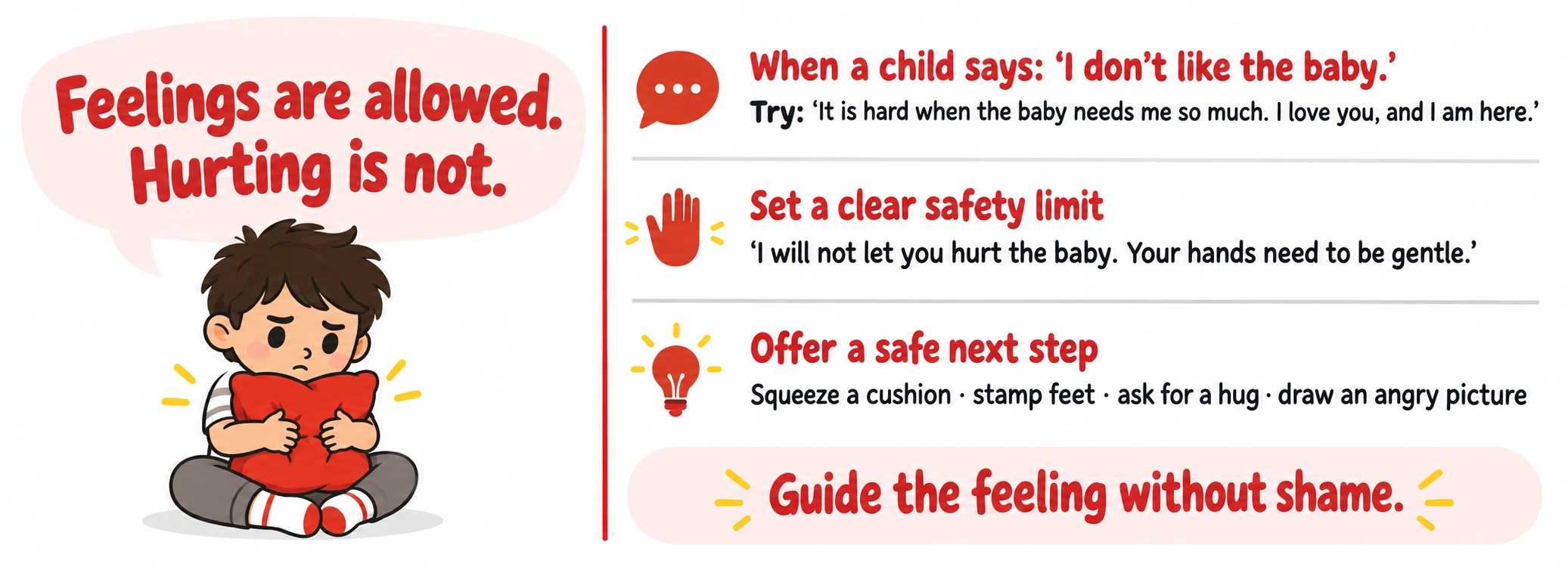
Jealousy is not something to punish out of a child. It is a feeling to guide safely.
If your child says, “I do not like the baby,” you might respond, “It is hard when the baby needs me so much. You wish you had me all to yourself. I love you, and I am here.”
You do not need to agree with hurtful behaviour. Feelings are allowed; hurting is not.
If your child hits, pushes, throws something near the baby or uses rough hands, move calmly and immediately:
“I will not let you hurt the baby. Your hands need to be gentle. You are angry, and I will help you be safe.”
Then give them a safe alternative: squeeze a cushion, stamp feet, ask for a hug, draw an angry picture or come with you to another room.
Avoid labels such as “jealous”, “naughty” or “bad big brother/sister”. These can make a child feel ashamed of emotions they are still learning to manage.
What Not to Say
Some common phrases are meant well but can add pressure.
Try to avoid:
- “You are a big child now. Stop behaving like a baby.”
- “Do not be jealous.”
- “You should know better.”
- “You have to share because you are older.”
- “Look how well the baby behaves.”
- “You are making Mummy sad.”
- “You want me close. I understand.”
- “You can be upset. I will help you.”
- “The baby needs feeding. Then I will sit with you.”
- “You do not have to love everything about this change today.”
- “We will learn how to be a family of four together.”
Let your child have their own life too
A new baby can easily become the centre of every conversation. Keep space for your older child’s interests, friends and everyday achievements.
Continue preschool where appropriate. Let them show their artwork, talk about their day, play in the society garden, attend a familiar activity or spend time with cousins.
Do not expect them to become the family’s helper all the time. They still need room to be silly, noisy, creative and fully themselves.
When Should Parents Seek More Support?
Most children adjust gradually, although the first weeks can be uneven. Speak with your paediatrician or a child mental-health professional if your child’s distress feels intense or prolonged, if they regularly try to harm the baby or themselves, if there are major changes in eating or sleeping, or if you are worried about their development or family wellbeing.
Asking for support is not a failure. It can help everyone settle more safely.
Final Thoughts
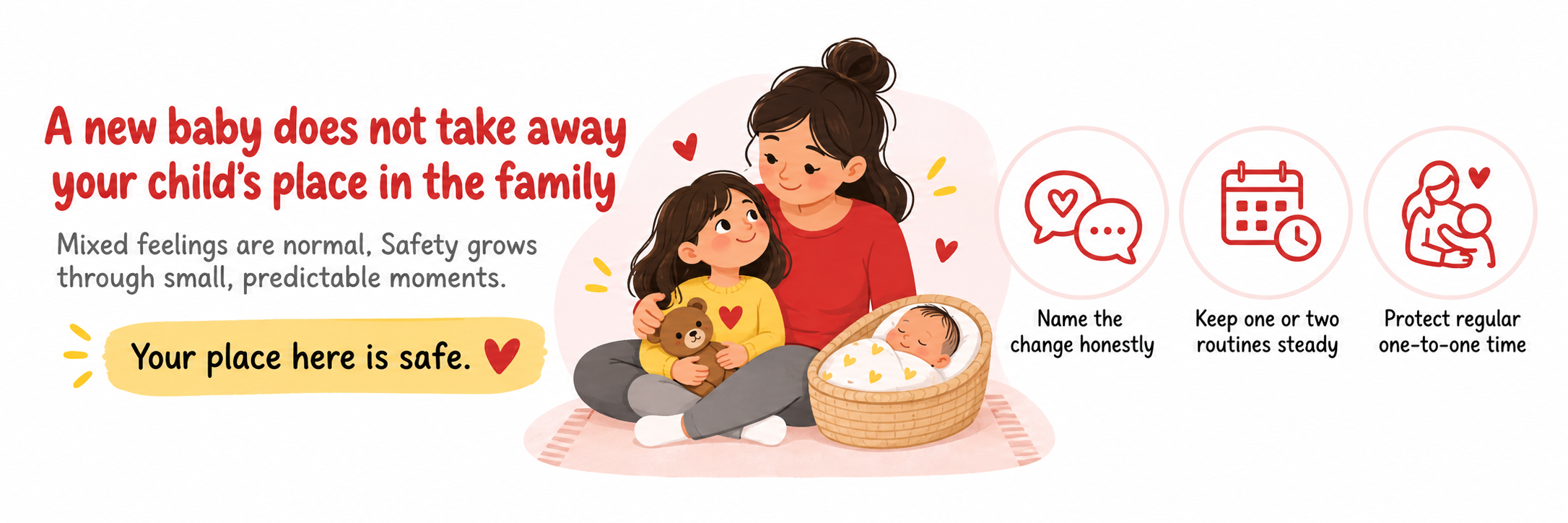
A new baby does not take away your child’s place in the family.
But your child may need to hear and feel that truth many times.
The goal is not a perfect first meeting or an instantly loving sibling relationship. The goal is a home where your child can be excited, cross, proud, clingy and curious and still know they belong.
FAQs
How soon should I tell my child about the new baby?
Should my child be made to help with the baby?
Is baby talk or toilet regression normal?
What if my child ignores the baby?
How can grandparents help?
Grandparents can protect familiar routines, give the older child one-to-one time, tell stories from when the child was a baby and avoid comparing the children.