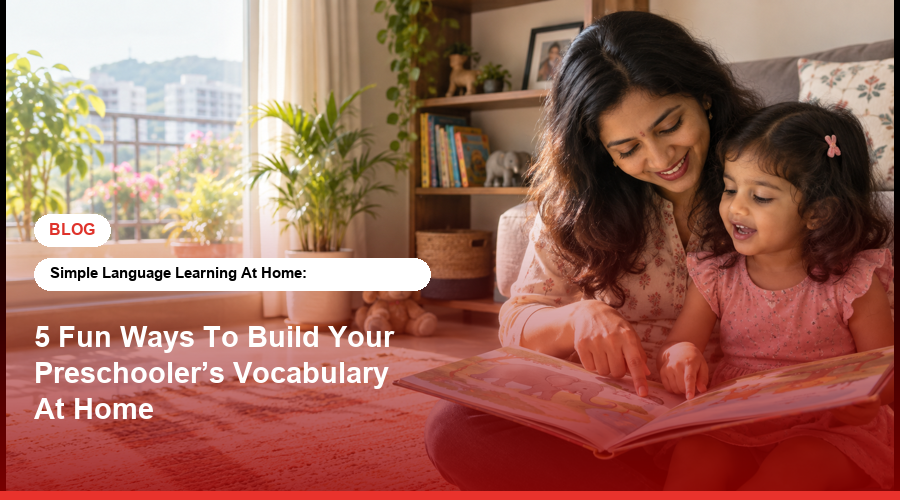
Your child points at a pigeon from the balcony and says, “Bird.” You reply, “Yes, a grey pigeon. It is flapping its wings.” A few minutes later, they notice a crow and ask, “Black bird?”
That small exchange is language learning.
For many parents, vocabulary can sound like something children build from flashcards, worksheets or long reading sessions. In the preschool years, it grows most naturally through conversations, stories, play, songs and ordinary family life.
Here is the most important thing to know before reading any further: your preschooler does not need more pressure to learn new words. They need more chances to hear, use and enjoy them with you.
At Dhruv Preschool, language learning is woven into play, routines, stories, music and relationships. Home can offer the same rich opportunities in small, relaxed ways.
Why Is Vocabulary Important in the Preschool Years?
Vocabulary is not simply a list of words a child can repeat. It helps them ask for what they need, explain what happened, join a game, share an idea and make sense of feelings.
A child who knows words such as frustrated, sticky, enormous, whisper, compare or careful has more ways to describe their world. They may still cry when upset, of course. But over time, language gives them another route besides crying, grabbing or withdrawing.
The routine itself does not remove disappointment. Your child may still protest the yellow cup. But a familiar sequence gives you a calmer place from which to meet the protest.
Vocabulary also grows best in context. A preschooler is more likely to remember the word drizzle after looking out at Pune rain with you than after seeing it alone on a card.
For families who use Marathi, Hindi, English or more than one language at home, this can feel confusing. It does not need to be. Your home language is not an obstacle. It is part of your child’s identity, comfort and communication. Talk, sing and tell stories in the language that feels natural to your family. Children can build meaningful words across languages.
What helps most
- Hearing words many times in real situations
- Having an adult listen and respond
- Playing with language without being corrected constantly
- Feeling safe enough to try a new word
- Connecting words with people, actions, objects and feelings
1. Turn Everyday Routines Into Vocabulary-Building Conversations
The easiest vocabulary activity is already happening around you. It is the small talk you offer while getting dressed, packing a tiffin, watering a plant, travelling in the car or preparing dinner.
Instead of only giving instructions, describe what you both notice.
At breakfast, you might say, “The banana is soft and ripe. This orange is juicy. Which fruit has a rough peel?” While getting ready, try, “Your socks are striped. Let us find the matching pair.” During a walk, notice “a noisy bus”, “a tiny ant”, “a slippery puddle” or “a tall building”.
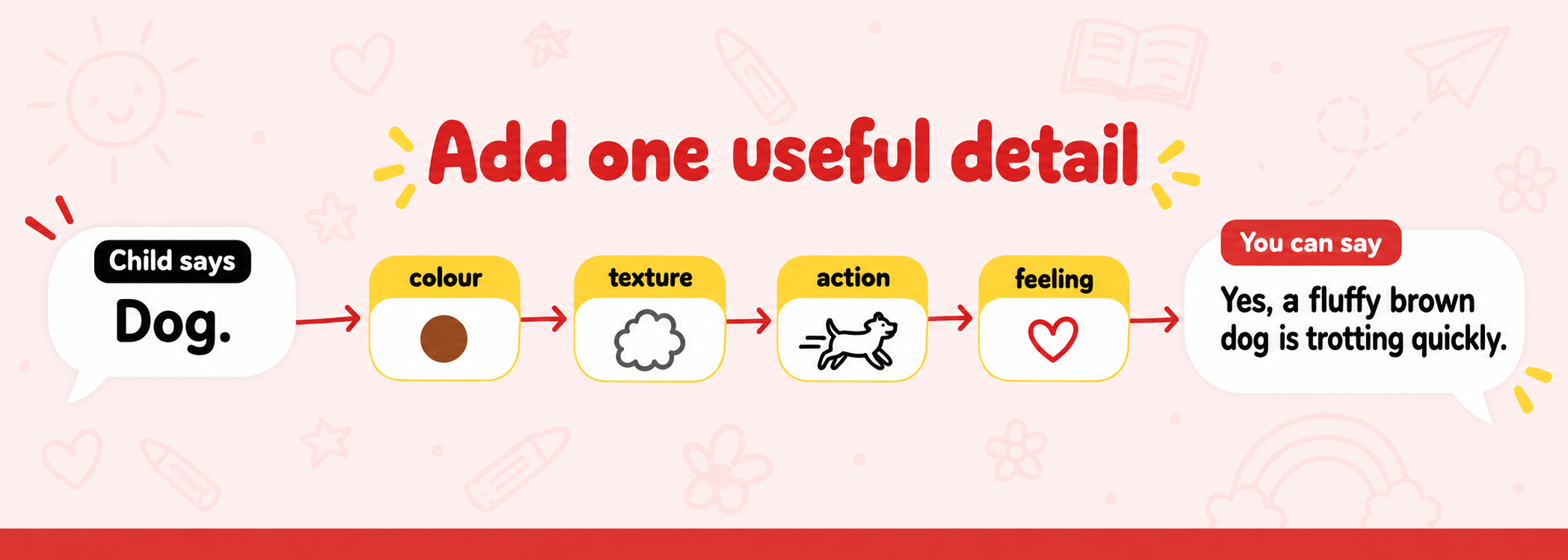
The important part is not using unusually difficult words. It is adding one useful detail to familiar words.
If your child says, “Dog,” you could say, “Yes, a fluffy brown dog. It is trotting quickly.” If they say, “Car,” you might add, “That red car is reversing.”
This is often called expanding a child’s language. You are not saying, “No, say it properly.” You are showing them the next step.
Try this at home
Choose one daily routine this week. Perhaps it is bath time, the walk to preschool or dinner preparation.
Use words about:
- Colour: bright, pale, dark, shiny
- Size: tiny, enormous, narrow, wide
- Texture: smooth, rough, squishy, stick
- Action: squeeze, pour, mix, carry, balance
- Feelings: excited, disappointed, proud, worried
2. Read Together and Let Your Child Retell the Story
Reading together is one of the most enjoyable ways to introduce new words. But you do not need to finish every page or read every sentence exactly as written.
Pause at a picture. Ask, “What do you think is happening?” Point to a small detail. “Look at the bear’s muddy boots. Where do you think he has been?” If your child gives a one-word answer, build on it: “Yes, he is hiding. He may feel nervous.”
When you read the same book again, children often notice more. Repetition is not boring for preschoolers. It is how a familiar story becomes theirs.
After the story, invite your child to retell it with toys, drawings or simple prompts:
- “What happened first?”
- “Who was the funniest character?”
- “What would you do if you found that treasure?”
- “Can you make a different ending?”
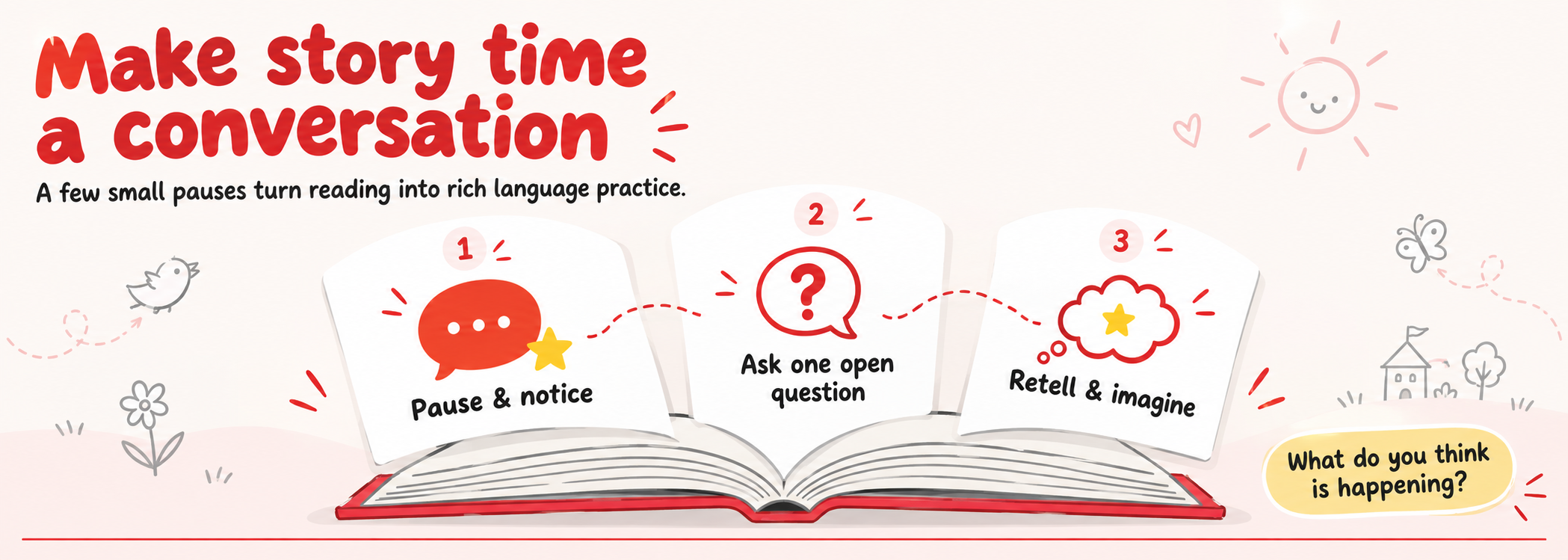
A simple book routine
- Let your child choose the book.
- Read slowly enough to look at the pictures.
- Pick two or three interesting words to repeat naturally.
- Ask one open question.
- End with a warm comment: “I liked hearing your idea.”
3. Build Vocabulary Through Pretend Play
Pretend play gives children a reason to use language. A cardboard box becomes a bus. Cushions become a hospital. A spoon becomes a microphone. In these moments, children are not memorising words. They are using them to direct a story.
Set up a simple pretend-play corner with things you already have: bowls, empty containers, scarves, safe boxes, paper, toy animals, old bags or a few cushions.
You can play shop, restaurant, doctor, bus, post office, vegetable market or pet clinic. Let your child lead. If they want to be the doctor for the tenth day in a row, that is perfectly useful practice.
Join in by adding language, not by taking over.
If your child says, “Medicine,” you might say, “This patient has a sore throat. Which medicine will help?” If they are running a café, try, “Could I have a crunchy sandwich and a cold drink, please?”
Pretend play naturally introduces words about roles, actions, questions and feelings:
- Customer, chef, driver, patient, helper
- Deliver, examine, choose, measure, serve
- Careful, urgent, empty, full, hungry
- Please, thank you, may I, what happened?
A useful reminder
Let your child be the expert sometimes. When they lead the game, they have more reasons to speak, decide and explain.
4. Use Songs and Rhymes to Build Language Skills
Songs, nursery rhymes and playful sound games help children hear patterns in language. They do not need to be performed perfectly. They can happen while folding clothes, sitting in traffic or waiting for dinner.
Try a familiar rhyme and pause before the final word. Your child may fill it in. Make up silly rhymes with their name. “Riya likes papaya.” “Kabir can cheer.” The sillier the better.
You can also play simple listening games:
- “Can you find something that starts like ball?”
- “I spy something that is green and crunchy.”
- “What rhymes with cat?”
- “Let us clap the beats in your name.”
- “Can you make a quiet sound, then a loud sound?”
For younger children, focus on enjoyment rather than getting the answer right. They may simply repeat a sound, laugh or point. That still counts as participation.
Songs also create a gentle way to practise new language in more than one home language. A grandparent may share a Marathi rhyme, a parent may sing a Hindi lullaby, and a preschool teacher may introduce an English action song. Each adds another layer of meaning and belonging.
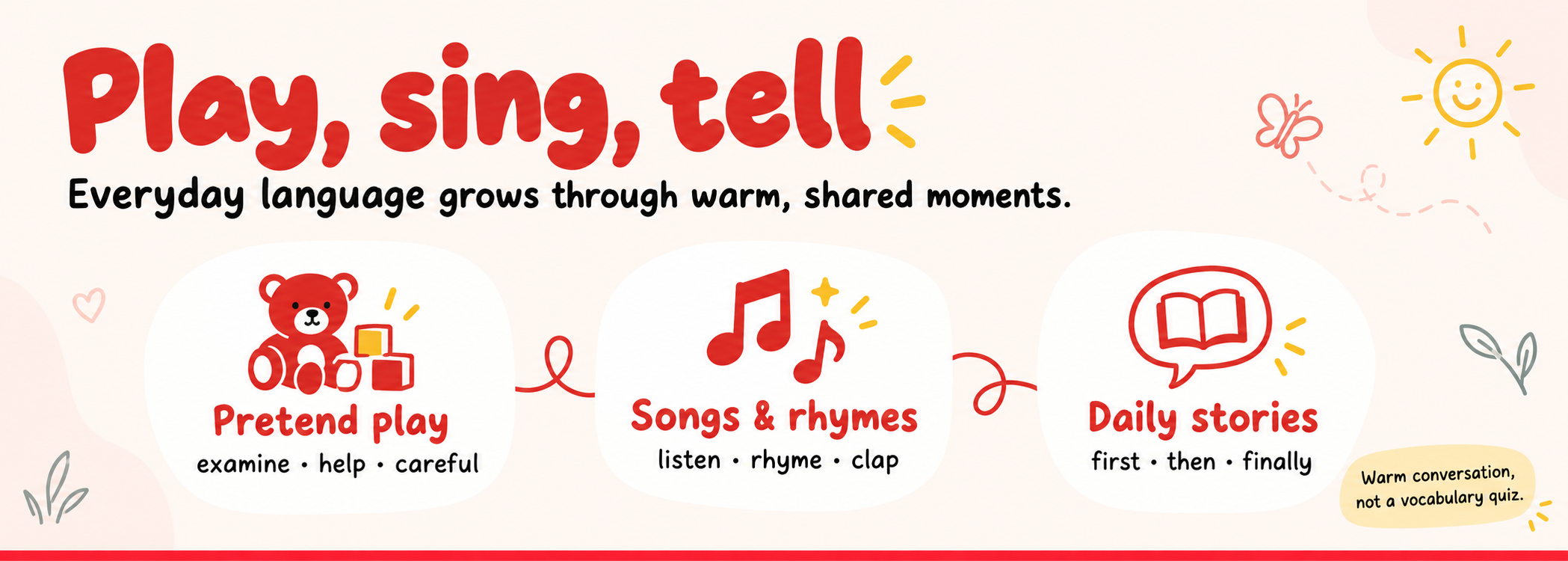
5. Encourage Your Child to Tell You About Their Day
Children love telling adults what happened. The details may arrive out of order, with a dinosaur appearing in the middle of preschool pickup. Listen anyway.
At the end of the day, rather than asking only, “What did you do at school?”, offer a more specific invitation:
- “What made you laugh today?”
- “Who did you sit next to?”
- “What did you build or make?”
- “Was there a part that felt difficult?”
- “Tell me one thing you remember.”
If your child says, “I played blocks,” you can gently expand: “You built a tall tower with blocks. Did it wobble or stay steady?”
You can make this into a family ritual. During dinner, each person shares one “best bit”, one “surprise” and one “kind thing” from the day. Your child hears adults using words for events and emotions. They also learn that their stories matter.
Photos can help too. Look at a picture from a birthday, park visit or family trip and ask your child to describe it. Avoid correcting every grammar mistake. Respond to the meaning first.
When a child says, “Me go garden,” you might answer, “Yes, you went to the garden and saw butterflies.” This gives them a stronger sentence to hear without making them feel wrong.
What Should Parents Avoid When Building Vocabulary?
Things that feel helpful but can make language learning harder
- Correcting every word or sentence
- Asking too many test-style questions
- Interrupting a child who is trying to explain
- Comparing siblings or classmates
- Relying only on worksheets or phone-based learning
- Treating one home language as less valuable than another
If your child is quiet, give them time. Some children need a pause before they answer. Others communicate first through pointing, expressions, gestures or play.
What Is Normal And When To Ask For Support
Children develop language at different speeds. Some speak early and constantly. Others watch, listen and use fewer words before making a sudden leap.
It is worth speaking with your child’s paediatrician or teacher if you have concerns about hearing, understanding, communication, a loss of skills, or whether your child is progressing as expected. Getting advice is not about labelling a child. It is a way to understand what support may help.
How Dhruv Preschool Builds Vocabulary
At Dhruv Preschool, children learn language through stories, conversations, songs, role play, group activities and exploration. Teachers use rich but age-appropriate words while following children’s interests.
A child making a block tower may hear words such as balance, steady, taller, collapse and rebuild. A child in the sand area may hear pour, scoop, wet, dry and full. A child who feels left out may be supported to name that feeling and find words to rejoin play.
Language becomes meaningful when it is connected to something a child is doing, feeling or imagining.
Final Thoughts
Vocabulary does not begin with a worksheet. It begins with a child noticing something, an adult paying attention, and both of them finding words for it together.
A story before bed, a conversation while cutting fruit, a made-up song in the car or a pretend shop on the living-room floor can all become language learning. Your child does not need you to be a teacher at home. They need you to be interested in what they are trying to say.
FAQs
Should I teach my preschooler only in English?
No. Speak and connect in the language that feels most natural at home. A secure foundation in a child’s mother tongue supports communication, identity and learning. English can grow through books, songs, preschool and everyday exposure.
How many new words should my child learn each day?
Are flashcards useful for preschool vocabulary?
They can be one small activity, but they are not necessary. Words are easier to understand and remember when children hear and use them in a real context.
What if my child only gives one-word answers?
Respond warmly and add a little more language. If they say, “Bus,” you might say, “Yes, a big yellow bus is turning.” Avoid pressuring them to repeat the full sentence.