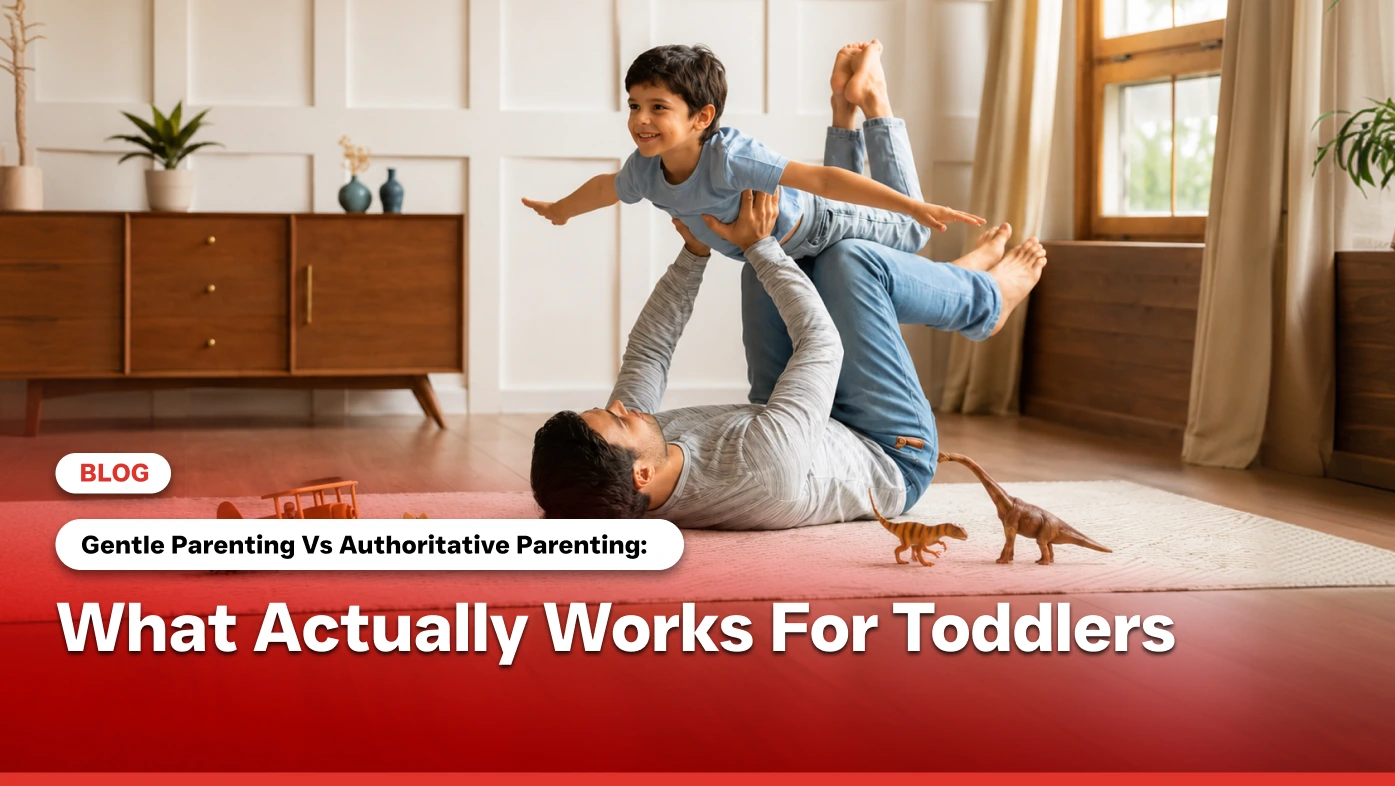
Somewhere between the Instagram reel that tells you to validate every feeling and the relative who says you are raising a spoiled child, there is a parent trying to figure out what to actually do when their four-year-old is screaming on the floor of a supermarket because the wrong colour straw came with their juice.
The parenting style conversation has never been louder. Gentle parenting, conscious parenting, lighthouse parenting, authoritative parenting, the labels multiply weekly, each accompanied by its own vocabulary, its own community, and its own quiet suggestion that every other approach is getting it wrong.
Most parents are not looking for a label. They are looking for something that works. Something that does not leave their child in pieces or themselves in guilt. Something they can actually sustain at seven in the morning when everyone is tired and nothing is going to plan.
This blog is not going to tell you which parenting tribe to join. It is going to tell you what the research actually says about what helps preschool-age children develop well and let you decide what to do with that.
What Is Gentle Parenting?
Gentle parenting is not a clinical term. It does not come from a single researcher or a specific theoretical framework. It is a cultural movement, largely Instagram-born, though with genuine philosophical roots that emphasises empathy, respect, and emotional connection over punishment, control, and compliance.
At its best, gentle parenting asks parents to see their child’s behaviour through a developmental lens. The four-year-old who screams about the straw is not being manipulative. They are a four-year-old with an underdeveloped prefrontal cortex, a genuine emotional experience, and no reliable way yet to regulate it. Gentle parenting says: meet that child where they are. Acknowledge the feeling. Stay connected. Do not add shame to distress.
This is genuinely useful. The research on emotion coaching, the practice of naming, acknowledging, and helping children process their feelings is strong. Children whose parents consistently acknowledge their emotions develop better emotional regulation, stronger language skills, and more secure attachment than children whose feelings are dismissed or punished.
Where gentle parenting becomes muddier is in its popular form. On social media, it can look like a child who is never told no, never experiences a consequence, and is negotiated with endlessly. It can look like a parent who is so focused on not causing distress that they have stopped providing the one thing young children need almost as much as empathy: structure.
What Is Authoritative Parenting?
Authoritative parenting is not the same as authoritarian parenting, a distinction that matters enormously and is frequently missed.
Authoritarian parenting is the traditional model: high expectations, strict rules, low warmth, compliance enforced through punishment. Because I said so is its motto. It produces children who comply when the parent is present and struggle when they are not, because the behaviour was never genuinely internalised.
Authoritative parenting is different. It combines high warmth with high expectations. It sets clear, consistent boundaries and it explains them. It is responsive to a child’s emotional state without being ruled by it. It says: I hear that you are upset. The rule is still the rule. I will help you through this feeling, and the boundary is not moving.
The research on authoritative parenting is among the most consistent in developmental psychology. Across decades, across cultures, across socioeconomic groups, children raised with authoritative parenting, high warmth, high structure, age-appropriate expectations clearly explained, show better academic outcomes, stronger emotional regulation, higher self-esteem, and lower rates of anxiety and behavioural difficulty than children raised with any other parenting style.
This is not a marginal finding. It is one of the most replicated results in the field.
Gentle Parenting vs Authoritative Parenting: Where They Overlap
Here is the part the parenting style debate usually misses: genuine gentle parenting and authoritative parenting are not opposites.
Both emphasise emotional warmth. Both reject shame and punishment as primary disciplinary tools. Both take a child’s inner experience seriously and respond to it with care. Both ask parents to explain rather than simply command.
Where they diverge is in their relationship to boundaries.
Authoritative parenting is explicit: warmth and structure are not in tension. They are complementary. A child who has both, who is deeply loved and clearly bounded, has the two things they need most. The warmth tells them they are safe. The structure tells them the world is predictable. Together, they create the secure base from which genuine development happens.
Gentle parenting in its popular form sometimes implies that boundaries are inherently ungentle, that a child in distress should always be met with softness and never with firmness. This is where the research does not follow. Children who grow up without consistent, loving limits do not develop better emotional regulation. They develop less of it, because they never had to practise managing frustration in a supported environment.
The firmness is not the opposite of warmth. For a preschool-age child, firmness is part of the care.
What Toddlers' Brains Actually Need
To understand why this matters, it helps to understand what is happening neurologically in a three to five year old.
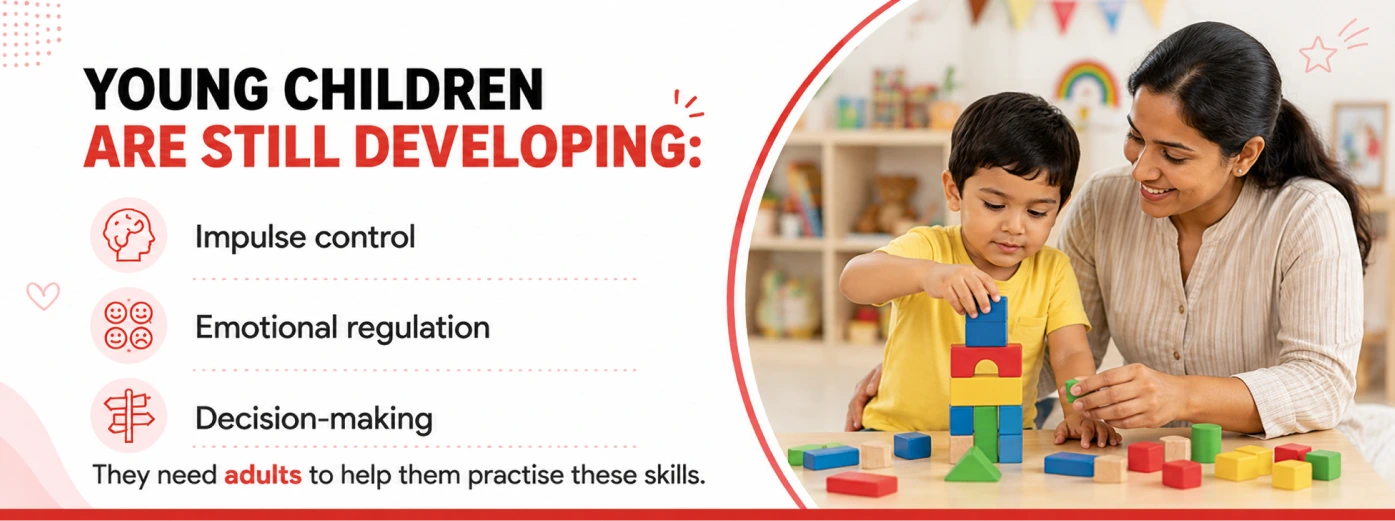
The prefrontal cortex, the part of the brain responsible for impulse control, emotional regulation, and rational decision-making is not fully developed until the mid-twenties. In a preschooler, it is in very early development. This means that a four-year-old who cannot regulate their emotions when told no is not being defiant. They are being four. Their brain literally does not yet have the circuitry to manage the feeling independently.
What builds that circuitry is not the absence of frustration. It is supported experience of managing frustration. A child who is gently but firmly held to a boundary, who experiences the feeling, is supported through it by a warm and present parent, and comes out the other side intact, has done something neurologically significant. They have practised. The neural pathway for managing that feeling is slightly stronger than it was before.
A child who is never held to a boundary because the distress it causes is immediately relieved never gets that practice. The feeling remains unmanageable because it has never been managed.
This is why the combination of warmth and structure is not a compromise between two approaches. It is the approach and one that makes biological sense.
Gentle Parenting vs Authoritative Parenting in Everyday Situations
When your child refuses to leave the playground
The gentle parenting response: acknowledge the feeling, give a warning, offer connection. I know you love it here and it is hard to leave. We are going in five minutes. Would you like to do the slide one more time?
The authoritative addition: the five minutes ends. You leave. Kindly, warmly, without negotiation, without the slide becoming ten slides. The boundary holds.
Both parts are necessary. The acknowledgement without the boundary teaches the child that distress can indefinitely postpone what they do not want. The boundary without acknowledgement teaches the child that their feelings do not matter. Together, they teach something more valuable than either: that feelings are real and important, and that the world does not reorganise itself around them.
When your child hits a sibling or friend
The gentle response: stay calm, do not match the intensity of the moment, make the other child safe first.
The authoritative response: name what happened clearly and without drama, name why it is not acceptable, and follow through with a consequence, not a punishment designed to produce suffering, but a natural, logical outcome. You hit. We are leaving the playdate now. The consequence is connected to the behaviour. It is not arbitrary. It is not delivered with anger. And it happens every time.
Consistency is the most important word in the authoritative vocabulary. A boundary that holds nine times out of ten teaches a child to escalate on the tenth attempt to find out whether this is one of the times it will move. A boundary that holds every time becomes, eventually, something the child internalises rather than tests.
When your child is having a full meltdown
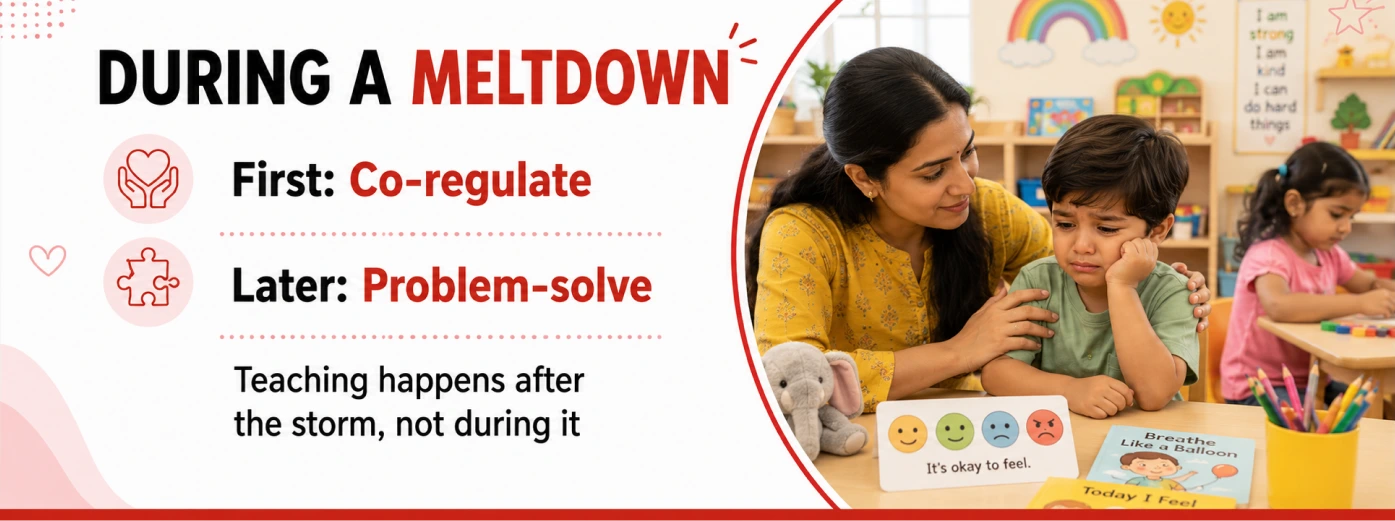
Neither approach advocates punishment in a moment of emotional flooding. A child who is in full dysregulation, screaming, unable to hear language, physiologically overwhelmed, is not available for a reason. They need co-regulation first. Physical presence. Calm. Sometimes silence. The gentle parenting instinct to stay close and stay warm is correct here.
What comes after the storm is where authoritative parenting adds something. Once the child is regulated, breathing, present, able to hear, a brief, simple, connected conversation about what happened and what will be different next time. Not a lecture. Two sentences. Then it is done.
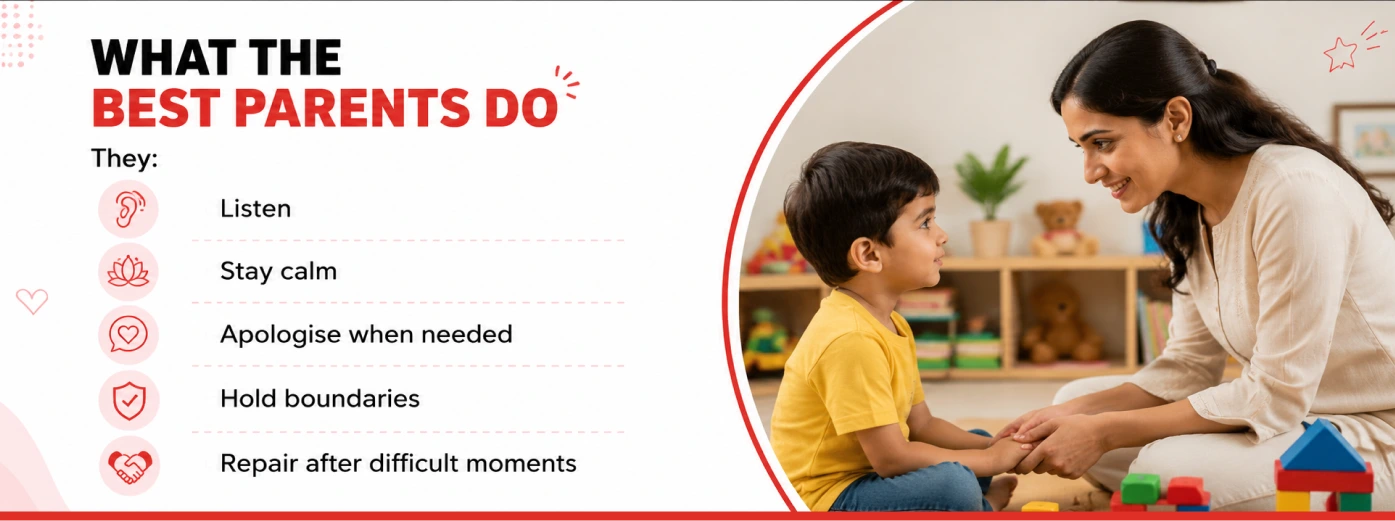
The repair after the rupture is where the most important learning happens. Not in the heat of the moment, but in the calm that follows, when a parent stays connected and helps a child make sense of what occurred.
Common Mistakes Parents Make with Both Parenting Styles
Gentle parenting’s trap is the belief that a child who never experiences frustration is a child who is being well-served. They are not. They are a child who is being protected from the very experiences that build resilience.
Authoritative parenting’s trap is rigidity, applying structure without genuine warmth, holding boundaries without genuine empathy, confusing consistency with coldness. A child who is held to clear expectations by a parent who does not seem to notice or care how they feel is not experiencing authoritative parenting. They are experiencing its hollow version.
Both traps are sprung by the same mistake: separating what should be held together. Warmth without structure. Structure without warmth. The research is consistent that neither, alone, produces the outcomes both approaches are trying for.
Which Parenting Style Is Best for Toddlers?
They do not pick a side.
The parents whose children develop most strongly are not the ones who have committed to a parenting philosophy and implemented it with ideological consistency. They are the ones who are genuinely present, who read their child, respond to their child, hold their child, and hold the line for their child, often all in the same afternoon.
They get it wrong sometimes. They repair it. They apologise when they lose their temper. They hold the boundary even when it is exhausting. They name the feeling even when they do not have the energy. They are not performing a parenting style. They are raising a person.
That is different. And it is the thing that no label, however thoughtfully designed, can fully capture.
How Dhruv Preschool Supports Emotional Development
We work in the space that both of these approaches are trying to occupy. Our classrooms are warm, genuinely, habitually warm, not performatively warm. Our teachers acknowledge feelings, name them, sit with children through difficult moments, and respond to distress with care and presence.
They also hold clear expectations. They are consistent. They follow through. They do not negotiate with a child who is testing a boundary, they support the child through the feeling and maintain the structure that makes the environment safe for everyone in it.
We also talk to parents about this. Not to tell them what to do at home, but because what happens at home and what happens in school are not separate conversations. A child whose home and school environments share the same values, warmth and structure, held together, consistently, is a child whose development has the most powerful foundation it can have.
If you would like to talk about how we approach behaviour and emotional development at Dhruv Preschool, come and visit us.