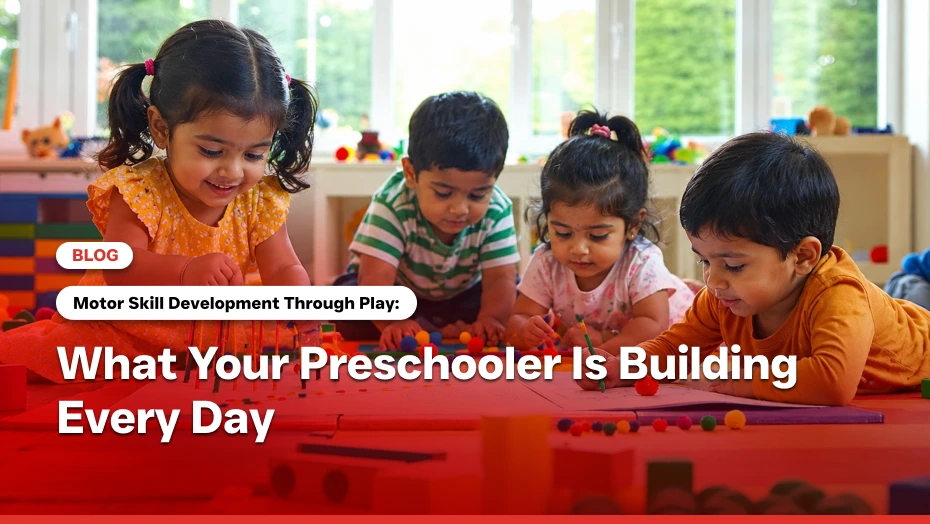
Watch a three-year-old for an afternoon and you will see someone who cannot sit still. They climb the sofa. They run in circles for no apparent reason. They pour water from one cup into another, over and over, with an expression of absolute concentration. They pick up a crayon and draw something they are deeply proud of that you will privately struggle to identify.
None of this is restlessness. None of it is random.
Every single one of those movements is work. Serious, developmental, neurologically significant work that is building the physical and cognitive foundations your child will rely on for the rest of their life. The climbing is building strength, spatial awareness, and risk assessment. The running is developing balance and coordination. The pouring is refining the fine motor control that will one day hold a pencil. The drawing is integrating hand, eye, and intention in a way that takes years to fully develop.
Play is not a break from development. For a preschool-age child, play is development. And motor skill development, the gradual mastery of the body’s capacity for movement, precision, and control is one of the most consequential things happening during those hours of apparently unstructured activity.
What Are Motor Skills? Understanding the Basics
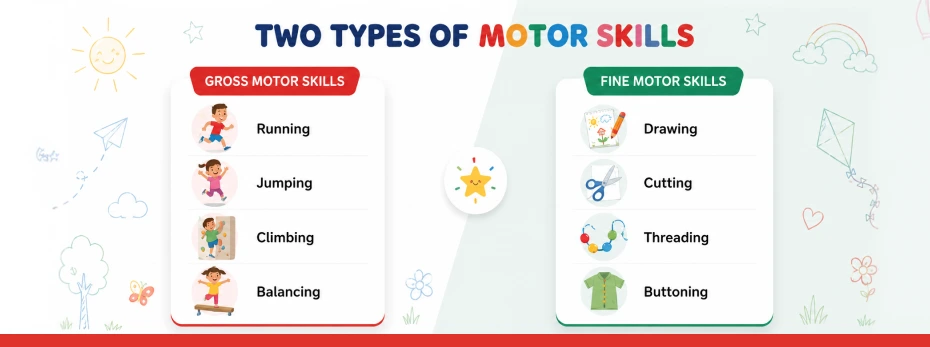
Gross motor skills involve the large muscle groups, the legs, arms, core, and back. Crawling, walking, running, jumping, climbing, throwing, catching, balancing. These are the movements that require the whole body to coordinate, that build strength and endurance, and that give a child physical confidence in the world around them.
Fine motor skills involve the small muscles of the hands and fingers and the intricate coordination between the hands and eyes. Holding a pencil, using scissors, buttoning a shirt, picking up a small object, manipulating playdough, threading beads. These are the precision movements that eventually underpin writing, drawing, self-care, and a vast range of practical life skills.
Both are developing simultaneously and continuously across the preschool years. Both are built primarily through play. And both are developing not just in the muscles themselves but in the brain in the neural pathways that connect intention to movement, that allow a child to want to do something and then coordinate their body to do it.
This is why motor skill development is not separate from cognitive development. It is part of it. Research consistently shows that children with strong motor skills tend to demonstrate stronger academic performance, better attention, and higher emotional regulation than those with underdeveloped motor abilities. The body and the brain are not distinct systems. They are one system learning to work together.
How Gross Motor Play Helps Children Grow
When your child runs across a garden, something remarkable is happening beneath the surface. Their cerebellum, the part of the brain responsible for balance and coordination, is calibrating the movement, making thousands of micro-adjustments per second to keep the body upright and on course. Their proprioceptive system, the body’s internal sense of where it is in space, is continuously updating. Their vestibular system, which governs balance, is being trained.
None of this can be taught through instruction. It is built through movement through falling and recovering, through reaching and missing, through the gradual, repetitive practice of using the body in increasingly complex ways.
Climbing is particularly valuable for this age group, which is why early childhood educators actively encourage it rather than restrict it. When a child climbs a frame, a tree, or a pile of cushions, they are planning a sequence of movements, assessing risk, building upper body strength, developing spatial reasoning, and experiencing the deep satisfaction of accomplishing something physically demanding. The controlled risk of climbing, the genuine possibility of falling is part of what makes it so developmentally rich.
Running, jumping, and skipping develop cardiovascular endurance, leg strength, and bilateral coordination, the ability to use both sides of the body in synchronised or alternating patterns. Skipping, specifically, is a developmental milestone that most children do not achieve until age four or five, and which requires a level of rhythmic bilateral coordination that represents a significant neurological achievement.
Throwing and catching build hand-eye coordination, depth perception, timing, and the ability to track a moving object and predict its trajectory. A child who cannot yet catch a ball is not failing, they are in the middle of a complex developmental process that takes years. Gentle, regular practice with soft balls, balloons, and beanbags builds the neural pathways gradually and without the frustration that accompanies harder, faster objects.
Balance activities, walking along a low wall, stepping on stones, using a balance beam, develop core strength, vestibular function, and the spatial confidence that allows a child to move through the world without fear.
How Fine Motor Play Prepares Children for School
Fine motor development is slower, quieter, and less immediately dramatic than gross motor development. It is also, in some ways, more consequential for the specific demands of formal schooling.
The ability to hold a pencil correctly, to form letters with control, to use scissors without frustration, these are the skills that children need for virtually every academic task in the early school years. And they are not built by practising pencil grip. They are built by years of play that develop the underlying hand strength, finger dexterity, and hand-eye coordination that pencil control requires.
Playdough is perhaps the single most effective fine motor activity available to preschool-age children, which is why it appears in every quality early years classroom. Squeezing, rolling, pinching, pressing, and shaping playdough builds the intrinsic muscles of the hand, the small muscles that control finger movement, in a way that is deeply satisfying and completely natural. A child who has spent years playing with playdough arrives at formal writing tasks with hand strength that a child without that experience simply does not have.
Threading and lacing, pushing a lace through a hole, threading beads onto a string, lacing a card, developing the pincer grip, hand-eye coordination, and bilateral hand use that underpin almost every fine motor task that follows. They also require patience, sequencing, and sustained attention, making them one of the most holistically developmental activities available to this age group.
Drawing and mark-making are the most direct precursors to writing, but their value extends beyond penmanship. When a child draws, they are translating an internal image or intention into a physical mark, a cognitively demanding task that requires the integration of visual memory, spatial reasoning, and motor control simultaneously. The child who draws constantly is not just making pictures. They are building the neural infrastructure for written communication.
Cutting with scissors is a skill that develops gradually across the preschool years and that parents often underestimate the complexity of. Using scissors requires bilateral coordination, one hand holding the paper, the other operating the scissors, as well as hand strength, fine motor control, and the visual tracking needed to follow a line. It is also, reliably, one of the activities that preschoolers find most satisfying when they begin to master it.
Construction play, building with blocks, Duplo, magnetic tiles, or found materials, develops spatial reasoning, grip strength, bilateral coordination, and the precision required to place one object carefully on top of another without toppling the structure. It is also, simultaneously, developing mathematical thinking, engineering intuition, and creative problem-solving. Construction play is one of the most densely educational activities available to young children, and it looks, to the casual observer, like just playing with bricks.

Why Outdoor Play Is Crucial for Preschool Development
The outdoor environment offers motor development opportunities that the indoor classroom simply cannot replicate and it is worth being specific about why.
Uneven terrain challenges the proprioceptive and vestibular systems in ways that flat indoor surfaces do not. A child walking across a garden, stepping over roots, navigating a slope, or balancing on a log is doing continuous, complex calibration of their movement systems. The variety is the point.
Natural materials, sticks, stones, mud, sand, water offer a sensory richness that manufactured materials rarely match. Digging in soil builds hand strength. Carrying a bucket of water develops bilateral coordination and core stability. Picking up small pebbles and placing them carefully refines the pincer grip. Rolling down a hill develops vestibular function and spatial orientation. None of this is incidental. All of it is developmental.
This is one of the reasons that quality preschools prioritise genuine outdoor time, not as a break from the educational day, but as one of its most important components.
Simple Ways Parents Can Support Motor Skill Development at Home
Let them do things themselves
Buttoning their own coat, carrying their own bag, pouring their own drink, spreading their own butter. These small acts of independence are motor skill practice wearing the clothes of everyday life. A child who is always helped with these tasks loses hundreds of small developmental opportunities each week.
Go outside every day
Not to a structured activity. Just outside, with room to move. Ride a bike, kick a ball, climb something, run for no reason. The daily accumulation of unstructured outdoor movement across the preschool years is one of the most powerful motor development investments a family can make.
Keep the art supplies accessible
Crayons, paint, clay, scissors, glue, available, not just on special occasions. A child who can choose to draw, cut, and construct at will is a child who is building fine motor skills at their own pace, driven by their own interest, which is always the most effective kind of practice.
Resist the urge to rescue
When a child is struggling with something physically demanding, the puzzle piece that will not fit, the zip that will not close, the tower that keeps falling, the instinct to step in is strong and loving. Resist it a little longer than feels comfortable. The moment of figuring it out, the effort, the frustration, and the eventual success is precisely the experience that builds both motor skill and the confidence to attempt hard things.
Get messy without apology
Mud, water, sand, paint, dough, the materials that children gravitate toward most instinctively are, without exception, the materials that build the most. The mess is not a side effect of the learning. It is evidence that the learning is happening.
How Dhruv Preschool Builds Motor Development Every Day
At Dhruv Preschool, motor development is not a subject on a timetable. It is woven through the entire day, in the materials we choose, the spaces we design, the outdoor time we protect, and the philosophy that guides everything we do.
Our classrooms are set up to invite fine motor activity at every turn. Playdough is always available. Art materials are at children’s height and in children’s reach. Threading, building, pouring, and cutting are daily possibilities, not occasional treats. Our outdoor space is used every day, in every season, because we know that the movement happening outside is as educationally significant as anything happening inside.
Our teachers understand that when they watch a child spend twenty minutes carefully building a tower only to knock it down and start again, they are watching someone do some of the most important work of their life. They do not interrupt it. They protect it.
Because that is what motor development through play looks like. Not impressive. Not dramatic. Completely ordinary, and completely extraordinary, every single day.
Come and see it for yourself. Visit Dhruv Preschool and watch what play is actually building.