If you have a toddler at home, you have probably asked this question at least once, maybe while handing over your phone to calm a meltdown, or while watching your child sit glued to a cartoon for the third episode in a row. How much screen time is actually safe? When does it go from okay to too much?
You are not alone. This is one of the most common worries parents have today. And it makes sense, screens are everywhere. Phones, tablets, televisions, laptops. Children see adults using them all day long. It can feel almost impossible to keep young kids away from screens entirely.
The good news is that you do not need to be perfect. But having clear, simple guidelines can help you make better choices for your child’s growth and development.
In this article, we break down the expert recommendations, explain why they exist, and give you practical steps you can use starting today.
Why Screen Time Matters More in the Early Years
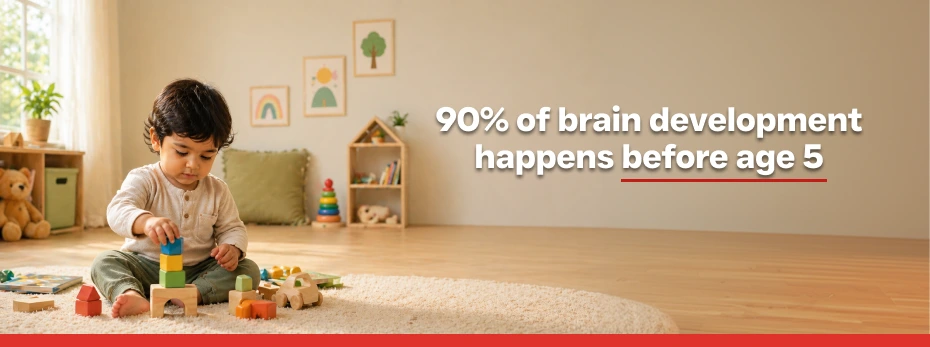
The first five years of a child’s life are when the brain grows the fastest. In fact, around 90% of brain development happens before the age of five. During this time, children learn by doing: touching, exploring, talking, playing, and interacting with the people around them.
When a child watches a screen, they are mostly passive. They watch, but they do not interact. They see faces, but those faces cannot respond to them. This is very different from a parent reading a book together, a caregiver explaining something in the kitchen, or a child building blocks with a friend.
This is not to say that screens are completely harmful. Quality content, used the right way, can support learning. But too much screen time, especially the wrong kind can get in the way of the real-world experiences that young children need most.
The Expert Guidelines: What Do They Say?
Two major health organisations: the American Academy of Pediatrics (AAP) and the World Health Organization (WHO) have published clear recommendations on screen time for young children. These guidelines are backed by years of research and are widely used by paediatricians around the world.
Here is a simple breakdown by age:
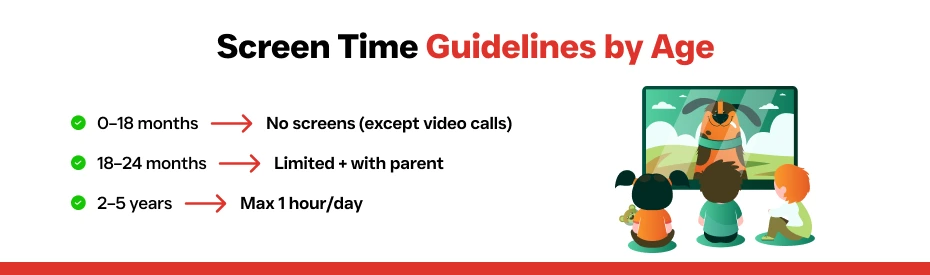
Under 18 Months — Avoid Screens (Except Video Calls)
For babies and very young toddlers, experts recommend avoiding screen time almost completely. The only exception is video chatting for example, calling a grandparent or a parent who is travelling. This is because video calls are interactive. There is a real person on the other side who can see the child, respond to them, and talk to them.
Everything else, cartoons, YouTube videos, even educational apps should be kept away from this age group. Babies simply cannot learn from screens the way they can learn from real life.
18 to 24 Months — Limited, High-Quality Content Only
If you want to start introducing some screen time around this age, it should be high-quality educational content and you should watch it with your child. Sitting together, explaining what is happening, and talking about what your child sees helps them actually absorb and understand the content. Without that, even “good” screen time offers very little benefit at this age.
Ages 2 to 5 Years — Up to 1 Hour Per Day
For preschool-aged children, the AAP and WHO both recommend a maximum of one hour per day of high-quality programming. On weekends, some experts allow a little more flexibility, up to two to three hours total but the weekday limit of one hour remains the standard recommendation.
Even within that one hour, the type of content matters. Educational shows, interactive stories, and age-appropriate content are much better choices than fast-paced videos or passive entertainment with no learning value.
What Counts as "Screen Time"?
This is something many parents find confusing. Not all screen use is the same.
Passive screen time is when your child simply watches without any interaction, cartoons playing in the background, YouTube videos on autoplay, or a show they zone out in front of. This type of screen time offers the least benefit and carries the most risk if it is overused.
Interactive screen time involves some level of engagement, a video call with family, an educational app where the child has to respond, or co-viewing where a parent watches alongside and asks questions. This type is considered more beneficial.
Background screen time is when a television or device is on in the room, even if no one is watching it. Research shows that background screens distract young children and disrupt their play, even when they are not actively looking at the screen. This is something many parents do not realise.
What Happens When Toddlers Have Too Much Screen Time?
Exceeding recommended screen time limits regularly is linked to several developmental concerns. Here is what the research shows:
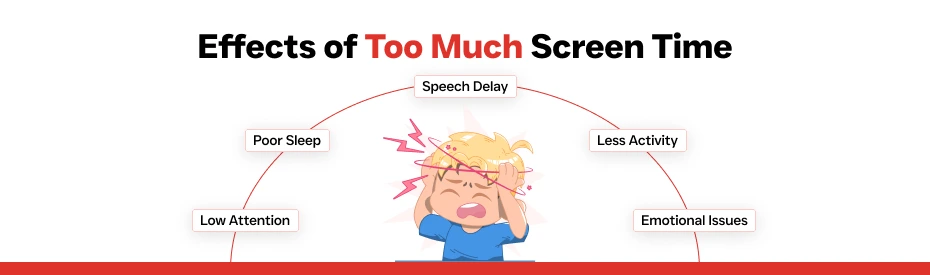
Delayed speech and language development: Children develop language by listening to and talking with real people. When screens replace those conversations, language growth can slow down. Studies have found that toddlers who watch more than two hours of screens per day are significantly more likely to experience speech delays.
Poor sleep quality: The blue light from screens interferes with the body’s natural sleep signals. Exposure to screens close to bedtime, especially in the hour before sleep makes it harder for young children to fall asleep and affects the quality of rest they get.
Shorter attention spans: Fast-paced videos and shows with rapid scene changes can make it harder for children to focus on slower, real-world activities like reading, drawing, or play. Over time, this can affect their ability to concentrate in school.
Less physical activity: Every hour spent in front of a screen is an hour not spent running, climbing, dancing, or playing. Physical movement is essential for motor skill development and overall health in the early years.
Emotional regulation challenges: Some studies suggest that excessive screen use particularly passive entertainment can affect how children handle emotions and social situations. Children may have more difficulty with frustration tolerance or waiting their turn.
Signs That Your Child May Be Getting Too Much Screen Time
Every child is different, but here are some signs to watch for:
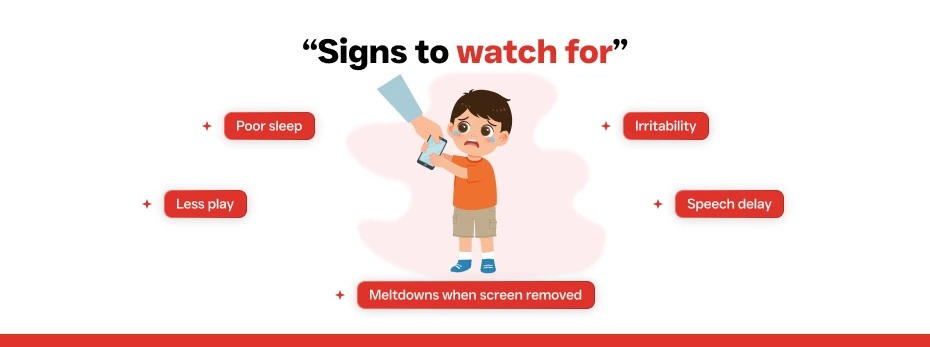
- They become very upset or aggressive when you turn off the screen
- They have trouble playing on their own without a device
- They are sleeping poorly or having trouble settling at bedtime
- They seem less interested in outdoor play, books, or physical activities
- Speech or communication seems slower than expected for their age
- They seem withdrawn or irritable after long screen sessions
If you notice several of these signs regularly, it may be worth reviewing your child’s daily screen habits and speaking with your child’s paediatrician if you have concerns.
Practical Tips to Manage Screen Time at Home
Set clear screen-free zones: Keep mealtimes and bedrooms screen-free. These two boundaries alone can make a big difference. Meals are an important time for conversation, and bedrooms should be spaces associated with rest and calm.
Create a daily routine: Children do better with structure. If your child knows that screen time happens at a specific time of day, for example, one episode after lunch, they are less likely to beg for it all day. Predictability reduces battles.
Watch together whenever possible: Co-viewing turns passive screen time into a learning moment. Ask your child questions about what they are watching. Talk about the characters. Connect it to real life. This simple habit dramatically improves the value of screen time.
Choose quality over quantity: Thirty minutes of a genuinely educational show is far better than two hours of fast-paced entertainment. Look for content that is age-appropriate, slow-paced, and encourages thinking, language, or creativity.
Keep screens off one hour before bedtime: This helps protect your child’s sleep quality. Replace that hour with a calming routine, a bath, a story, some quiet conversation. Children who have consistent bedtime routines tend to sleep better and wake up in a better mood.
Model good habits yourself: Children watch everything their parents do. If they see you constantly on your phone, it sends the message that screens are the most important thing in the room. When you are spending time with your child, try to keep your own device out of sight.
Offer engaging alternatives: Children reach for screens when they are bored or unstimulated. Keep a mix of activities available: colouring supplies, play dough, building blocks, simple puzzles, outdoor time, books. The more interesting their environment, the less they will miss the screen.
A Note for Parents
In India, many households have screens running throughout the day, news on television, phones being used for work, extended family video calls. This is part of normal life, and that is okay.
The key is to be intentional about your young child’s direct exposure. You do not need to achieve a perfect zero. But being aware of how many hours your toddler is actively watching and what they are watching puts you in a much better position to support their development.
India’s National Education Policy (NEP) 2020 also emphasises play-based learning and real-world exploration as the foundation of early childhood education. This is very much in line with what global health experts recommend about screen use, that hands-on, interactive experiences should always come first for young children.
The Bottom Line
Screen time is not the enemy. But like most things, it works best when it is used with care and intention.
Here is a simple summary to remember:
- Under 18 months: No screens, except video calls
- 18 to 24 months: Limited, high-quality content, always with a parent
- Ages 2 to 5: Up to 1 hour per day of quality programming
Beyond the numbers, remember that the best thing you can give your toddler is your time, your attention, and a rich environment to explore. No screen, no matter how educational can replace that.
If you have questions about your child’s development or screen habits, do not hesitate to speak with your child’s school or paediatrician. Early guidance makes a big difference.