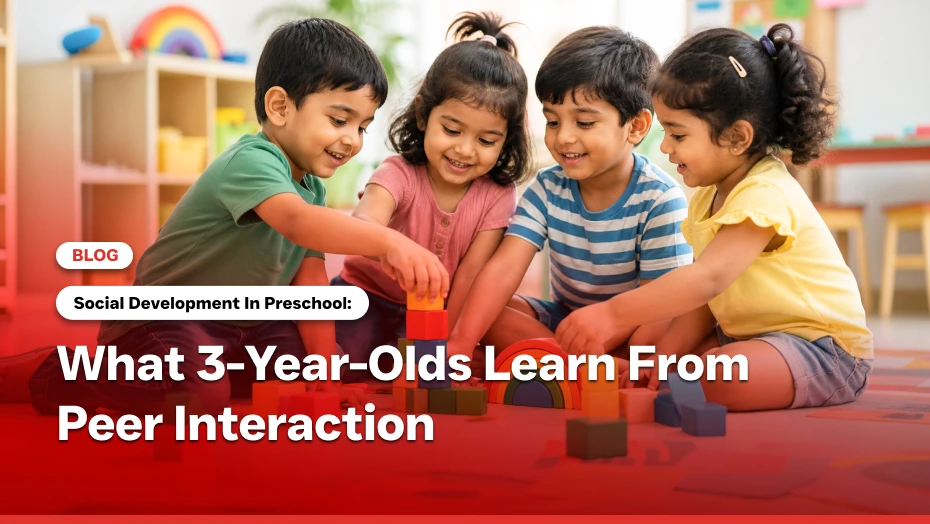
Watch two three-year-olds negotiate over a single toy truck, and you are watching something that looks like conflict. Watch more carefully, and you are watching something else entirely: two small humans working out, for perhaps the first time in their lives, how to want the same thing at the same time and survive it.
This is not a minor social moment. This is the preschool classroom doing what it does best, what no parent at home, no matter how attentive, can replicate on their own. Peers teach children things that adults simply cannot. The research is unambiguous on this point, and it has significant implications for how we think about preschool education.
The common parental instinct is to evaluate a preschool primarily on its academic preparation, does it teach letters, numbers, phonics? These things matter. But research from ScienceDirect, the NIH, and the University of Cambridge shows that the period between ages 3 and 5 is the most rapid period of social and linguistic development in the entire human lifespan. What children learn from other children during this window in ways that are invisible to the untrained eye, shapes their emotional health, language ability, and academic performance for years.
This blog explains what that peer learning actually involves, why it matters so much, what it looks like in everyday preschool moments, and what parents can do to support it at home.
Why Children Learn Social Skills Better from Peers Than Adults
Most of what children learn from their parents happens through a relationship that is, by its nature, unequal. The parent is older, bigger, more capable, more emotionally regulated, and deeply invested in the child’s wellbeing. This is exactly what a young child needs and it is also exactly why a parent cannot replicate the peer relationship.
A peer is the same size. A peer has the same limited patience. A peer wants the same toy. A peer does not automatically defer, does not automatically comfort, and does not automatically let the other child win. And this asymmetry, this equality of power, need, and emotional intensity is precisely what makes peer interaction the most challenging and most educational relationship a young child has.
Research published in ScienceDirect (2025) found that young children’s language and social skills are directly and significantly influenced by their peers, what researchers call ‘peer effects’. Bandura’s social learning theory explains one mechanism: a child who watches a classmate successfully ask for a toy using words and receives it, learns immediately that words work, often more effectively than watching an adult model the same behaviour, because the peer’s reality feels more directly applicable.
A 2022 longitudinal study from the University of Cambridge’s Play and Communication Lab followed children from age 3 to age 7 and found that stronger peer play ability at age 3 predicted significantly lower risk of both internalising problems (anxiety, withdrawal) and externalising problems (aggression, defiance) at age 7. The quality of peer play in preschool was a better predictor of mental health outcomes at primary school age than many other variables measured. In plain terms: how well your child plays with other children at 3 significantly affects how they do at 7.
Key Social Skills Your 3-Year-Old Is Developing at Preschool
Much of the social learning that happens in a preschool classroom is invisible unless you know what to look for. Here is a guide to the specific skills being built and what they look like in everyday moments.
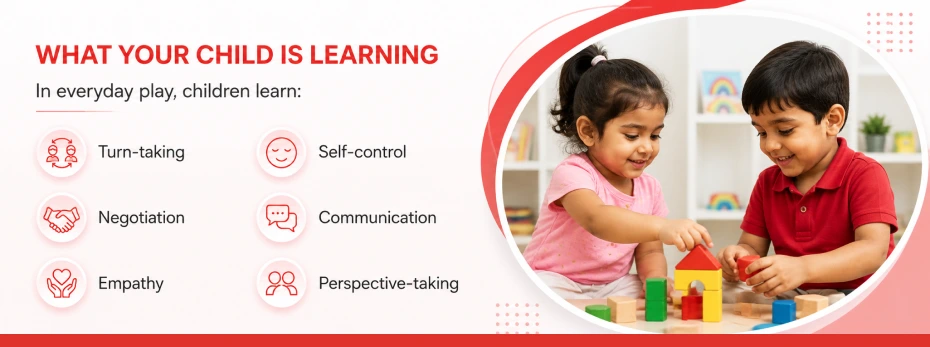
Every one of the skills in this table is being developed in a good preschool classroom every single day, not in explicit lessons, but in the messy, relational, joyful work of children simply being together.
The Six Things Your Child Is Learning Right Now
1. Turn-taking — the engine of social life
Turn-taking sounds trivial. It is not. It is the structural basis of conversation, collaboration, sport, music, and virtually every form of cooperative human activity. The NIH’s peer play research describes how at around age 3, children begin to shift from parallel play, playing side by side without interaction to cooperative play, in which a shared idea or goal requires coordination. This shift demands turn-taking as a basic operating principle.
A child learning to wait while a friend has the paintbrush is not just learning patience. They are learning impulse control, delayed gratification, and the idea that other people’s needs have equal standing to their own. These are the building blocks of every meaningful relationship they will ever have.
2. Conflict — not a problem, but a curriculum
Here is something that surprises many parents: conflict between children in a preschool setting is not a sign that something is wrong. It is, as NAEYC research describes, a primary mechanism through which young children develop emotional awareness, perspective-taking, and problem-solving.
Research from the Taylor & Francis journal (2025) identified the main conflict strategies used by 3–5-year-olds: insistence, negotiation, disengagement, and seeking adult help. The progression from insistence (“Mine!”) toward negotiation (“You can have it after me”) is not automatic. It happens through accumulated social experience, through children discovering, over hundreds of small encounters, that negotiation tends to work better than grabbing.
A skilled preschool teacher does not rush to resolve every conflict. They observe, they create the space for children to attempt resolution themselves, and they intervene when safety requires it but not before. This restraint is a teaching decision, not inattention.
3. Language — peers as the most powerful vocabulary teachers
A 2025 ScienceDirect study found that in preschool classrooms, children engage in more verbal interaction with peers than with adults. This is significant because peer conversation drives vocabulary acquisition in a specific and powerful way: children use more sophisticated language with each other than they would alone, and they pick up new words through the natural pressure to communicate clearly.
The American Academy of Pediatrics’ landmark paper on the power of play notes that children who play under minimal adult direction name three times as many non-standard uses for an object compared with children who are given specific instructions. Peer play, unscripted, child-led is one of the richest language environments available to a 3-year-old.
Parents in multilingual Pune households sometimes worry that their child’s vocabulary seems smaller than expected. A good preschool environment, where language flows freely across peers, often accelerates vocabulary significantly within a single term.
4. Empathy — built through experience, not instruction
You cannot teach a 3-year-old empathy the way you teach the alphabet. It does not work through explanation. It is built through accumulated social experience through the moment a child causes a peer to cry and sees their face, through the moment a classmate’s kindness makes them feel better after a difficult morning, through the gradual realisation that other people feel things too.
NAEYC research notes that children as young as just-turned-3 show a normative stance, they understand when rules have been violated, and they respond. This early moral awareness is the precursor to genuine empathy. The preschool classroom, with its daily negotiations, collisions, and reconciliations, is the environment where empathy is practised into competence.
5. Self-regulation — peer feedback as a mirror
One of the most underappreciated mechanisms of social learning is the social mirror effect: a child modifies their behaviour in response to how peers react to them. A child who shouts and sees their friend withdraw learns something through that withdrawal that a parent’s instruction cannot quite deliver. A child who shares and sees their friend’s delight learns something through that delight that no reward chart replicates.
This is why peer group composition matters in a preschool. Children regulate each other. A warm, engaged, generally prosocial peer group has a measurable positive effect on individual children’s self-regulation. It is not the only factor, teacher quality and classroom environment matter enormously but it is a genuine one.
6. Identity — who am I when I'm not with my family?
Perhaps the most profound thing a 3-year-old is working out in preschool is this: who am I when my parents are not here? What do other people think of me? What am I good at? What do I want? This identity formation, tentative, experimental, sometimes painful, is happening in every free play session, every group activity, every moment a child tests a boundary and watches what happens.
The preschool classroom is, for most children, the first social world they inhabit independently. Its quality, the warmth of the environment, the skill of the teachers, and the nature of the peer group shapes that first experience of the world beyond home. This is not small. It is the foundation on which everything social is built.
What Parents Can Do to Support Social Development at Home
The preschool environment cannot be replicated at home, but what happens at home matters too. Here is what research suggests makes the most difference.
Name social emotions precisely
Children who hear social emotions named accurately, “She looked hurt when you grabbed the book”, develop empathy more quickly than those who receive general instruction. Use the language of feelings in real moments, not in the abstract. When your child reports a conflict from preschool, resist the urge to take sides or immediately solve it. Ask: “How do you think they felt? What did you do?”
Let them solve their own peer problems with you nearby
Arrange small-group playdates, not just big parties
Talk about preschool in terms of people, not activities
Instead of “What did you do today?” try “Who did you play with? What were you playing? Did anything feel hard or fun?” The questions that prompt social reflection are more developmentally useful than those focused on activities or academic content. They also give you a far richer picture of your child’s inner social world.
How Dhruv Preschool Aundh Supports Social Development
At Dhruv Preschool in Aundh, Pune, we understand that the most important learning happening in our classrooms every day is not always visible in a worksheet or a performance chart. It is happening in the sandpit, in the role-play corner, at the art table, and during the moments between structured activities, where children are simply figuring out how to be together.
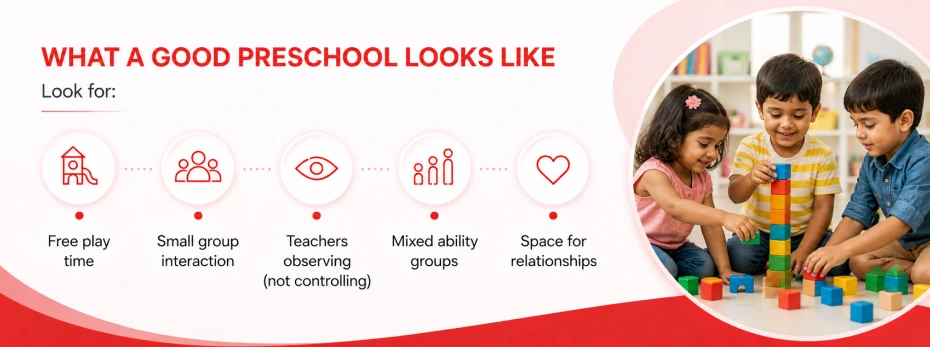
Our classroom environments are designed with this understanding at their centre. Children have meaningful periods of unstructured, child-led play every day, not as a break from learning, but as the primary vehicle for social development. Our teachers are trained to observe and facilitate these interactions rather than over-direct them, stepping in with intention rather than reflex.
Class sizes are deliberately small because social development requires teachers who know each child’s social profile, who they gravitate toward, who they find challenging, when they are struggling, and when they are thriving. This is not possible in a room of thirty children. It is possible here.
We also maintain active, warm communication with parents about how their child is doing socially, not just academically. If a child is navigating a peer difficulty, a developmental transition, or a social milestone, we tell you. We believe that the preschool’s job is not simply to manage children for a few hours a day. It is to be a genuine partner in the most significant developmental period of their lives.
When you bring your child to Dhruv Preschool, you are not just choosing a safe place for them to spend the morning. You are choosing the peer group and environment that will shape their first experience of the social world. We take that seriously.
Final Thoughts
The next time you drop your child at preschool and they run toward the play area without a backward glance, resist the pang of loss for just a moment. Watch what happens instead. Watch them navigate toward a group. Watch them test a social move, a word, a gesture, a toy held out. Watch them process the response.
That child is not just playing. They are doing the most important developmental work of their life and they are doing it with their peers, in the space that good preschool education creates for exactly this purpose.
Preschool is not daycare. It is the first and most formative social education your child will ever receive. Choose it accordingly.