
Every year, lakhs of Class 11 and 12 students in India face the same challenge. On one side, there is school, attendance, homework, practicals, internal tests, and board exams. On the other side, there is the dream: engineering through JEE, or medicine through NEET.
Both feel urgent. Both feel important. And both can feel like they are pulling in opposite directions.
The good news is that they do not have to. With the right approach, students can do well in their board exams and build a strong foundation for JEE or NEET at the same time. It takes planning, consistency, and the right mindset. But it is very much possible.
This guide is written for students in Class 11 and 12, as well as for parents who want to support them through this demanding phase.
Why This Balance Feels So Hard
Before we talk about solutions, it helps to understand why so many students struggle.
The syllabus feels like two separate worlds: School exams often require detailed written answers, language papers, and practical work. JEE and NEET demand a different kind of thinking, mostly multiple-choice questions, speed, and application of concepts. Students feel like they are preparing for two very different tests.
Time is genuinely tight: A school day runs for six to eight hours. Add travel, homework, and basic rest, and a student is left with perhaps three to four hours of personal study time on weekdays. That time has to cover revision, coaching modules, and practice questions.
The competition is intense: The numbers are sobering. Over 15 lakh candidates appear for JEE Main every year. More than 22 lakh students appeared for NEET-UG in 2025. Available seats in top government colleges are limited. This pressure, when not managed well, leads to stress, burnout, and poor performance in both school and entrance exams.
But here is the most important thing to understand: the overlap between CBSE school studies and JEE/NEET is enormous. Students who recognise this stop treating school and entrance prep as two separate tasks and that changes everything.
The Hidden Advantage of Being a CBSE Student
If you are studying at a CBSE school, you already have a head start.
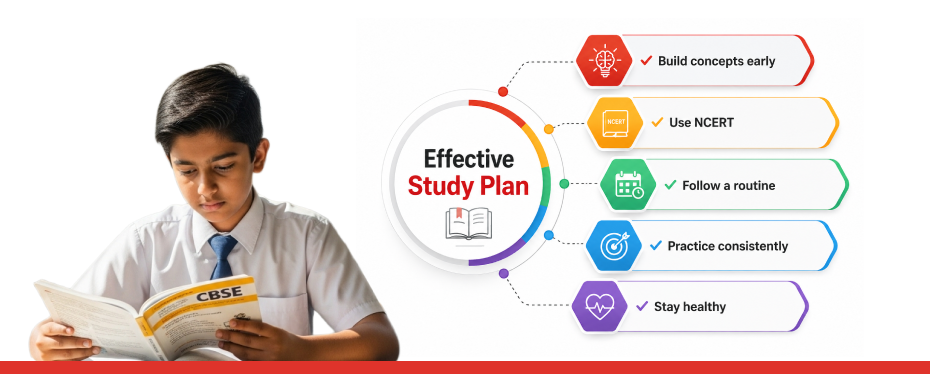
JEE Main and NEET are both based almost entirely on NCERT textbooks, the same books taught in CBSE classrooms across India. This means that a student who pays attention in class, understands concepts deeply, and studies NCERT thoroughly is not starting from zero when they begin entrance exam prep.
A student preparing from ICSE or a state board has to first bridge the gap between their syllabus and NCERT content and then prepare for the entrance exam on top of that. CBSE students skip that extra step entirely.
This syllabus alignment is one of the biggest reasons parents choose CBSE schools for children who are likely to pursue engineering or medicine. The foundation is already being built every day in the classroom.
The Two-Year Plan: Class 11 vs Class 12
Class 11: Build the Foundation
Class 11 is the year to go deep. The concepts introduced in Class 11: thermodynamics, organic chemistry, mechanics, cell biology are the building blocks for everything that follows. Students who rush through Class 11 and try to cram it all in Class 12 almost always struggle.
The priority in Class 11 is conceptual clarity over speed. Understand every topic thoroughly. Ask questions. Build your notes. Get comfortable with NCERT. At this stage, students should not be panicking about mock tests or ranks, they should be building the kind of understanding that will make Class 12 far easier.
This is also the right time to join a structured coaching programme, if that is part of the plan. Starting early means you have time to learn at a manageable pace, rather than rushing through everything in the final months before the exam.
Class 12: Balance Becomes Critical
Class 12 is where the real pressure arrives. Board exams and entrance exams both fall within the same academic year. This is where planning becomes non-negotiable.
The good news: CBSE has introduced biannual board exams from the 2025–26 session, where Class 10 students can appear twice and the best score is recorded. Similar flexibility is being extended progressively across grades. Additionally, the CBSE exam pattern is increasingly aligned with the competency-based format used in JEE and NEET, so strong entrance exam preparation actually improves board performance too.
In Class 12, the focus should shift to revision, practice, and mock tests while keeping school performance solid.
A Practical Daily Study Plan
Here is a sample structure that works for most students on school days. This is not a fixed rule, it should be adapted to individual sleep needs, school timings, and coaching schedules. But it gives a clear starting framework.
Morning (Before School — 5:30 to 7:00 AM)
School Hours
Pay attention in class. This sounds obvious, but many students zone out during school because they think coaching will cover everything. It will not. School teachers often explain concepts in ways that are surprisingly useful for entrance exams. Active listening during school saves hours of self-study later.
Where possible, complete homework or assignments during free periods, lunch breaks, or study halls. Every task finished at school is one less task at home.
Evening (After School — 5:00 to 9:00 PM)
This is the main study window. A good structure for this block:
- 60 minutes: New concept from JEE/NEET syllabus (whichever subject was weakest that day)
- 45 minutes: MCQ practice on the topic just studied
- 45 minutes: Revision of an older chapter
- 30 minutes: Error log — review wrong answers and note the correct logic
Take a 15-minute break after every 90 minutes of study. Short breaks improve focus and prevent mental fatigue.
Night (Before Sleep — 9:30 to 10:30 PM)
Keep this light. Go over short notes, formula sheets, or diagrams. Avoid starting heavy new topics at this hour. Sleep by 10:30 to 11:00 PM at the latest. Sleep is not optional, it is when the brain consolidates memory. Sacrificing sleep for study hours is one of the most counterproductive habits students develop during this period.
Weekends
Use at least one day of the weekend for a timed mock test. Sit the full test under real exam conditions, no phones, no breaks beyond what the actual exam allows. Spend 90 minutes after each mock test reviewing your answers, especially the ones you got wrong. This analysis phase is where improvement actually happens.
Smart Study Habits That Make the Difference
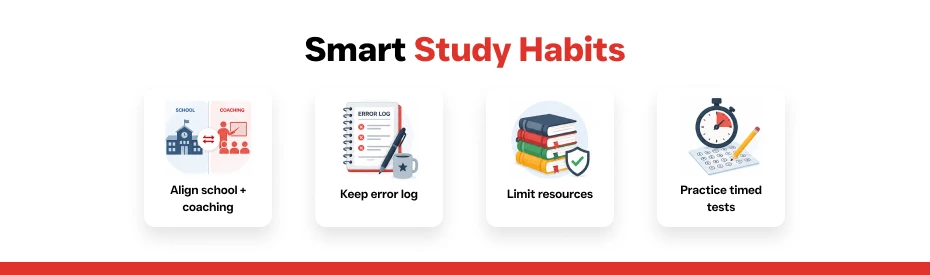
Align what you study at school with what you practice at home
When a topic is being taught in school, say, electrochemistry or human reproduction, use that window to go deeper on the same topic for entrance prep. Double coverage of the same concept at the same time is the most efficient use of limited hours.
Keep a single error log
Every time you get an MCQ wrong, write it down in a dedicated notebook. Include: the correct answer, why you got it wrong, and the concept behind it. Review this log every week. Students who do this consistently see faster improvement than those who simply move on to the next chapter.
Do not collect too many resources
One of the most common mistakes is buying or downloading too many books, PDFs, and online courses. NCERT plus one good reference book per subject is enough. The goal is depth, not breadth.
Practice under timed conditions regularly
Students who only study in a relaxed, no-pressure environment often underperform in the actual exam simply because they are not used to working against the clock. Build this habit early.
Managing Stress and Staying Well
This period is genuinely demanding. It is important to acknowledge that and plan for it, not just academically, but personally.
Physical activity is not a distraction from studying. It is what makes studying sustainable. Even 30 minutes of walking, sport, or yoga each day improves concentration, mood, and sleep quality. Many students who cut out all physical activity in the name of “more study time” find their performance drops, not improves.
CBSE has issued mental health guidelines specifically asking schools to support students through this period. Schools are required to offer career counselling, reduce unnecessary pressure, and integrate wellbeing practices into the school day. If you are feeling overwhelmed, speak to your school counsellor, a teacher you trust, or your parents. Carrying this pressure silently makes it much harder to manage.
It is also worth stepping back and thinking honestly about motivation. Students who are genuinely passionate about engineering or medicine have a natural reservoir of energy that keeps them going through hard moments. Students who are preparing for these exams purely because of family pressure or social expectation often find the two-year journey extremely difficult. If you are unsure, speak to your parents, counsellors, and teachers. Choosing the right path matters far more than choosing the popular one.
A Note for Parents
Your role in this period is enormous and it is not the role of a second teacher.
The most helpful thing a parent can do is create a calm, consistent home environment. Ensure your child gets proper meals, enough sleep, and some physical activity every day. Avoid comparing your child’s progress to others. Avoid adding to the pressure by talking about ranks, seats, and competition constantly.
The government has proposed capping coaching hours to two to three hours per day and aligning the Class 11–12 syllabus strictly with competitive exams, a signal that policymakers recognise the burden students currently carry. The direction of reform is clear: learning that sticks, not pressure that breaks.
What students need most at home is support, not surveillance. Ask how they are feeling. Celebrate small wins. Make sure there is space for rest and conversation, not just study schedules.
The Bottom Line
Balancing CBSE school studies with JEE or NEET preparation is not about doing twice the work. It is about doing the right work, in the right order, with clarity and consistency.
Start early. Build concepts in Class 11. Use your CBSE advantage, NCERT is your most powerful tool. Plan your time carefully, but leave room for rest. And remember: a student who is healthy, focused, and motivated will always outperform a student who is exhausted and anxious, regardless of how many hours they studied.
The two-year journey to JEE or NEET is long. Pace yourself, stay consistent, and trust the process.