
If you have a child in a CBSE school, April 2026 was a significant month, even if it did not feel like it yet.
The Central Board of Secondary Education released the revised curriculum for Classes 9 and 10 on April 2, 2026, and for Classes 11 and 12 a day earlier on April 1. On that same day, Union Education Minister Dharmendra Pradhan separately launched the AI curriculum for Classes 3 to 8. Taken together, these releases represent what many education commentators are calling the most significant overhaul of CBSE schooling in a decade.
Parents deserve more than headline summaries. You deserve to understand exactly what has changed, why it has changed, and most importantly what it means for your child’s education and future. This is that guide.
This blog makes the research-backed case for why extracurricular activities: music, art, and sport in particular are no longer supplementary to a good education. They are central to it.
The Foundation: Why Is CBSE Changing at All?
To understand the 2026–27 reforms, you need to understand what is driving them.
India’s National Education Policy (NEP 2020) was passed six years ago and promised a root-to-branch transformation of school education. The National Curriculum Framework for School Education (NCF-2023), the implementation blueprint for NEP, was published two years later. The actual curriculum changes in classrooms are only arriving now, starting academic year 2026–27.
The core argument behind both NEP and NCF is this: Indian school education has, for decades, over-rewarded memorisation and under-invested in reasoning, creativity, and real-world skill-building. The new curriculum is CBSE’s most concrete attempt to fix that not through minor tweaks, but through a structural redesign.
This is an important context. The 2026–27 changes are not arbitrary updates. They are the result of years of policy deliberation at the highest levels of India’s education system, and they carry a clear and coherent philosophy: move from rote learning to understanding, from information recall to skill application, and from a narrow academic pathway to a genuinely holistic one.
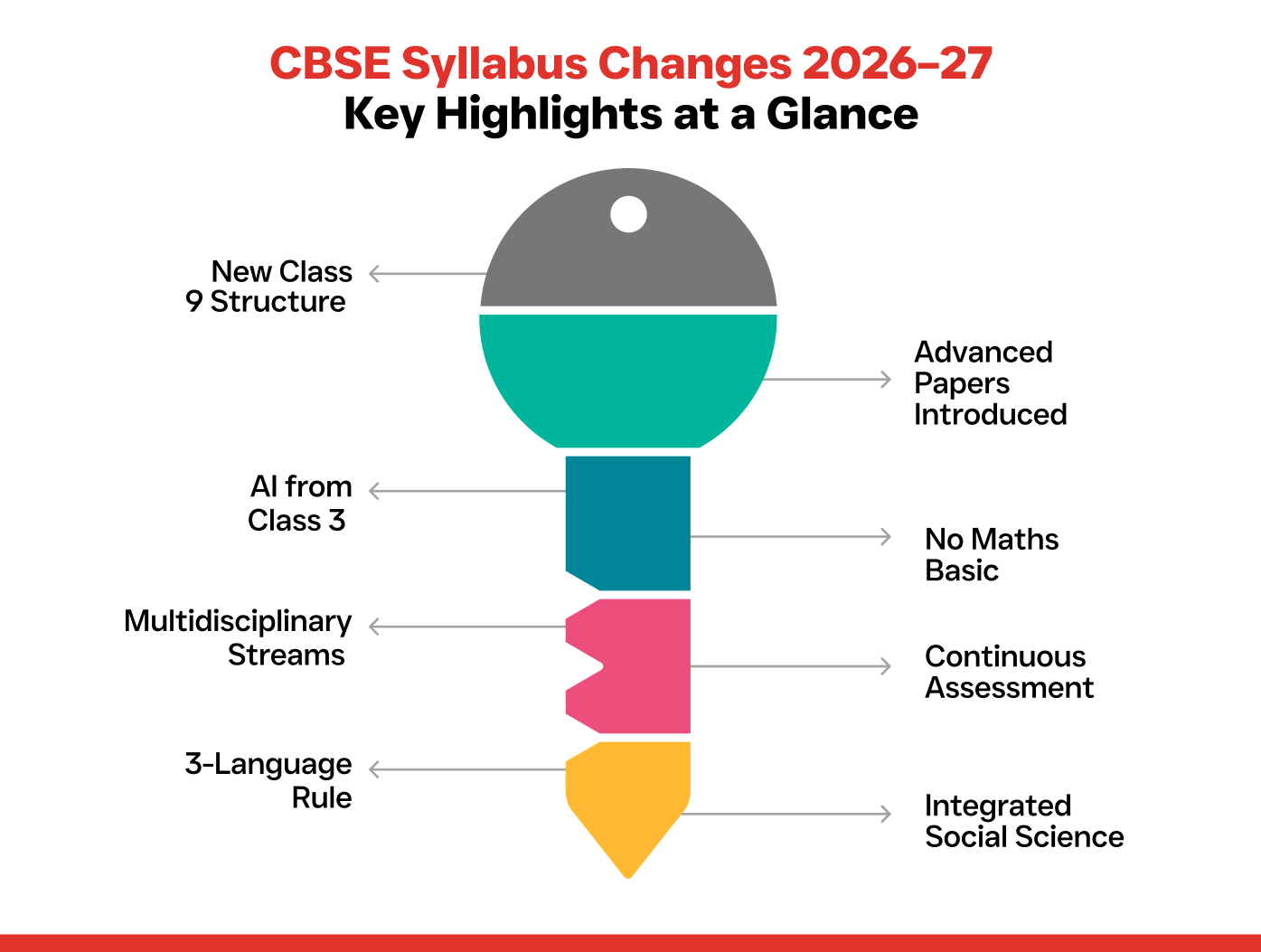
Change 1: A Completely New Structure for Class 9
The most significant impact of the new curriculum will be felt by students entering Class 9 and Class 11 in the 2026–27 session. The curriculum is no longer a collection of disconnected subjects but is now organised into a more integrated framework.
For Class 9 specifically, the curriculum is being divided into three distinct parts: Part 1 — Language Core, which focuses on communication and linguistic proficiency; Part 2 — Academic Core, which includes fundamental domains like Mathematics, Science, and Social Science; and Part 3 — Cross-Curricular Areas, which includes Vocational Education, Arts, Physical Education, and the newly introduced Interdisciplinary Areas.
A brand new subject called “Individuals in Society” has been introduced for Class 9. It covers individual rights and responsibilities, constitutional values, social issues, and interdisciplinary understanding, and will be assessed through school-based internal assessment only; there is no Board Exam for this subject.
Why does this matter? Because it signals a fundamental shift in what CBSE believes school is for. A subject on individual rights and societal responsibilities, assessed continually rather than in a high-pressure exam, tells us that CBSE is taking seriously the idea that schools must develop citizens, not just exam candidates.
Change 2: The End of Maths Basic and the Rise of Advanced Papers
This is one of the changes generating the most conversation among parents and educators and it deserves careful explanation.
For the Class 9 cohort of 2026–27, Maths Basic is being discontinued. In its place, CBSE is introducing an optional Advanced paper in both Mathematics and Science.
The Advanced paper in each subject consists of 25 marks and lasts one hour, focusing on higher-order thinking and conceptual understanding, the kind of reasoning that JEE and NEET preparation demands. Critically, the advanced marks are not added to a student’s overall aggregate, so there is no risk in attempting it. Students who score 50% or above receive a separate notation on their Class 10 mark sheet, a signal to colleges and competitive exam coaching institutions.
Students can choose to take Advanced Maths, Advanced Science, both, or neither. NCERT is preparing additional learning material and higher-order questions for these tracks. The first board exam under this two-level system for Class 10 students will be held in 2028.
For parents planning ahead: if your child has aspirations toward engineering or medicine, the Advanced paper track is designed precisely for them, and starting that track from Class 9 makes strategic sense.
Change 3: Mathematics Gets Restructured — Spiral Learning Arrives
To promote “spiral learning,” several topics previously taught in Class 10 and 11, such as Arithmetic Progressions and Pair of Linear Equations have been moved down to the Class 9 syllabus.
Spiral learning is a well-established pedagogical principle: introduce concepts early, return to them at greater depth in subsequent years, so that understanding builds gradually rather than arriving all at once under exam pressure. This is how the best education systems in the world approach mathematics, and it is now embedded in the CBSE structure.
For parents, this means students entering Class 9 in 2026–27 will encounter some content that was previously only introduced in Class 10. This is not cause for concern, it is cause for ensuring your child has strong mathematical foundations from the middle school years.
Change 4: Social Science Becomes an Integrated Discipline
History, Geography, Political Science, and Economics will no longer be treated as separate silos. They are being integrated into a cohesive study of human society, with a strong focus on the Indian Knowledge System (IKS).
This change reflects a view that is well-supported by international research: when students understand how history, geography, economics, and civic life interact and influence each other, their understanding of each individual discipline deepens considerably. The world does not present itself in neat subject boundaries, and a curriculum that does not either is more honest and more useful.
The integration of the Indian Knowledge System is also significant. CBSE is signalling that the study of India’s civilisational heritage, traditional knowledge, and indigenous intellectual traditions is not peripheral, it is core.
Change 5: The Three-Language Formula Becomes Compulsory
A key pillar of the reform is the three-language formula, structured as R1, R2, and R3. CBSE has reiterated that at least two of the three languages must be Indian, in line with NCFSE 2023. The third language will be compulsory from Class 6 in the 2026–27 session and extended progressively to Class 10 by 2030–31.
English is not removed. What changes is its treatment: if a student is already studying two Indian languages at R1 and R2 levels, English can be studied as the R3 language.
CBSE has also expanded its language offerings, adding Santhali, Maithili, Dogri, and Konkani at the secondary level. There are now a total of 44 languages listed by the board.
Students currently in Class 9 will sit their first board exam under this three-language structure in 2028. The cohort starting Class 6 this year will be the first to sit the fully implemented three-language board exam in 2031.
For Indian families living abroad or in multilingual households, this change is particularly meaningful. CBSE is actively valuing linguistic diversity and cultural rootedness as educational assets rather than complications.
Change 6: AI and Computational Thinking — Now Mandatory from Class 3
This is perhaps the most forward-looking change of the entire reform package, and it is one that Dhruv Global School has been anticipating and preparing for.
CBSE has translated NEP 2020’s ambitions into action with its official Computational Thinking and Artificial Intelligence curriculum for Classes 3 to 8, released for Academic Year 2026–27. This is not an elective. This is not a pilot. This is the mainstream CBSE curriculum aligned with NCF-SE 2023, now embedded into Mathematics, Science, and Social Studies from Grade 3 onwards, evolving into dedicated AI literacy from Grade 6.
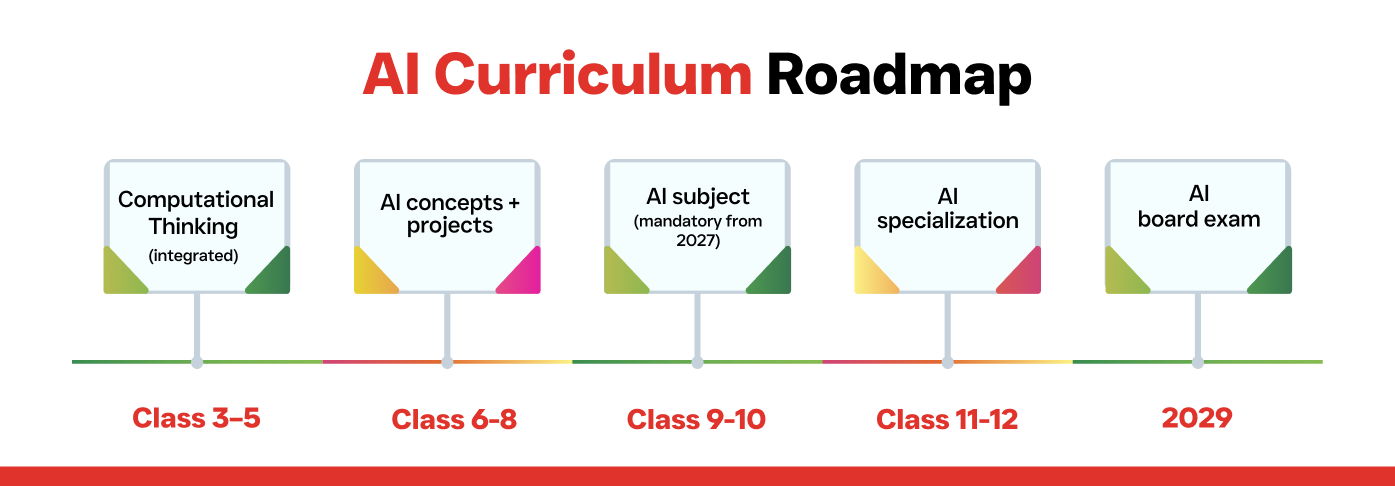
The approach is carefully structured to be age-appropriate. Computational Thinking will be interwoven into existing subjects for the youngest learners in Classes 3 to 5, not taught as a separate discipline. Children start learning logical sequencing through language exercises, problem-solving skills through environmental studies, and pattern recognition through science and mathematics.
As students progress to middle school (Classes 6 to 8), they begin exploring how AI actually works through interactive projects, transitioning from being technology users to critical thinkers. The curriculum becomes more specialised in secondary classes, with AI becoming a compulsory subject in Classes 9 and 10 from 2027–28. It then transforms into an elective specialisation in Classes 11 and 12, allowing students to explore machine learning algorithms and real-world applications.
AI becomes a compulsorily board-examined subject starting 2029, when today’s Class 6 students reach Class 10.
The expert committee developing this curriculum includes faculty from IIT Madras, MNIT Jaipur, NITTTR Bhopal, and Azim Premji University, among the most credible names in Indian technical and educational research.
Change 7: The Multidisciplinary Stream — Science + History Is Now Possible
One of the most liberating changes in the 2026–27 reforms is the dissolution of the rigid stream system that has defined Indian secondary education for generations.
The rigid boundaries between Science, Commerce, and Arts are being dissolved. A student can now choose to study Physics along with History or Economics, allowing for a more personalised and interest-driven academic path.
This matters enormously. For decades, students who loved both science and the humanities were forced to choose, often at the age of fifteen or sixteen, when most young people are not remotely ready to make that decision. The new framework recognises that the most creative and impactful professionals of the 21st century will be those who can think across disciplinary boundaries, the scientist who understands society, the economist who understands technology, the doctor who understands the humanities.
Change 8: Assessment Reforms — Reducing the Single-Exam Death Grip
There is a significant shift toward continuous evaluation. Internal assessments, including projects, lab work, and participation will now carry more weight, reducing the high-stakes pressure of a single year-end exam.
The exam pattern continues with an 80-marks theory component plus 20 marks for internal assessment, but with further increased emphasis on competency-based and application-driven questions. The question mix for assessments moves toward 40% competency-based questions, 20% objective (MCQs), and 40% short and long answers.
Through the National Credit Framework (NCrF), students will also earn credits for hours spent in sports, arts, and vocational training, making their report cards a “Holistic Progress Card” rather than a narrow academic transcript.
This last point deserves emphasis. A child who devotes serious time to classical dance, competitive chess, football, or community service will now have that recognised formally in their academic record. This is not just a nice gesture, it reflects a genuine shift in what Indian education is willing to value.
The Rollout Timeline: What Changes When
Understanding when each change takes effect is critical for planning:
Academic Year 2026–27 (now): New structure for Class 9 begins. CT and AI curriculum mandatory for Classes 3–8. Three-language formula mandatory from Class 6. Maths Basic discontinued for Class 9.
Academic Year 2027–28: AI and CT becomes a formal subject for Classes 9–10. New NCERT textbooks for Classes 10 and 11 introduced.
Board Exams 2028: First Class 10 board exam under the new structure. Optional Advanced Maths and Science papers available. Three languages are compulsory for appearing students.
2029 onwards: AI becomes a compulsorily board-examined subject for Class 10. Three-language formula progressively mandatory through to Class 10 by 2030–31.
What This Means for Students at Dhruv Global School
At Dhruv Global School, we have been closely tracking the NCF-2023 framework and the CBSE implementation roadmap throughout the policy development process. We are not waiting for change to arrive, we are already embedded in it.
Our curriculum teams have mapped every subject area to the new competency-based framework. Our teachers have undergone structured training on the new assessment philosophy and pedagogical approaches that competency-based learning demands. Our technology infrastructure supports the CT and AI curriculum requirements that are now mandatory, not optional. And our holistic programme, spanning academics, arts, sports, and community engagement means our students are already building the kind of Holistic Progress Card that CBSE is now formalising.
For students entering Class 9 at Dhruv Global School in 2026–27: you are the first cohort to experience the full weight of India’s most ambitious educational reform in decades. That is not a burden, it is a significant privilege. The education you will receive is designed for the world you will actually inhabit.
Final thoughts
India’s CBSE has just made its most significant educational commitment in a generation. The 2026–27 reforms are ambitious, thoughtfully sequenced, and grounded in both domestic educational research and global best practices. They ask more of students, more thinking, more application, more breadth and they give more in return: more choice, more recognition of the whole child, and a curriculum that actually connects to the world students will graduate into.
The honest caveat that every informed parent should hold onto is this: the curriculum is only as good as its implementation. AI education that becomes just another memorisation exercise defeats the purpose. Vocational learning without proper lab infrastructure is a box-ticking exercise. The reform needs schools and parents who take it seriously.
Frequently Asked Questions
Class 10 students in 2026–27 are still largely following the previous scheme. The first board exam that fully reflects the new curriculum structure, including no Maths Basic, optional Advanced papers, and CT & AI as a formal subject will be held in 2028 for the Class 9 cohort entering this year.
No. English is not removed. It remains an available option as R1, R2, or R3 language. What changes is that at least two of a student’s three languages must be Indian languages.
The Advanced paper carries no risk, the marks are not counted in the overall aggregate. Students who score 50% or above receive a separate notation on their mark sheet. For students considering JEE, NEET, or other competitive pathways, attempting the Advanced paper is strongly advisable as early preparation and a distinguishing mark on the record.
The CBSE curriculum document explicitly mandates hands-on activities, games, and puzzles, not textbook memorisation as the required pedagogical approach for CT and AI. The quality of delivery depends on school implementation, which is why choosing a school that has genuinely invested in this curriculum matters enormously.
Compared to international boards like IGCSE and the American curriculum, CBSE is now moving closer to a skill-based, flexible learning model. The multidisciplinary stream choice, competency-based assessment, and AI integration bring CBSE meaningfully closer to the global educational mainstream.