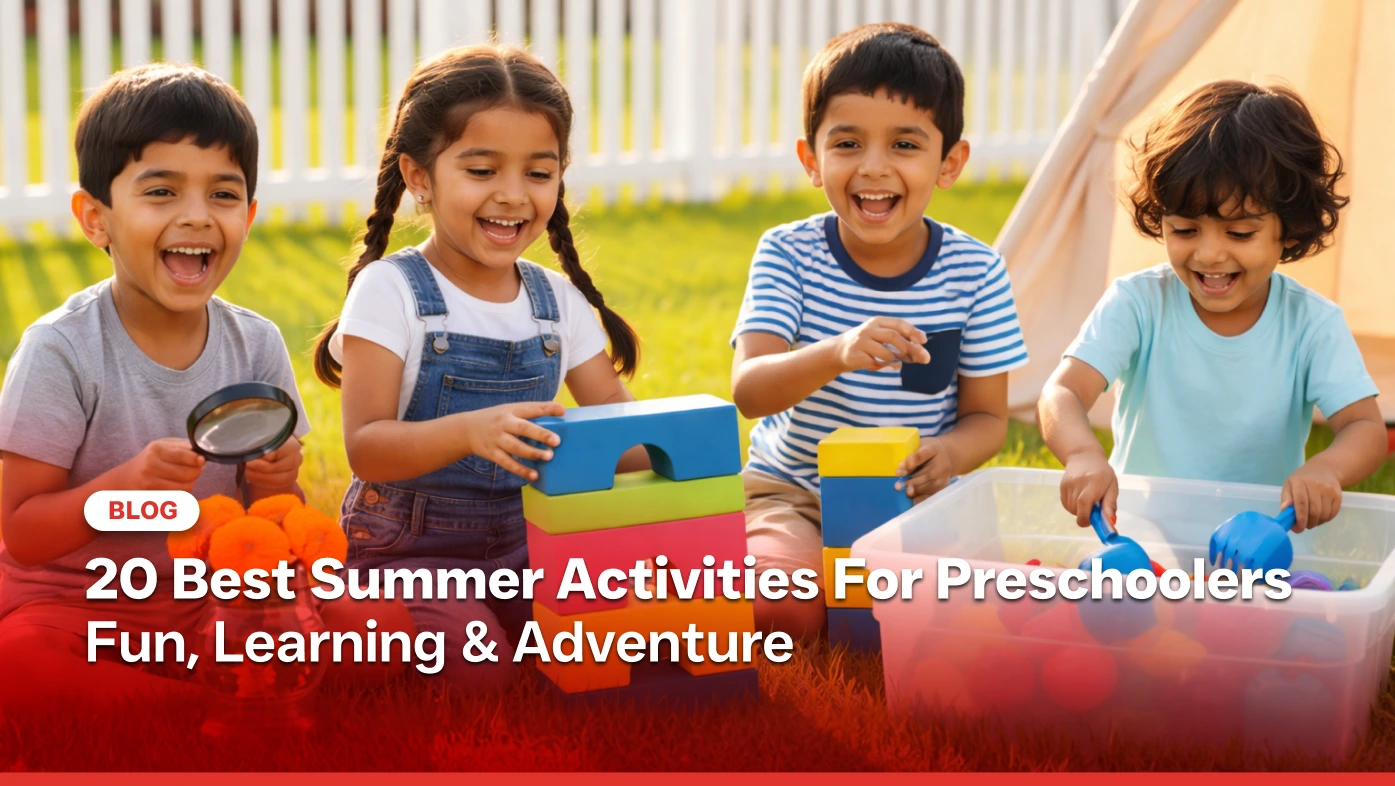
Summer is magical for young children. Long, unhurried days. No alarm clocks. Time to dig, splash, build, explore, and just be. But any parent of a preschooler knows that magic can quickly turn into mayhem without a little structure and inspiration.
The good news? The best summer activities for preschoolers don’t require expensive day camps or elaborate planning. What they do require is thoughtfulness and activities that genuinely engage young minds, build important developmental skills, and make children feel like every day holds something worth waking up for.
Why Summer Activities Matter for Preschool-Age Children
Before we dive into the ideas, it is worth understanding why intentional summer activity matters for children aged 3–5.
Research in early childhood development consistently shows that unstructured but stimulating play during the summer months supports language development, executive function, social skills, and physical coordination. The key word is stimulating, it does not mean structured like school, but it does mean offering varied, engaging experiences that challenge children to think, move, create, and connect.
Equally important is preventing what researchers call the “summer slide”, a documented regression in language, literacy, and numeracy skills that can occur when young children spend extended periods without any cognitive stimulation. The activities below are designed to be genuinely fun while naturally embedding the kinds of experiences that keep young minds sharp and ready for the year ahead.
Outdoor Summer Activities for Preschoolers
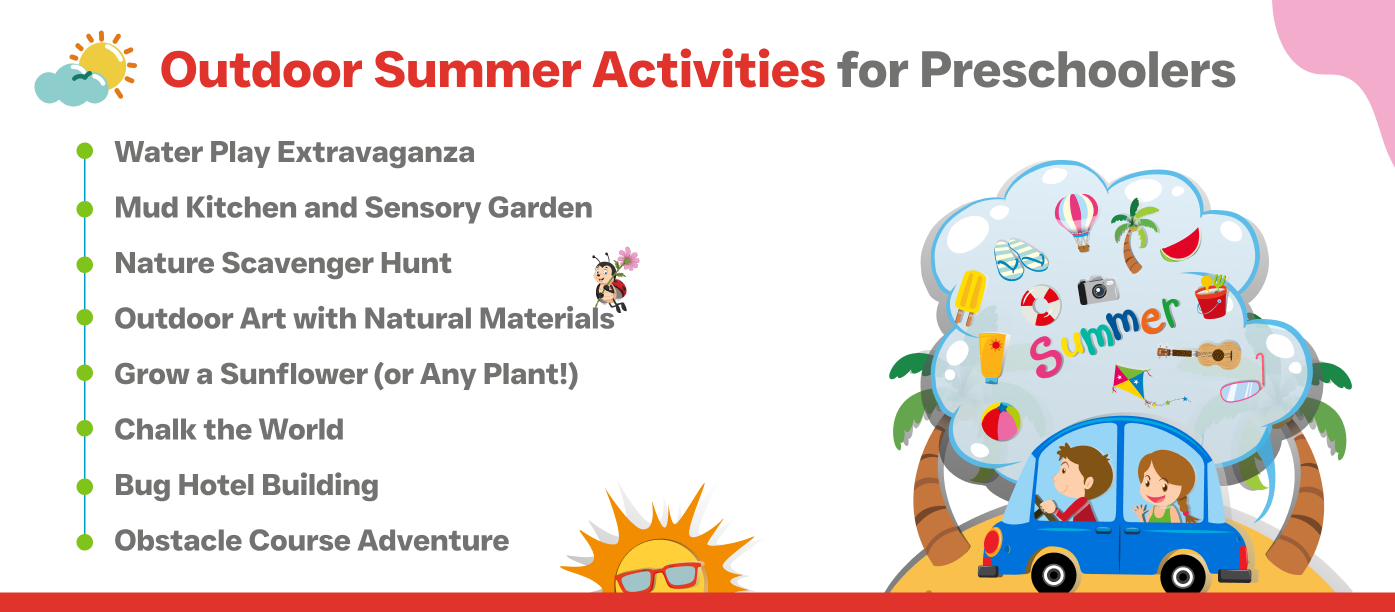
1. Water Play Extravaganza
Water play is the undisputed champion of summer activities for toddlers and preschoolers. Set up a simple water station in the garden, a large tub, some cups, funnels, sponges, and small toys and watch children spend hours in deep, joyful concentration.
Water play develops fine motor skills, early scientific thinking (Why does this float? Why does that sink?), and mathematical concepts like volume and capacity, all without a single worksheet. Add food colouring, ice cubes, or bubbles to extend the exploration in new directions.
Learning boost: Introduce vocabulary like pour, absorb, float, sink, full, empty to build language alongside the play.
2. Mud Kitchen and Sensory Garden
Give children an old pot, some spoons, soil, water, leaves, and flower petals and step back. The “mud kitchen” is one of the most powerful sensory play setups in early childhood education, and it costs almost nothing to create.
Children naturally engage in imaginative role play (cooking, serving, mixing “potions”), develop sensory tolerance, practise fine motor skills, and build scientific curiosity about materials, textures, and cause and effect. Yes, it’s messy. It is also magnificent.
3. Nature Scavenger Hunt
Create a simple picture-based scavenger hunt checklist, a leaf, a round stone, something yellow, a feather, an insect and head to a local park or garden. Scavenger hunts are brilliant summer learning activities because they combine physical movement with observation, language, counting, and sustained attention.
For preschoolers, keep the list to 6–8 items and use drawings rather than words. Celebrate every find enthusiastically. The sense of discovery and accomplishment is deeply satisfying for young children.
4. Outdoor Art with Natural Materials
Take the art table outside. Let children create with leaves, petals, sticks, mud, and stones, arranging them into pictures, patterns, or abstract creations on the grass, a large sheet of paper, or a garden paving stone.
Natural art develops aesthetic awareness, fine motor control, and creative thinking. It also introduces early mathematical concepts like symmetry, pattern, and geometry in a completely organic way.
5. Grow a Sunflower (or Any Plant!)
Planting, watering, observing, and waiting for a seed to sprout is one of the most profoundly educational experiences a preschooler can have. It teaches patience, responsibility, scientific observation, and the miracle of natural cycles, all wrapped in the very real excitement of watching something they planted actually grow.
Sunflowers are ideal: fast-growing, dramatic, and deeply satisfying. Let children be responsible for watering their plant each morning to build routine and ownership.
6. Chalk the World
A tub of sidewalk chalk and an outdoor surface is all you need for hours of creative, physical, mathematical play. Children can draw, trace body outlines, create hopscotch grids, draw roads for toy cars, make letter mazes, or simply express themselves freely.
Chalk play encourages gross motor movement, spatial reasoning, early literacy, and creativity and it washes away with the next rainfall, making it endlessly repeatable.
7. Bug Hotel Building
Collect sticks, pinecones, dry leaves, and hollow stems and stack them into a “bug hotel”, a simple structure that provides shelter for insects and garden creatures. This activity sparks deep curiosity about the natural world, introduces concepts of habitat and ecology, and gives preschoolers a genuine sense of environmental contribution.
Follow up with daily “hotel checks”, who has moved in? What can we see? to sustain inquiry over several weeks.
8. Obstacle Course Adventure
Use cushions, hula hoops, chalk lines, stepping stones, and garden furniture to create an outdoor obstacle course. Change it up every few days to maintain novelty and challenge.
Obstacle courses develop gross motor skills, body coordination, spatial awareness, and when children help design them, engineering thinking and creative problem-solving. They also absolutely wear children out in the most wholesome way possible.
Creative Indoor Summer Activities for Kids
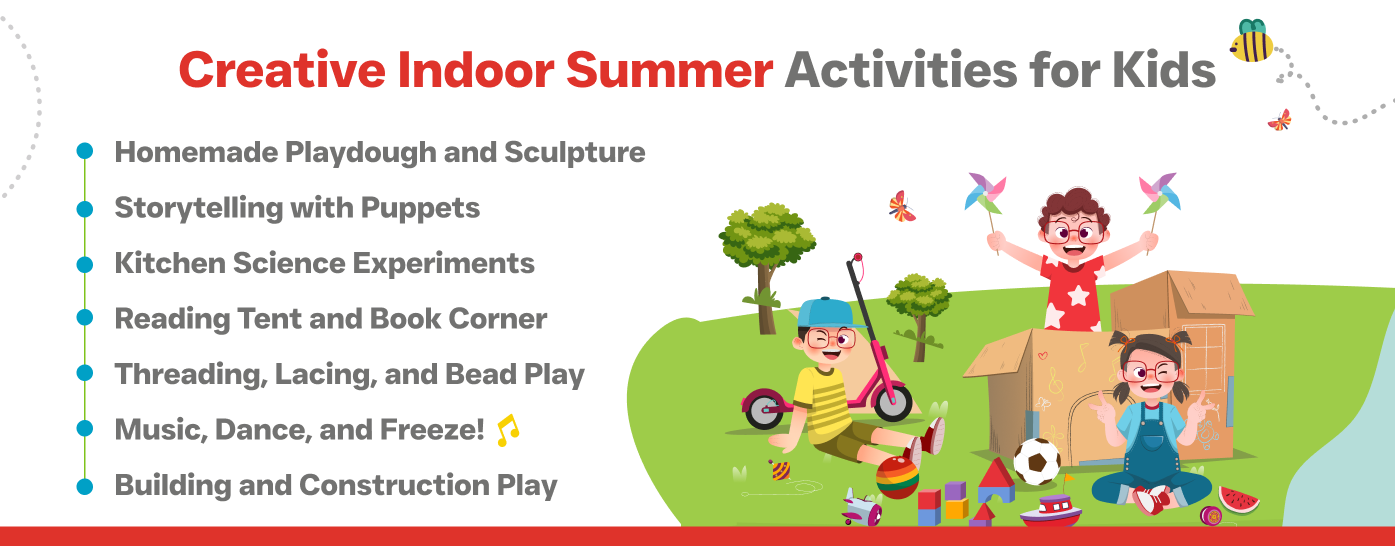
9. Homemade Playdough and Sculpture
Making playdough is itself a wonderful activity, measuring, mixing, and watching ingredients transform into a pliable material. Using it is even better. Playdough develops fine motor strength (critical for later writing), supports imaginative play, and provides the kind of calming sensory input that helps regulate children’s nervous systems.
Add natural items like shells, pebbles, sticks for texture exploration, or use seasonal colours to create summer scenes.
10. Storytelling with Puppets
Making and performing with puppets is one of the richest language development activities available to preschool-age children. Help children make simple sock puppets or paper bag puppets, then encourage them to create and tell their own stories.
Puppet play develops narrative structure, vocabulary, confidence in self-expression, and the ability to take another’s perspective, the root of empathy. It is also wildly entertaining for the whole family.
11. Kitchen Science Experiments
Baking soda and vinegar volcanoes. Celery absorbing coloured water. Raisins dancing in fizzy water. Ice melting in warm versus cold hands. The kitchen is a fully equipped science laboratory, and preschoolers are born scientists.
Simple kitchen experiments develop observation skills, vocabulary, hypothesis-forming (“What do you think will happen?”), and a lifelong love of scientific inquiry. Always narrate what’s happening in simple language and ask open-ended questions to maximise the learning.
12. Reading Tent and Book Corner
Create a dedicated summer reading space, a tent made from a sheet, a pile of cushions, some fairy lights and stock it with a rotating selection of picture books. Visit the library regularly to keep things fresh.
Daily read-aloud time is the single highest-impact activity for preschool language and literacy development. Children who are read to regularly enter school with significantly stronger vocabulary, narrative comprehension, and phonological awareness than peers who are not. Make it a summer ritual.
13. Threading, Lacing, and Bead Play
Threading large beads, lacing cards, and stringing pasta to make necklaces are beautifully simple activities that build the fine motor precision and hand-eye coordination children need for writing. They also naturally introduce patterning which is foundational mathematical thinking.
These activities are wonderfully portable too, perfect for keeping preschoolers engaged on long summer car journeys or while waiting in restaurants.
14. Music, Dance, and Freeze!
Put on a playlist of upbeat children’s music and dance. Play Freeze Dance when the music stops, everyone freezes in their funniest pose. Introduce instruments made from household objects: a drum from a pot, maracas from a jar of rice.
Music and movement develop rhythm, coordination, listening skills, emotional regulation, and social synchrony. They are also, quite simply, among the most joyful experiences childhood has to offer.
15. Building and Construction Play
Blocks, Duplo, magnetic tiles, cardboard boxes, and toilet roll tubes are all you need for open-ended construction play that lasts for hours. Building develops spatial reasoning, physics intuition, engineering thinking, mathematical concepts, and extraordinary persistence, especially when a tower falls and must be rebuilt.
Give children a challenge: “Can you build a house tall enough for this bear?” to add motivation and problem-solving purpose to the play.
Summer Learning Activities That Build School Readiness
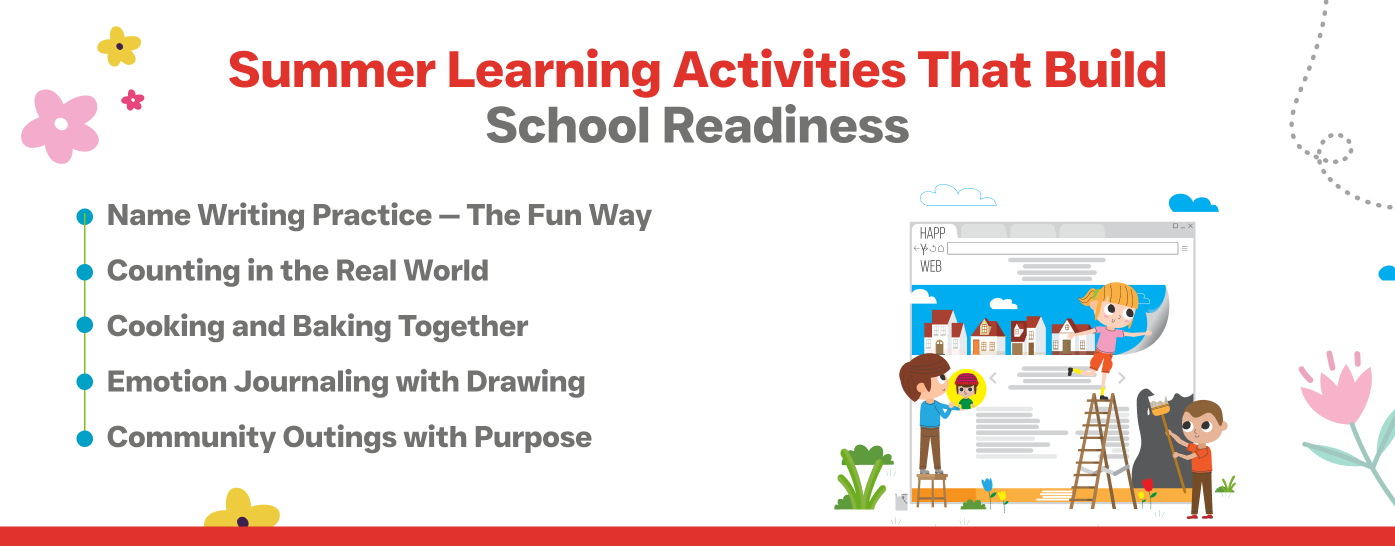
16. Name Writing Practice — The Fun Way
Practising name recognition and early writing doesn’t need to feel like homework. Write your child’s name in sand, shaving foam, or paint and let them trace it. Use magnetic letters on the fridge. Find their initial letter everywhere you go, on signs, menus, cereal boxes.
Making literacy feel like a treasure hunt rather than a task builds positive associations with reading and writing that are far more valuable than any formal exercise at this age.
17. Counting in the Real World
Count everything. Steps up to the front door. Strawberries in the bowl. Cars in the car park. Petals on a flower. Preschool-age children are in a critical window for number sense development, and the most powerful numeracy experiences happen not at a table with worksheets but in the rich, countable world around them.
Add simple comparison language: more, fewer, bigger, smaller, heavier, lighter to every counting moment to build mathematical vocabulary alongside number recognition.
18. Cooking and Baking Together
Involve preschoolers in simple cooking and baking, measuring ingredients, stirring, pouring, rolling, and cutting with child-safe tools. Cooking is one of the most naturally educational activities available to young children, embedding mathematics (measuring, counting, fractions), science (heat, mixing, transformation), language, and fine motor skills in a deeply purposeful context.
The satisfaction of eating something they helped make also builds confidence and a sense of meaningful contribution to family life.
19. Emotion Journaling with Drawing
Give each child a dedicated summer journal and encourage them to draw one thing from each day, something they saw, felt, built, or enjoyed. Ask them to tell you about their drawing and write their words underneath (or let them “write” in their own way).
Drawing journals build fine motor skills, narrative memory, emotional literacy, and a love of creative expression. By the end of summer, the journal becomes a treasured record of the season that children can return to again and again.
20. Community Outings with Purpose
The library, the farmers’ market, a community garden, a local bakery, a fire station, and purposeful community outings expose preschoolers to the wider world and build the social vocabulary, cultural knowledge, and sense of belonging that are just as important as academic skills.
Prepare children beforehand (“Today we’re going to the library, what do you think we’ll find there?”) and debrief afterwards (“What was your favourite thing? What surprised you?”) to maximise language and reflection.
How Dhruv Preschool Supports Summer Learning
At Dhruv Preschool, we know that the learning your child does at home during summer is a seamless extension of the learning they experience with us. That’s why we share seasonal activity ideas, reading lists, and home learning packs with every family at the end of each school year, ensuring that summer is enriching, not empty.
Our early years educators are always available to recommend age-appropriate activities, suggest books, and answer questions about how to support your child’s development during the holidays. Because we believe the partnership between school and family is one of the most powerful forces in a young child’s life.
Final thoughts
Summer is short. The preschool years are even shorter. The activities in this list are not just ways to fill time, they are investments in your child’s development, confidence, and love of the world that will pay dividends for years to come.
You don’t need to do all twenty. Pick three or four that feel right for your child and your family, do them with full attention and genuine enthusiasm, and let the magic happen.