
For decades, Indian parents have operated with an unspoken hierarchy: academics first, everything else later. Maths tuition on Monday. Science tuition on Wednesday. Football practice, if there is time left, if the exams are not close, if the teacher says it is okay.
This approach made a kind of sense in an earlier era. Jobs were more predictable. University admissions were almost entirely marks-based. The child who scored highest got the best opportunity. Full stop.
That era is ending. The skills that employers, universities, and the world now prize most: leadership, resilience, creative thinking, collaboration, the ability to perform under pressure are not built in a classroom where a child copies notes from a board. They are built on a football field, in a music room, at an art table, on a stage.
This blog makes the research-backed case for why extracurricular activities: music, art, and sport in particular are no longer supplementary to a good education. They are central to it.
What the Research Actually Says
The evidence on extracurricular participation has been accumulating for decades, and by now it is compelling. A landmark longitudinal study that tracked students from Class 6 through to age 25–26 found that adolescents who participated in prosocial, non-academic activities during school consistently showed the most positive long-term outcomes in career, in relationships, and in wellbeing.
A 2024 study published in Behavioural Sciences, drawing on OECD Social and Emotional Skills Survey data, found a robust link between participation in extracurricular arts and sports and the development of social and emotional skills in adolescents. Crucially, it also found a synergistic effect: students who participated in both arts and sports showed significantly greater social and emotional development than those who did only one.
A peer-reviewed study published in npj Science of Learning found that participation in extracurricular music and visual arts was positively associated with improvements in overall academic performance, not just in art and music subjects, but in Mathematics, Science, Social Studies, and Language as well. The more consistently students engaged with arts activities, the better they performed across the board.
This is not a coincidence. It is cause and effect. Music trains the brain to process patterns, hold sequences, and coordinate physical action with thought. Sport trains the nervous system to function under stress. Art trains sustained attention, spatial reasoning, and the tolerance for ambiguity that is fundamental to problem-solving. These are the very skills that academic learning builds on.
What Each Activity Actually Builds
Parents often think of extracurriculars as enrichment, a pleasant add-on for well-rounded children. But look at the skills each activity develops and you will see something different: a structured, rigorous programme of human development that complements academic learning in ways a classroom alone cannot.
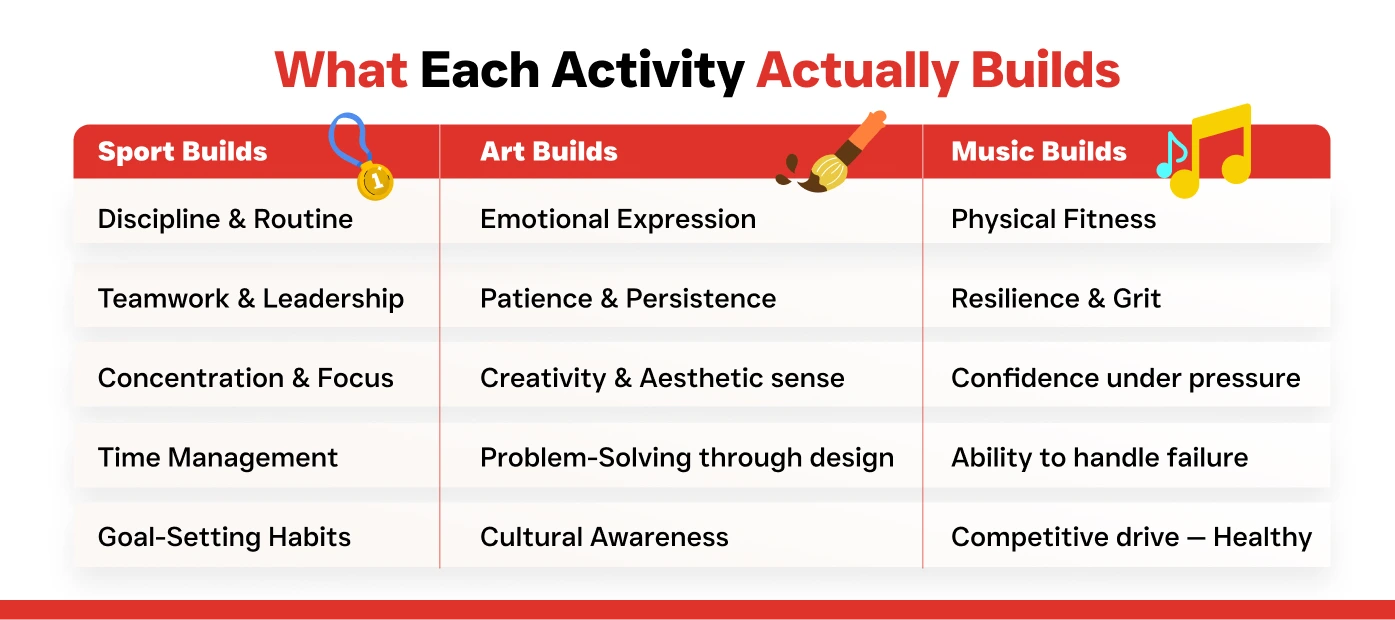
None of these skills show up in a Class 10 mark sheet. All of them show up in how a child handles their first job interview, their first major failure, their first leadership role. This is what holistic education means in practice, not a vague aspiration, but a deliberate investment in skills that take years to build.
The NEP 2020 Shift: India Is Officially Changing Course
India’s National Education Policy 2020 is the clearest signal yet that the country’s educational establishment has caught up with what the research has long shown. NEP 2020 explicitly calls for the integration of arts, sports, and vocational learning into the main school curriculum, not as optional extras, but as core components of holistic education.
The policy specifically states that sports, yoga, arts, crafts, and other co-curricular activities must be seen as integral to children’s development and that these should not be subordinated to academic subjects. Schools are being encouraged to ensure that every child has access to physical activity, cultural expression, and creative output.
Alongside this, India’s top universities are moving the same direction. Delhi University reserves 2.5% of its seats for sports excellence and another 2.5% for extracurricular achievement. IIT Madras was among the institutions that discussed a formal sports quota. IIMs evaluate personal interviews holistically and a student who has captained a team, performed on a stage, or exhibited their artwork communicates something about their character that a mark sheet simply cannot.
The message from India’s top institutions is consistent: they want students who have done more than study. They want evidence that a child has learned to lead, to fail, to persist, and to create.
The Academic Performance Myth and the Reality
The most persistent fear among Indian parents is this: if my child spends time on football or music, their studies will suffer.
The research consistently says the opposite is true with one important nuance.
Students who participate in extracurricular activities show, on average, higher grade point averages, better attendance, and stronger standardised test scores than peers who do not even when factors like family income and parental education are controlled for. This is because extracurricular participation builds time management, self-discipline, and the habit of sustained effort, all of which transfer directly into academic performance.
The nuance: this holds true for meaningful, consistent participation. A child who flits between twelve activities with no depth in any one gains less than a child who commits seriously to two or three. The benefit comes from the commitment, not from the quantity.
The real danger is not too much sport or too much music. The real danger is a child who does nothing but study and arrives at college never having learned to lose, to collaborate, to perform under pressure, or to find joy in something for its own sake.
What Indian employers and top colleges are actually looking for
- IIMs assess extracurricular achievements as part of their holistic profile evaluation, a candidate with significant sports or cultural achievements stands out in personal interviews.
- IIT Madras has discussed introducing supernumerary seats for sporting excellence, a recognition that physical and competitive achievement is a signal of character, not just talent.
- A 2024 survey of top Indian and multinational employers consistently cited communication, leadership, teamwork, and resilience as the most valued graduate attributes, all built through extracurricular participation, not in lecture halls.
What Good Extracurricular Provision Actually Looks Like in a School
- Are the activities genuinely resourced, trained teachers, adequate equipment, dedicated time in the timetable or are they an afterthought?
- Does the school treat these activities as important to the school’s identity, or are they quietly cancelled when exam pressure builds?
- Is there progression, can a student who is good at something go from interest to skill to excellence within the school?
- Does the school celebrate achievement in these areas with the same visibility as academic results?
- Are students given genuine performance opportunities at concerts, exhibitions, matches, competitions, not just practice?
How Dhruv Global School Lives This
At Dhruv Global School, the belief that extracurriculars are not extra is not a policy statement. It is the architectural reality of our campuses.
Across our Sangamner, Nande, and Undri campuses, we have built an infrastructure that makes this commitment visible: eight badminton courts, a football field with a 200-metre track, indoor table tennis facilities, a mini Olympic-size swimming pool, an auditorium, a dance and gymnastics hall, a recording studio, and dedicated music spaces. These are not aspirational additions. They are central facilities, used daily.
In 2023–24, our students earned 955 medals across academic, sports, arts, and cultural activities. This number is not a marketing figure. It is a record of children discovering what they are good at, being supported to develop it, and being given a stage to demonstrate it.
Our approach draws on Howard Gardner’s theory of multiple intelligences, the framework that recognises that a child who excels on a football field or in a music room is exercising a form of intelligence that is just as real and just as valuable as a child who excels in Mathematics. Our teachers are trained to recognise and nurture ability in all its forms, not just the forms that show up in mark sheets.
Yoga and physical wellness are also woven into daily school life, not as a separate programme, but as part of the yogic values framework that shapes how Dhruv students move through their day. The research on yoga, mindfulness, and academic focus is consistent: children who have structured physical and reflective practice are calmer, more focused, and more resilient in demanding academic situations.
The school year at Dhruv is not designed around exams with everything else fitted around the edges. It is designed around the full development of a child with academics, sport, music, and art each given the space, the time, and the seriousness they deserve.
Final thoughts
The word ‘extracurricular’ literally means ‘outside the curriculum.’ But if sport teaches resilience, music teaches discipline, and art teaches creative problem-solving, if these activities produce the very skills that universities want and employers need then calling them extra is no longer accurate.
They are not outside the curriculum. They are part of it. The curriculum just needs to catch up to what the research, and experience, have been telling us for years.
When you choose a school for your child, look at the sports fields and the music rooms as carefully as you look at the board results. Both tell you what the school believes a child is.