Choosing the right preschool for your child is one of the most meaningful decisions you’ll make as a parent. Walk into any early childhood education fair today and you’ll encounter a dizzying array of buzzwords: Montessori, play-based, structured, child-led, inquiry-driven. But what do they all actually mean? And more importantly, which approach is right for your child?
At Dhruv Preschool, we believe that informed parents make empowered choices. In this guide, we break down the three most popular preschool philosophies — Montessori, play-based, and traditional, comparing their methods, benefits, and potential drawbacks so you can find the perfect fit for your little learner.
What are the Three Major Preschool Approaches
What Is the Montessori Approach?
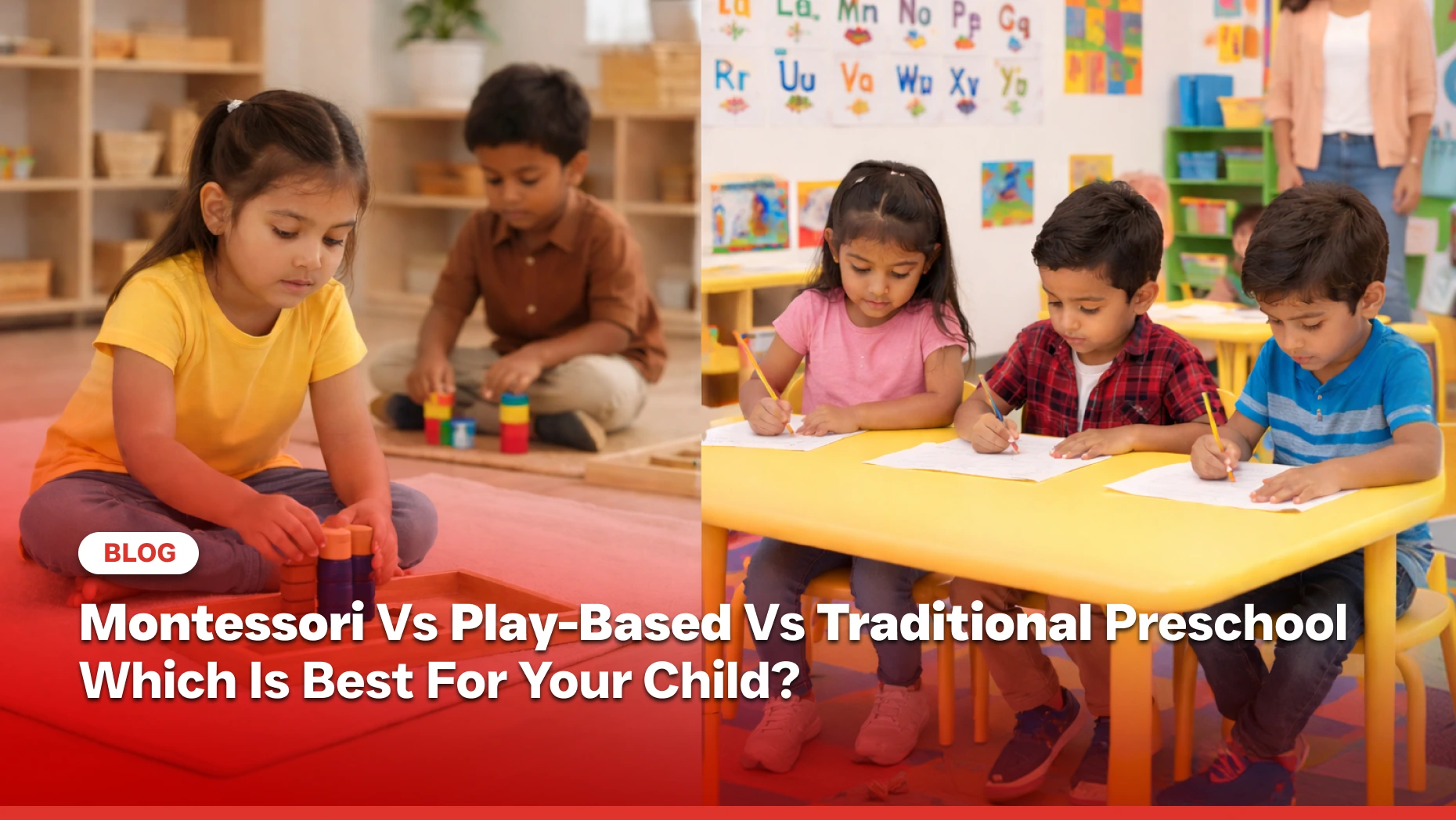
Key Features of Montessori Preschools
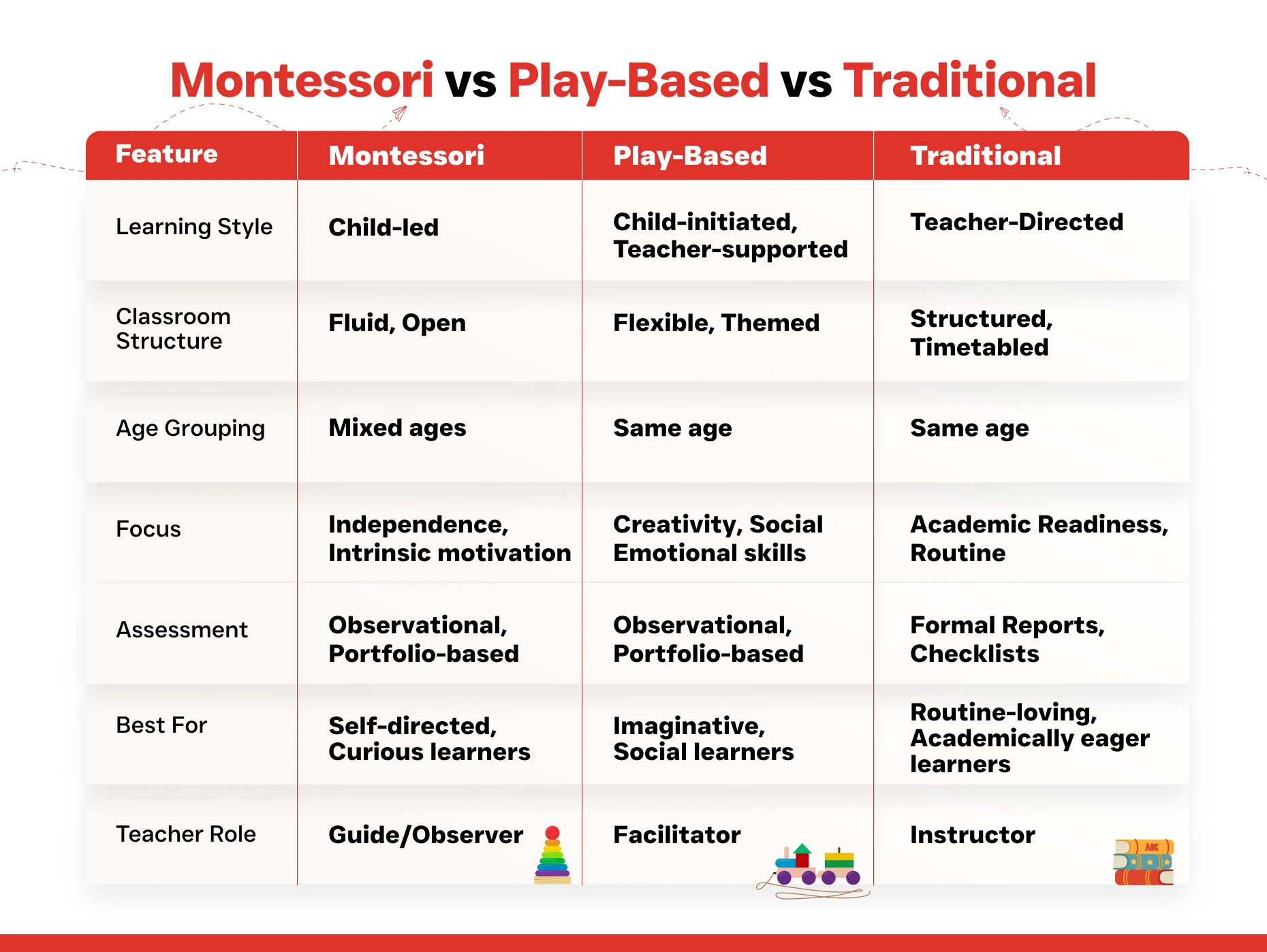
- Child-led learning: Children choose their own activities from a carefully curated set of materials. There are no rigid timetables.
- Mixed-age classrooms: Children aged 2.5 to 6 typically learn together, allowing younger children to observe and learn from older peers.
- Mixed-age classrooms: Children aged 2.5 to 6 typically learn together, allowing younger children to observe and learn from older peers.
- The prepared environment: Every object in the classroom has a purpose. The space itself is designed to invite exploration and independence.
- The role of the teacher: In Montessori, teachers are called “guides.” They observe, support, and gently intervene but rarely lecture.
Benefits of Montessori Education
Research consistently shows that Montessori-educated children develop stronger executive function skills, the ability to plan, focus, and regulate emotions than their peers in traditional settings. They also tend to demonstrate greater intrinsic motivation, a love of reading, and impressive social skills, partly because the mixed-age environment encourages mentorship and collaboration.
Children in Montessori settings often develop a deep sense of independence and self-confidence. Because they are trusted to make choices, they learn to own their learning journey from a very young age.
Potential Considerations
What Is Play-Based Learning?
Key Features of Play-Based Preschools
- Child-initiated and teacher-supported play: Children choose how to play, but teachers are actively involved, asking questions, extending thinking, and introducing new vocabulary.
- Dramatic and imaginative play: Dress-up corners, sand tables, water play, and building blocks all play central roles in the curriculum.
- Social and emotional learning: Play naturally encourages sharing, turn-taking, negotiation, and conflict resolution.
- Flexible, theme-based learning: Many play-based programmes weave learning across themes like “The Ocean” or “Community Helpers”, integrating language, maths, science, and art through play.
- Low stress, high curiosity: The emphasis is on enjoyment and exploration rather than performance or output.
Benefits of Play-Based Learning
Decades of research in early childhood development strongly support play as the primary vehicle for learning in the early years. Play develops language skills, creativity, problem-solving, and emotional intelligence simultaneously. According to the American Academy of Pediatrics, free and guided play is essential for healthy brain development in children under six.
Play-based settings tend to be warm, joyful environments where children develop a positive association with school and learning, a foundation that pays dividends throughout their academic life.
Potential Considerations
What Is the Traditional Preschool Approach?
Key Features of Traditional Preschools
- Teacher-directed learning: The teacher leads the class through lessons in letters, numbers, shapes, and colours.
- Structured timetables: The day is broken into defined periods: circle time, craft, outdoor play, snack time, literacy, and numeracy.
- Formal preparation: Traditional preschools often prioritise preparing children for the academic demands of primary school, including pencil grip, worksheet activities, and early reading readiness.
- Assessment and reporting: Children’s progress is more regularly tracked and reported to parents.
- Clear expectations: Children learn to follow instructions, sit still, and transition between activities, skills needed in a formal school setting.
Benefits of Traditional Preschool
Traditional programmes give children a clear preview of what formal schooling looks like. Children who attend traditional preschools often feel more “ready” for Year 1 in terms of knowing classroom routines and expectations. Parents frequently appreciate the structured progress updates and the tangible sense of what their child is learning each week.
For children who love routine and clear expectations, the traditional approach can feel safe and reassuring. Teachers are highly visible guides who offer direct support.
Potential Considerations
Critics of traditional preschool argue that a heavily academic approach is developmentally inappropriate for children under six. Young children’s brains are not yet wired for the kind of rote learning and sedentary instruction that structured classrooms demand. Over-emphasis on academic output at this age can sometimes lead to anxiety, a reduced love of learning, and burnout. Research by child development experts, including Dr. Peter Gray of Boston College, suggests that early academic pressure can have negative long-term effects on motivation and mental health.
So, Which Approach Is Best?
Here’s the honest answer: there is no single “best” approach. The right preschool philosophy depends on your child’s individual personality, learning style, and temperament, as well as your family’s values and goals.
Here are some questions to guide your thinking:
Choose Montessori if your child:
- Is highly independent and self-motivated
- Loves exploring materials at their own pace
- Is comfortable in less structured environments
- Thrives when given freedom and choice
Choose Play-Based if your child:
- Is imaginative, social, and communicative
- Learns best through exploration and creativity
- Needs emotional warmth and flexibility
- Would benefit from a joyful, low-pressure introduction to school
Choose Traditional if your child:
- Loves routine and predictability
- Responds well to direct instruction
- Is highly motivated by academic milestones
- Will be transitioning into a formal, structured primary school
How Dhruv Preschool Approaches Early Learning
At Dhruv Preschool, we understand that no child fits neatly into a single category. That’s why our early years curriculum is thoughtfully designed to blend the best elements of all three approaches, giving children the freedom to explore, the joy of play, and the structure they need to build strong foundations for future learning.
Our trained educators create warm, stimulating environments where every child is seen as a capable, curious individual. We combine Montessori-inspired independent exploration with rich play-based experiences and the gentle structure that prepares children confidently for their next academic step.
We invite you to visit our campus, speak with our educators, and see our learning philosophy in action. Because the best preschool isn’t just about the curriculum, it’s about the community, the care, and the spark it lights in your child’s eyes.
Final thoughts
The preschool years are among the most important in your child’s life not because of what they learn to read or count, but because of how they learn to feel about learning itself. A child who leaves preschool curious, confident, and kind is far better prepared for life than one who can recite the alphabet but dreads going to school.
Whatever approach resonates most with you, choose a school where your child will be truly seen, genuinely celebrated, and joyfully challenged every single day.
Frequently Asked Questions
Most children are ready for preschool between the ages of 2.5 and 3. The key indicators are an ability to separate from a parent, basic communication skills, and some level of toilet training, though many quality preschools support children through this transition.
“Better” depends entirely on your child. Montessori has strong research backing for long-term outcomes in executive function and intrinsic motivation. However, a child who craves structure may thrive more in a traditional environment. The best preschool is one that matches your child’s needs.
Yes. Research consistently shows that children from quality play-based programmes develop strong language, social, and problem-solving skills that serve them well in formal schooling. The widely-held fear that play-based children are “behind” academically is not supported by the evidence.
Absolutely. Many excellent preschools, including Dhruv Preschool draw on multiple philosophies to create a balanced, child-centred curriculum. In practice, the most effective early years programmes blend structured guidance with the freedom to explore and play.
Look for warm, responsive teachers who genuinely enjoy being around young children. Check that the physical space is safe, stimulating, and inviting. Ask about the daily routine, how they handle transitions, how they communicate with parents, and how they support children with different learning needs.