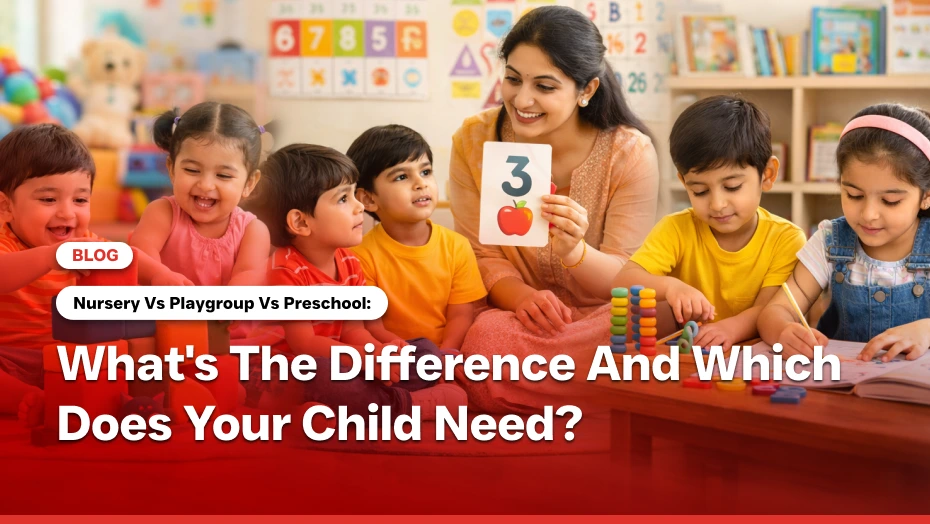
You want to enrol your child in a programme for the first time. You open a browser, start searching and immediately run into a wall of confusing terms. Playgroup. Nursery. Preschool. Play school. Junior KG. LKG. Pre-nursery. The same concept seems to have a dozen different names depending on which school website you are reading.
You are not imagining the confusion. These terms are genuinely inconsistent across India. Different schools, cities, and boards use them differently, which is exactly why so many parents feel unsure about which programme their child actually needs and when.
This blog cuts through the noise. It explains clearly what each stage involves, the typical age range, what your child gains from each one, and most importantly, how to decide which is the right starting point for your specific child.
Why the Early Years Matter More Than Most Parents Realise
Before we get into the labels, a brief but important point: the years between birth and age five are the most significant period of brain development in a human being’s entire life. By age two, a child’s brain has reached approximately 80% of its adult weight. By age five, it reaches 90%. During this window, up to a million new neural connections are forming every single second.
According to the National Association for the Education of Young Children (NAEYC), experiences in the first years of childhood affect the development of brain architecture in a way that later experiences simply do not. UNICEF India notes that quality early learning programmes directly improve cognitive, language, emotional, and social outcomes with benefits that last well into secondary school and beyond.
And here is the reassuring part: the fact that your child is distressed when you leave is a sign that a healthy attachment has formed between you. Children who have never formed strong bonds with a caregiver often do not cry at separation at all. The tears, as hard as they are to witness, are evidence that your relationship with your child is secure.
This is not to pressure parents into enrolling their child as early as possible. It is to say: the quality of these early learning experiences matters enormously. Which is why choosing the right type of programme at the right age, not just any programme is worth understanding properly.
Playgroup: The Gentle Beginning
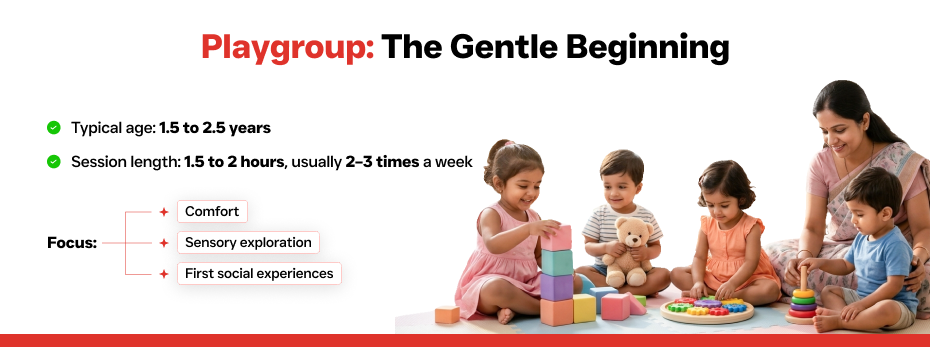
Playgroup is the earliest and most informal stage of early childhood education. It is designed for very young children, toddlers who are still deeply attached to their primary caregiver, who are just beginning to explore a world beyond home.
The word ‘learning’ in a playgroup context does not mean sitting at a table with worksheets. It means sensory play: sand, water, clay, music, movement. It means singing rhymes and clapping. It means sitting in a circle with other small children for the first time and discovering that other people exist and are interesting.
The most important thing happening in a playgroup is not academic at all. It is emotional. A toddler who learns that it is safe to be away from their parents for a short time so that the world does not end when mummy leaves the room is building the emotional foundation that all future learning depends on.
Sessions are short because the attention span and stamina of a child this age is limited. Two hours is genuinely enough. The goal is not academic output, it is the quiet, invisible work of building trust in a world outside home.
Is playgroup right for your child?
Playgroup suits children aged around 1.5 to 2.5 who show curiosity about other children, who have some basic language (even just a few words), and whose parents feel they would benefit from early socialisation. It is particularly helpful for children who spend most of their time at home with limited peer interaction.
It is not essential for every child. Some children who start directly at nursery at age 3 adjust perfectly well. But for a child who is shy, who has had very little experience of group settings, or who finds change difficult, playgroup can make the nursery transition significantly smoother.
Nursery: Building the Foundation
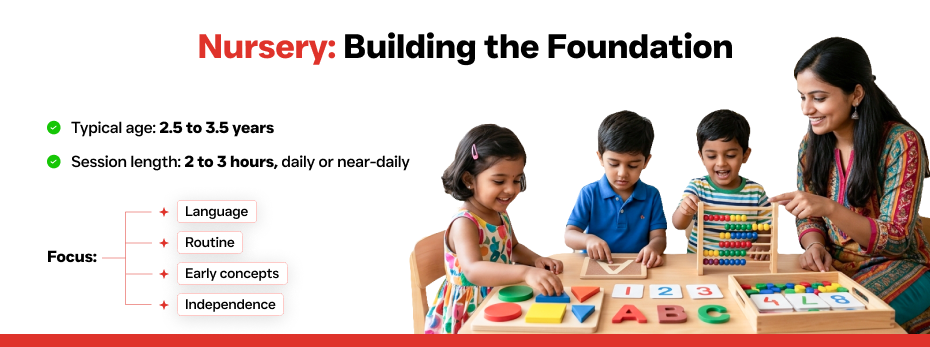
Nursery is the next rung up. Children at this stage are older, more verbal, more curious, and ready for more structure. Sessions are longer and more frequent. The environment still involves a great deal of play, but it is increasingly guided play: play with a learning intention behind it.
At nursery age, children are building vocabulary rapidly. They are learning colours, shapes, numbers, and the first concepts of letters, not through formal instruction, but through songs, stories, sorting activities, art, and conversation. They are also learning how to follow a routine: what circle time means, when snack happens, how to wait for their turn.
Emotionally, nursery children are navigating something significant: developing a sense of self that is separate from their parents. They are learning to express their needs to an adult who is not their mother or father, to negotiate with other children, and to manage small frustrations without immediately melting down.
An Indian birth cohort study published in Scientific Reports (2024) found that structured early childhood education exposure at this age was associated with significantly higher cognitive scores at both age 5 and age 9, even after accounting for socioeconomic factors. The benefits of quality nursery experience are measurable, lasting, and substantial.
Is nursery right for your child?
Nursery is generally the right starting point for a child aged around 2.5 to 3.5 who has not been to playgroup, or as the natural next step after playgroup. It suits children who are beginning to communicate in short sentences, show interest in other children, and can manage a brief separation from their parents.
If your child did not attend playgroup, that is completely fine, nursery works well as a first experience for most children in this age range. Give the settling-in period four to six weeks before drawing any conclusions.
Preschool / LKG: Preparing for School
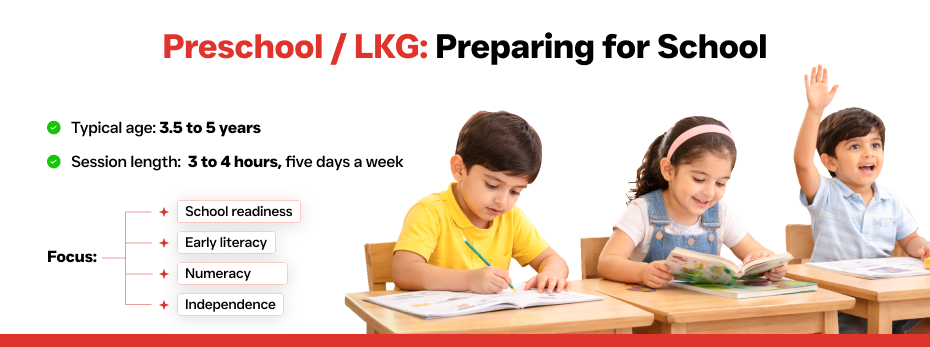
By preschool age, broadly 3.5 to 5 years, covering what is called Preschool, LKG (Lower Kindergarten), or Senior KG depending on the school, children are genuinely ready for more structured learning. They can sit and attend for longer periods, follow multi-step instructions, and engage in activities that require sustained focus.
The curriculum at this stage introduces pre-literacy skills: phonics awareness, recognising letters, understanding that print carries meaning. It introduces early numeracy: counting, patterns, simple addition through games and stories. It involves more complex art, drama, music, and storytelling. And it involves a great deal of collaborative and independent work.
Importantly, this is also the stage at which school readiness is built, not just academic readiness, but the habits and dispositions that determine whether Class 1 feels manageable or overwhelming. Can the child sit and focus? Follow a teacher’s instruction? Ask for help? Manage their belongings? Get along with classmates? These are the real outcomes of a good preschool year.
Is preschool / LKG right for your child?
A child aged 3.5 to 5 who has been through playgroup and nursery is typically well prepared for this stage. For children joining with no prior early education experience, most schools provide a settling-in period, and children of this age generally adapt faster than younger children.
The key readiness signs at this stage are: can your child communicate their needs, manage basic self-care tasks (going to the toilet independently, eating without assistance), tolerate a few hours away from home, and show interest in other children and in learning?
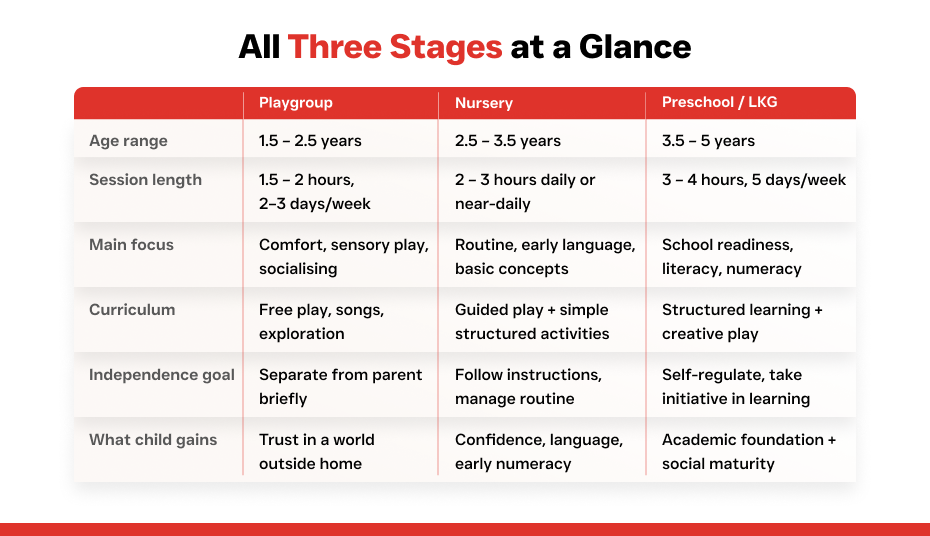
All Three Stages at a Glance
Age vs Readiness: Which Matters More?
This is probably the most important question in this entire blog. And the honest answer is: readiness matters more than age, but age gives you the most reliable guide to readiness.
Two children of exactly the same age can be in very different developmental places. One two-year-old may be highly verbal, confident in new environments, and genuinely ready for playgroup. Another may still be deeply attached, with limited language, and would benefit from waiting a few months.
The signs of readiness that matter most for any stage of early education are:
- Emotional: Can your child manage brief separations without prolonged distress?
- Social: Does your child show interest in other children, even if they do not yet know how to play with them?
- Communication: Can your child express basic needs, hunger, discomfort, wanting something, verbally or through gestures?
- Physical: Can your child walk confidently, manage basic self-care, and engage with objects through play?
- Curiosity: Does your child show interest in exploring new things and engaging with people outside the immediate family?
If your child meets most of these for their age stage, they are likely ready. If they are showing very few of them, it is worth waiting, a child who starts before they are ready will have a harder experience, and a harder start can colour their relationship with school for years.
A note for parents who feel pressured to start early
- There is a common anxiety in Indian urban families that 'starting late' will put a child behind. Research does not support this.
- A child who begins nursery at 3 years and 2 months, rather than 2 years and 8 months, does not end up behind. What matters far more is the quality of the experience, the warmth of the environment, and the child's emotional readiness when they start.
- Sending a child too early, before they are ready is far more likely to cause difficulty than waiting a few months longer.
A Quick Note for Multilingual Families in Pune
Many children in Aundh and across Pune grow up with Marathi, Hindi, and English all present in their daily lives. Parents sometimes worry that this multilingual environment will confuse their child or slow their early language development at playgroup or nursery.
It will not. As covered in our speech milestones blog, bilingual and multilingual children do not develop more slowly, they simply distribute their vocabulary across languages. A good preschool environment will welcome and support your child’s home language while gently expanding their English and Hindi alongside it.
Tell your child’s teacher which languages are spoken at home. This helps them respond to your child sensitively in the settling-in period, and it helps build a genuine home-school partnership from the very start.
How Dhruv Preschool Approaches Each Stage
At Dhruv Preschool in Aundh, Pune, we offer programmes across the playgroup, nursery, and preschool stages and our approach at each stage is specifically designed for the developmental needs of that age group, not just a version of the same thing made slightly shorter.
Our youngest children at the playgroup stage spend their time in a warm, sensory-rich environment where the primary goal is comfort. No child is rushed. No academic targets are set. The teacher’s job at this stage is to become a trusted adult, a person your child is happy to be with while you are not there. Everything else follows from that.
As children move through nursery and into preschool, the environment gradually introduces more structure: circle time, guided activities, group projects, and early literacy and numeracy but never at the cost of joy. We believe a child who loves coming to school learns more than any curriculum can teach them.
Our teachers are trained in early childhood development and in the specific needs of children across this age range. Small class sizes mean that every teacher knows every child individually, their temperament, pace, interests, and what they find hard. This is not a nice-to-have at this age. It is the foundation of good early education.
If you are unsure which stage is right for your child, we welcome you for a conversation before you make any decision. Bring your child. Watch how they respond to the environment. That is always the most reliable guide.
Final thoughts
Playgroup, nursery, and preschool are not just different names for the same thing. They are distinct stages, designed for distinct developmental needs, at distinct ages. Understanding which stage your child is ready for rather than simply which one fits the school’s age bracket is the most useful thing you can do before you enrol.
The single biggest mistake parents make in early education is focusing on the programme and forgetting about the child. Your child’s readiness is the most important variable in this decision. Not the school’s reputation, not what the neighbours are doing, and not how early other children in your building started.
Start when your child is ready. Choose a warm, play-centred environment. And trust that the first years, done well, set up everything that comes after.