Your child has spent an hour at the desk. The textbook is open, important lines are highlighted, and the notebook looks beautifully complete. Then, the next evening, you ask a gentle question about the chapter and receive a familiar answer: “I studied it. I just cannot remember.”
That moment can worry even calm parents. It is tempting to conclude that the child was distracted, careless or not working hard enough. Often, none of those things is true. The child may have spent time looking at information without practising the harder job of bringing it back from memory.
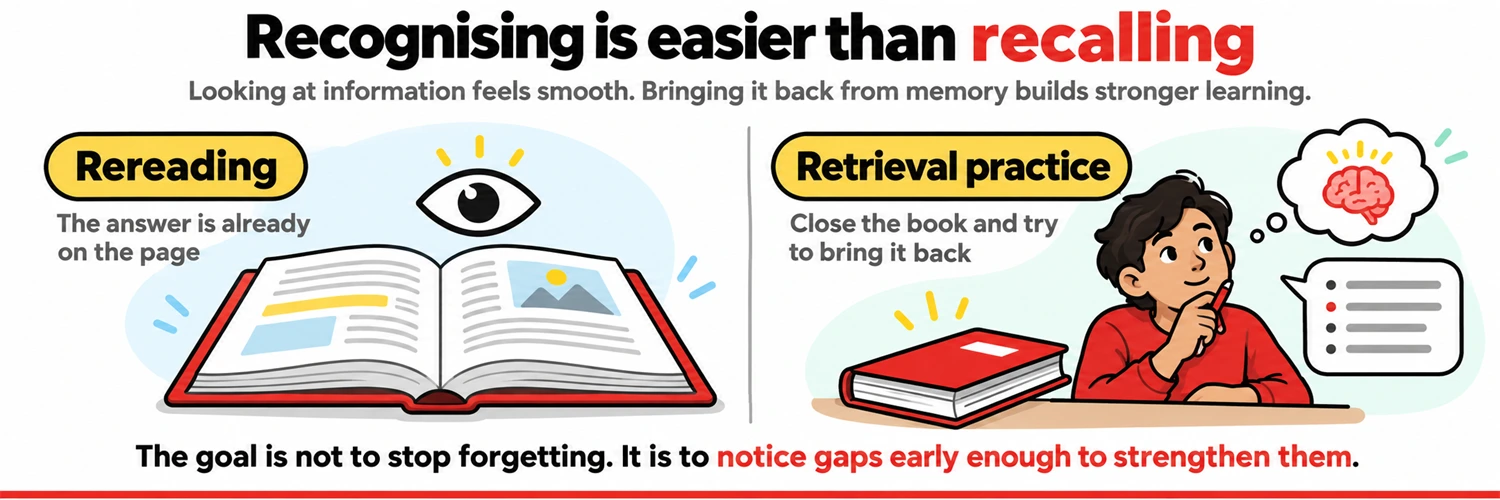
This difference matters. Reading notes again feels smooth because the answer is already in front of us. Remembering without the book feels slower and slightly uncomfortable. That discomfort is not always a warning sign. Used in short, manageable doses, it can be part of learning.
Quick answer
Children forget much of what they only reread because recognising information on a page is easier than recalling it independently. Retrieval practice means closing the book and trying to bring key ideas, steps or examples back from memory, then checking what was missed. Short recall attempts, spaced across several days and followed by calm feedback, can make revision more useful than a long night of rereading. It is not a test of intelligence. It is practice for remembering.
Why Do Children Forget What They Study?
Forgetting is not proof that learning failed. It is a normal part of memory. A child may understand a teacher’s explanation, follow a worked example and even answer questions while the chapter is open. But that does not automatically mean the information is ready to be used later without prompts.
Several ordinary factors can make the gap feel larger:
Recognition is mistaken for recall. A definition looks familiar when a child sees it, but familiarity is not the same as producing it unaided.
One long study session creates a false sense of mastery. Repeating the same page immediately can feel productive because it remains fresh.
Revision happens too late. If the first return to a topic is just before a test, the child has fewer chances to rebuild the memory.
The task is unclear. “Revise science” is a broad instruction. “Explain photosynthesis in four steps without looking” is a usable one.
Stress, tiredness and overload get in the way. A child who is exhausted may need sleep, food, movement or a shorter plan before they need another worksheet.
The important reframe is this: the goal is not to stop forgetting entirely. The goal is to notice what has faded early enough to strengthen it.
A helpful parent question: “What can you remember without looking?” is usually more useful than “Have you finished studying?”
What Is Retrieval Practice and How Does It Work?
Retrieval practice is the act of trying to recall learned information from memory. It can be a two-minute oral explanation, a blank-page summary, a small set of flashcards, a low-stakes quiz, or one worked problem completed without checking the method first.
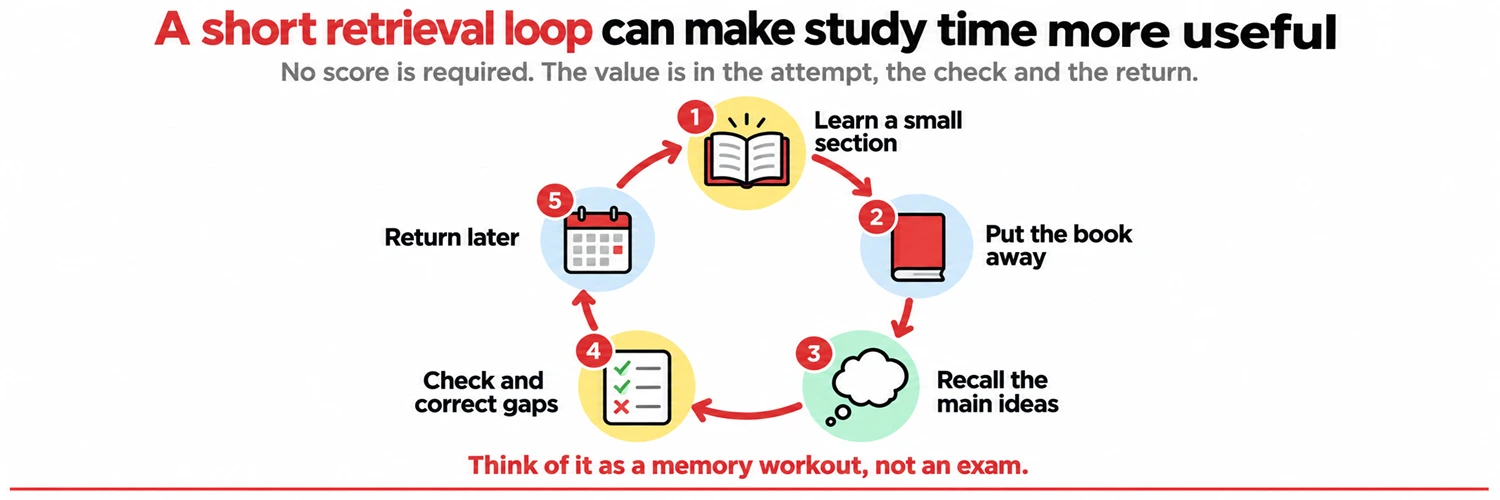
The key sequence is simple:
- Learn a small section properly.
- Put the book away.
- Try to retrieve the main ideas, steps or examples.
- Check against the source.
- Correct gaps briefly and return to them later.
It is sometimes called the “testing effect”, but that label can make children nervous. At home, think of it as a memory workout, not an exam. No score is required. The value lies in the attempt and the feedback.
The U.S. Institute of Education Sciences recommends active retrieval through quizzing at different points in learning to support lasting memory. Research reviews in psychology also describe retrieval as a useful study strategy for learners, including school-age students. That does not mean a surprise quiz will solve every difficulty. It means that recall should sit alongside explanation, practice and feedback rather than being saved only for formal exams.
How Is Retrieval Practice Different From Rereading And Highlighting?
| Study action | What it is good for | What to add next |
|---|---|---|
| Rereading a chapter | Getting familiar with an idea or reviewing a confusing section | Close the book and list the three most important points |
| Highlighting notes | Marking vocabulary, dates, formulas or headings | Turn highlighted lines into questions |
| Watching a solution | Seeing the sequence in a difficult problem | Complete a similar problem without the solution |
| Copying answers | Checking presentation or learning a model response | Cover the model and write a shorter answer from memory |
| Flashcards | Recalling facts, terms and short steps | Mix old and new cards; revisit the difficult ones later |
The difference is effort. When a child is only looking, the page carries most of the burden. When they retrieve, their mind has to search, organise and express the information. That is why it can feel harder at first.
Harder is not always better, children still need clear teaching and adequate support. But a small, purposeful challenge is often more valuable than a familiar page read for the fourth time.
How Can Parents Help Children Remember What They Study?
Parents do not need to become tutors. In fact, taking over is one of the quickest ways to make a useful strategy feel like another demand. Your role is to help create a short routine, ask neutral questions and make it safe to be wrong.
Start with ten minutes. Choose one small piece of learning, not an entire chapter. For a younger child, it may be three spellings, a number fact or the sequence of a story. For a middle-school child, it may be a diagram, a formula, an explanation paragraph or the steps in a maths method.
Try these options:
1. The blank-page recall
After reading a short section, give the child a blank page. Ask them to write or sketch everything they can remember: keywords, arrows, examples, dates, labels or questions. Then let them compare it with the book using a different colour pen.
The missing parts are not a failure report. They become tomorrow’s focus.
2. The teach-it-back minute
Ask: “Can you teach me this as if I missed the lesson?” Listen for one minute. You do not need to know the subject well. Use simple prompts: “What happened first?” “Why does that step matter?” “Can you give me an example?”
If the child pauses, allow thinking time before offering a clue. Silence can be useful.
3. Question cards, not answer cards
Write a clear question on one side of each card and an answer or worked step on the other. Examples include “What are the three states of matter?” or “How do I calculate the area of a triangle?” Keep the cards mixed. A card answered easily can return later; a difficult card can return tomorrow.
4. The three-question exit routine
At the end of a study session, ask the child to answer three questions without notes: one fact, one “why” question and one application question. For example, in history: “What was the event?” “Why did it matter?” “How might it have changed people’s lives?”
This approach moves revision beyond memorising isolated lines.
What Does A Realistic Weekly Retrieval Routine Look Like?
The most sustainable plan is small and repeated. A child does not need a forty-card quiz every day. They need a reason to return to learning after the first lesson.
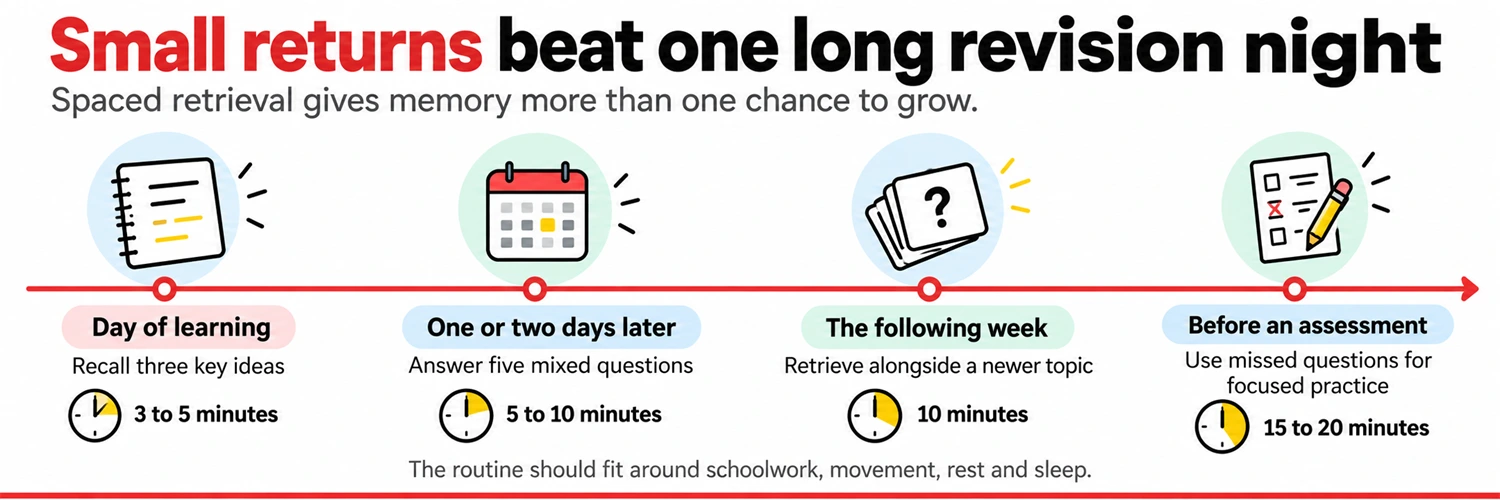
| When | A simple action | Time needed |
|---|---|---|
| The day of learning | Recall three key ideas before closing the notebook | 3–5 minutes |
| One or two days later | Answer five mixed questions or redraw a diagram | 5–10 minutes |
| The following week | Retrieve the topic alongside a newer topic | 10 minutes |
| Before an assessment | Use missed questions to guide focused practice | 15–20 minutes |
This is spaced retrieval: revisiting information after a gap. The gap allows some forgetting to occur, so the next recall attempt has genuine work to do. It also gives the child useful evidence about what needs attention.
For Classes IX and X, a subject rotation can prevent a last-minute pile-up. Monday might include a short science recall and a maths problem; Tuesday, a social science timeline and vocabulary; Wednesday, a language paragraph plan. The routine should fit around schoolwork, sports and rest, not replace them.
How Can Retrieval Practice Work In Different Subjects?
Retrieval practice is flexible because different subjects demand different kinds of remembering.
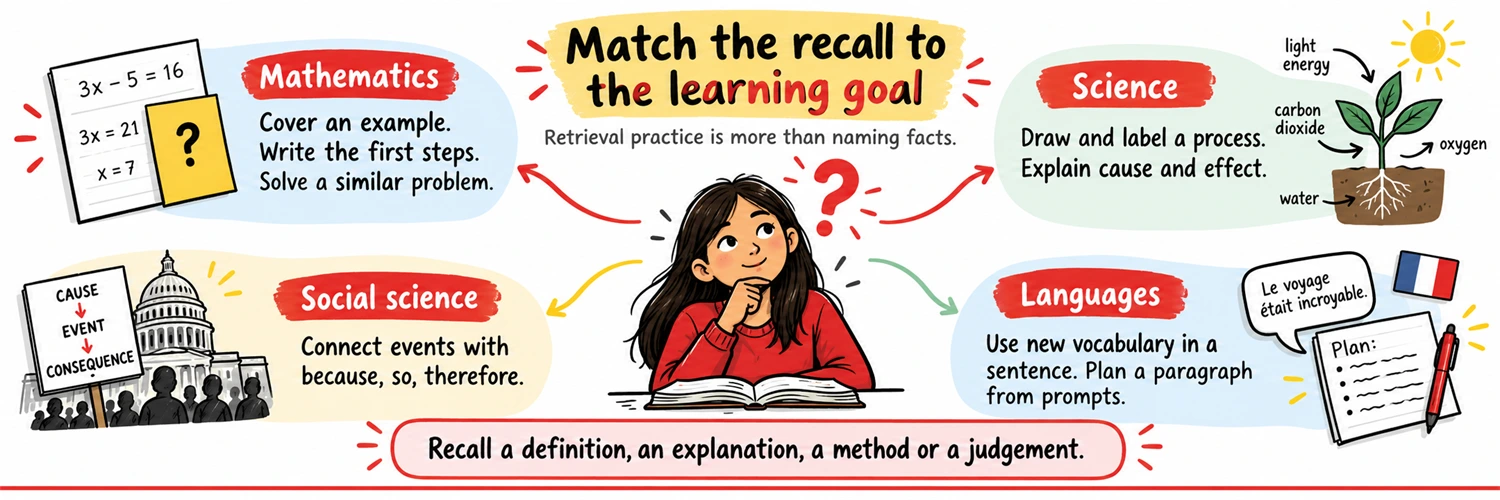
In mathematics, children can cover a solved example and write the first three steps from memory. They can then solve one similar problem and explain where they got stuck. Formula cards work best when paired with questions about when to use the formula.
In science, a child can draw and label a process, explain a cause-and-effect chain, or compare two concepts. Instead of memorising “photosynthesis” as a paragraph, they might answer: What does the plant need? What does it make? Where does the process happen?
In social science, timelines, maps and “because, so, therefore” explanations are useful. Ask children to connect events rather than recite a list of dates.
In languages, retrieval can mean recalling new vocabulary in a sentence, planning a paragraph from three prompts, retelling a scene, or listing the features of a format before writing.
The question should match the learning goal. Recalling a definition is useful, but so is retrieving an explanation, a method or a judgement.
What Mistakes Make Revision Less Effective?
- Giving the answer too quickly. Wait a little. A clue is better than a full solution.
- Turning every recall task into a score. Children need room to make mistakes without feeling measured.
- Using only one format. Flashcards are excellent for some material, not every kind of learning.
- Practising only what already feels easy. Keep a small “not yet” list and return to it.
- Ignoring understanding. Retrieval cannot replace a teacher’s explanation, a worked example or a conversation about a misconception.
- Adding more work to an overloaded child. Shorten the task or pause. A calm routine is more likely to last.
Try this language: “Let’s find what needs another look,” not “You should know this by now.”
When Might Forgetting Signal A Need For Extra Support?
Every child forgets. But it is worth speaking with the teacher when forgetfulness is frequent across subjects, persists despite sensible support, or comes with changes in mood, confidence, attendance, sleep or concentration.
Bring observations rather than labels. You might say: “She can explain the topic at home on Monday but cannot begin a similar question on Wednesday. Is this happening in class too?” This invites a shared picture of the child’s learning.
The school may identify a specific gap, recommend a different study approach, or suggest further support. Retrieval practice is a tool, not a diagnosis, not a replacement for sleep, and not a substitute for professional advice when a child’s wellbeing is affected.
How Dhruv Global School Supports Stronger Learning Habits
At Dhruv Global School, learning is approached as a process of understanding, reflection and steady practice. The school’s focus on holistic development means a child’s academic habits sit alongside wellbeing, curiosity, communication and confidence.
Families can support this approach by keeping home conversations specific and calm. Ask a child what they can explain, what still feels uncertain and what one small next step would help. For further ideas on revision, read DGS’s guide to study skills for Classes IX and X and its resource on signs a child may need extra academic support.
The aim is not perfect recall on demand. It is a child who knows how to return to a difficult idea and make progress.
Final Thoughts
The most helpful study question is not, “How long did you sit with the book?” It is, “What can you do without it?”
When children use small moments of recall, check their gaps and revisit learning over time, they stop treating forgetting as a verdict. It becomes information. That shift can make revision calmer, more honest and far more useful.