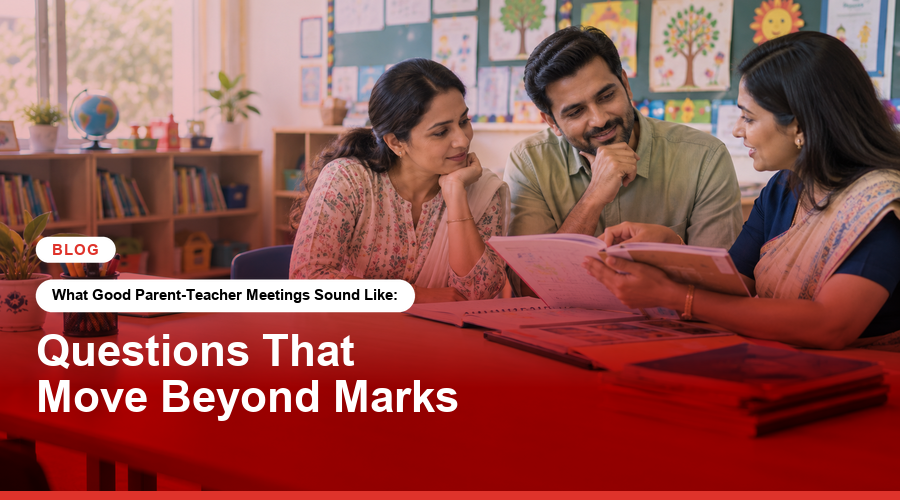
A parent–teacher meeting can begin with a familiar question: “How are the marks?” It is understandable. Marks are visible, comparable and often the first signal parents receive about progress. But they are only one signal. A child can score well while becoming anxious about speaking in class. Another may need more time in a subject while showing growing curiosity, resilience or confidence.
The most useful PTM questions open the window wider. They help a parent understand how a child approaches work, responds to feedback, relates to classmates and manages the ordinary pressures of school. They also give teachers useful context from home. That is the real value of a parent–teacher meeting, not a report handed over, but a shared plan.
Many parents understandably arrive with a mental list of marks, tests and homework. Bring those questions. Then add a few that move beyond them. A thoughtful conversation can reveal the next small step that makes school feel more manageable and more meaningful for your child.
Quick answer: Good parent–teacher meetings focus on progress, habits, wellbeing and next steps as well as marks. Ask what your child does well, where they get stuck, how they participate, how they work with peers and what one practical action will help at home. Leave with one or two shared goals rather than a long list of worries.
Why Parent–Teacher Meeting Questions Matter More Than a Mark Sheet
A mark tells you how a child performed on one assessment or across one period. It rarely explains the route they took. Did they understand the core idea but rush? Did they avoid asking for help? Did they improve after feedback? Did language, confidence, attendance, organisation or a friendship issue affect the result? These are the details that make a response useful.
Parent–teacher conferences are usually brief. That is why preparation matters. The Victorian Department of Education describes conferences as a place for teachers to discuss next steps and for parents to seek clarification and share relevant context. UNICEF also stresses that two-way communication helps families understand learning and support it at home. The best meeting is a conversation, not an interrogation. Full stop.
This matters in a CBSE school context too. Children are developing knowledge, skills, communication and judgement at the same time. A conversation that includes all of those areas is more likely to lead to support that fits the child.
What Should Parents Ask at a Parent–Teacher Meeting?
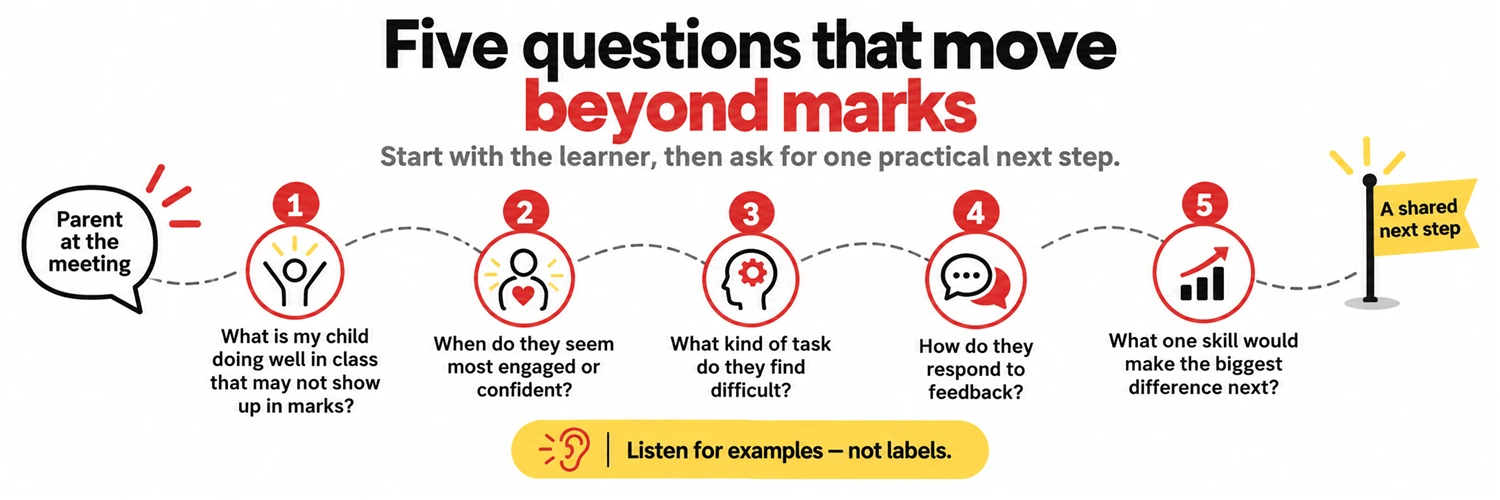
- What is my child doing well in class that may not show up in marks?
- When does my child seem most engaged or confident?
- What kind of task do they find difficult: starting, understanding, staying focused or finishing?
- How do they respond when you give feedback?
- What is one skill that would make the biggest difference over the next few weeks?
These parent–teacher meeting questions are specific enough to be useful, yet open enough for the teacher to share what they observe. They also avoid the trap of turning a child into a percentage. A child is not a percentage.
Questions to Ask About How Your Child Learns
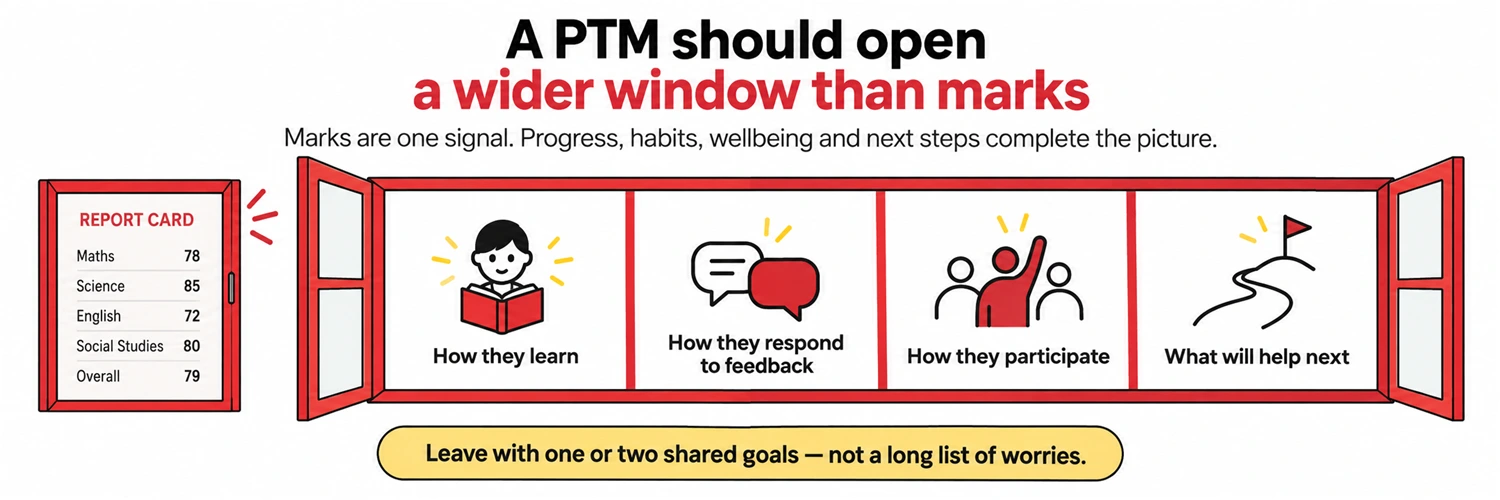
Learning habits often explain more than the latest test. Ask the teacher how your child begins a task, whether they check instructions, how they use notes, and what happens after an error. A student who makes careful corrections may be building a valuable habit even if the first attempt was not perfect.
Listen for a pattern, not a verdict. “Needs more practice” is broad. “They understand fractions when they can draw them, but lose track during multi-step questions” gives a parent something concrete to try. It could lead to ten calm minutes of visual practice, not an hour of pressure.
Questions to Ask About Confidence and Participation
School life is social. A child’s willingness to participate can shape what they learn and how they feel about learning. Ask how they contribute in pairs, groups and whole-class discussion. Ask whether they seem comfortable seeking help. Ask whether they have positive peer connections during everyday moments, not only during formal activities.
A quiet child is not automatically unhappy, and a talkative child is not automatically confident. The useful question is whether your child can participate in ways that feel safe and appropriate for them. Teachers see children in a setting that parents do not always see. Parents know the home context that teachers may not see. Put those two views together.
One question to ask: “When does my child seem most like themselves at school and when do they seem less at ease?”
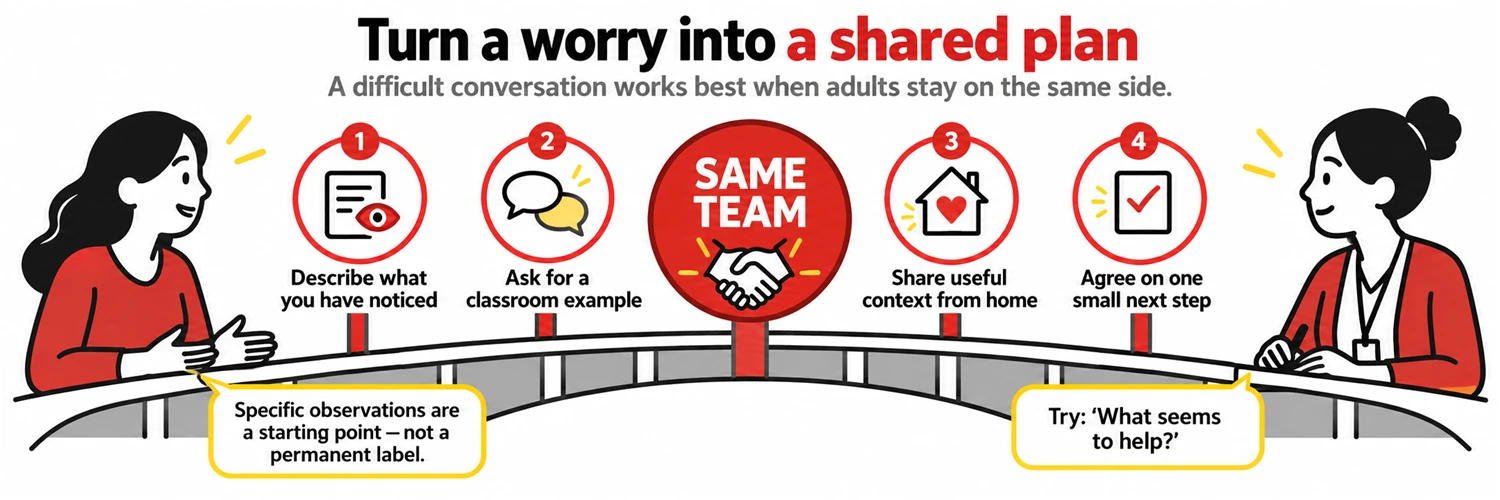
If the teacher mentions a concern, ask for an example and a next step. Avoid asking for a label. A specific observation is more helpful: “They avoid reading aloud after making a mistake” is a starting point for support. It is not a permanent description of the child.
How to Discuss a Concern With Your Child’s Teacher
Some meetings bring difficult news. Homework may be incomplete. A child may be distracted, withdrawn or struggling with a concept. It is natural to feel protective. Take a breath before you respond. The teacher is sharing one view of your child’s day, not passing judgement on your parenting.
Try language that keeps the adults on the same side: “We have noticed something similar at home. What have you tried so far?” “What seems to help?” “Would it be useful if we kept a simple routine for two weeks and checked back?” These questions move a concern towards a plan.
You can also share context that may matter: a change in sleep, illness, a move, a family event or a new routine. Share only what feels appropriate. The goal is not to explain away every difficulty. It is to help the teacher understand the child more completely.
What Should You Do After a Parent-Teacher Meeting?
The conversation with your child after a PTM matters as much as the meeting itself. Do not open with, “Your teacher said you are not working hard enough.” Start with curiosity: “Your teacher noticed you have interesting ideas in science. How do you feel about that class?” Then share one practical next step together.
Choose one goal that is small, visible and kind. “Pack the bag before dinner on school nights” is clearer than “be more organised”. “Read the question twice before beginning” is more useful than “stop making careless mistakes”. A child should know the adults are building support around them, not building a case against them.
The American Academy of Pediatrics advises parents to schedule another conversation when the available conference time is not enough. That is sensible. A short PTM can identify the issue; a follow-up can give it the care it needs.
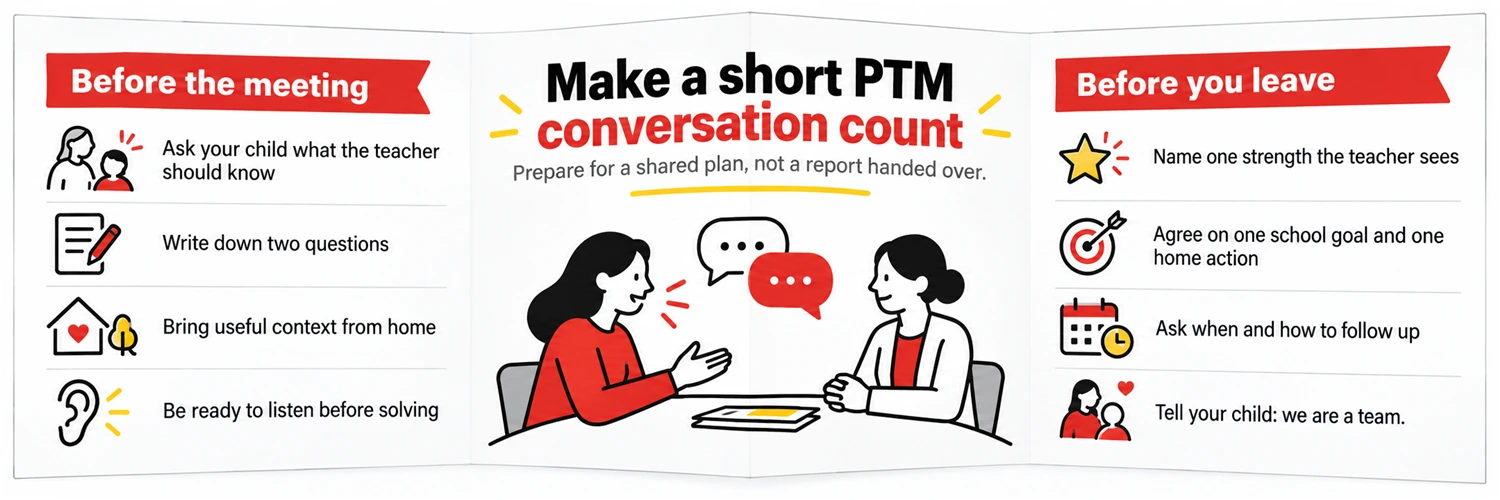
A Simple Parent–Teacher Meeting Checklist
| Before the meeting | Before you leave |
|---|---|
| Ask your child what they want the teacher to know. | Name one strength the teacher sees. |
| Write down two questions, not ten. | Agree on one school goal and one home action. |
| Bring useful context from home. | Ask when and how to follow up. |
| Be ready to listen before solving. | Tell your child the conversation is a team effort. |
How Dhruv Global School Builds Meaningful Family-School Conversations
Dhruv Global School, a CBSE school with campuses in Nande, Undri and Sangamner, sees learning as more than a collection of marks. A useful parent–teacher meeting can include academic progress, but it can also explore curiosity, communication, habits and confidence. That wider view is consistent with a school experience that values multiple intelligences and whole-child development.
Families can continue that conversation by asking simple, regular questions at home: What felt interesting today? What felt difficult? Who helped you? What would you try differently tomorrow? Those questions make room for reflection before a report or PTM is due.
For more parent resources on looking beyond a narrow definition of achievement, visit the Dhruv Global School blog archive at https://dhruv.edu.in/blogs/.