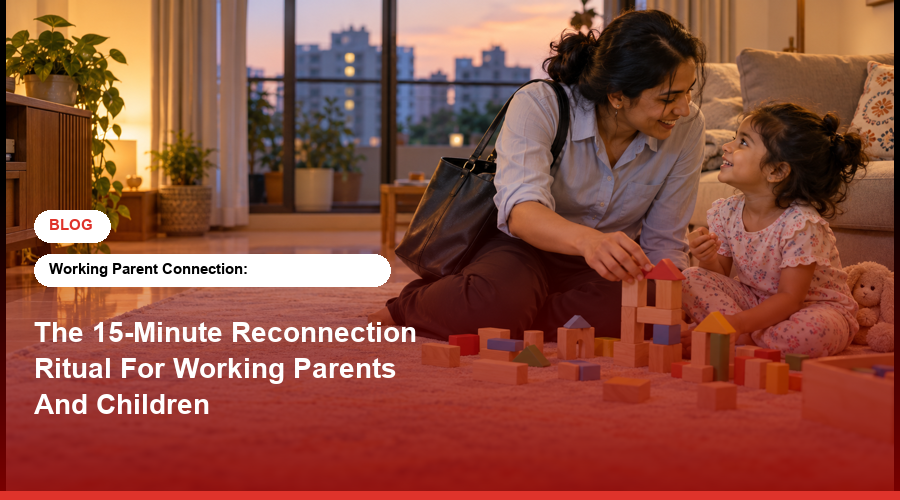
You walk in after work with a full head and an empty battery. Your child has been waiting, perhaps happily playing, perhaps irritable, perhaps immediately demanding your attention while you are still taking off your shoes.
Then comes the familiar guilt: I have been away all day. I should be doing more.
Here is the reassuring truth: children do not need a perfect parent with unlimited time. They need small, reliable moments of genuine connection.
For a young child, fifteen focused minutes can feel very different from an entire evening spent near a parent who is answering calls, preparing dinner or trying to recover from a difficult day.
Quick Answer
A reconnection ritual is a short, predictable period after work when you give your child your full attention. Put the phone away, let your child choose a simple activity, listen without rushing to correct or teach, and end with a clear transition into the evening routine. Fifteen calm minutes can strengthen connection without creating an unrealistic schedule.
Why The After-Work Moment Matters
A preschooler may have spent the day sharing toys, following routines, managing noise, separating from family and waiting for adults to help. By pickup or evening, they may be hungry, tired or full of feelings they cannot yet explain.
Working parents carry their own load too: travel, meetings, traffic, unfinished tasks, dinner, laundry and messages waiting on the phone.
That is why the first few minutes together can become difficult. Your child may cling, cry, become silly, refuse to cooperate or suddenly seem upset over something small. This is not usually a sign that they are trying to make your evening harder. It is often a sign that they are finally with a trusted adult again.
The goal is not to fill every minute with activities. It is to offer a dependable signal: I am home. I see you. We have a little time that belongs to us.
What Is the 15-Minute Reconnection Routine?
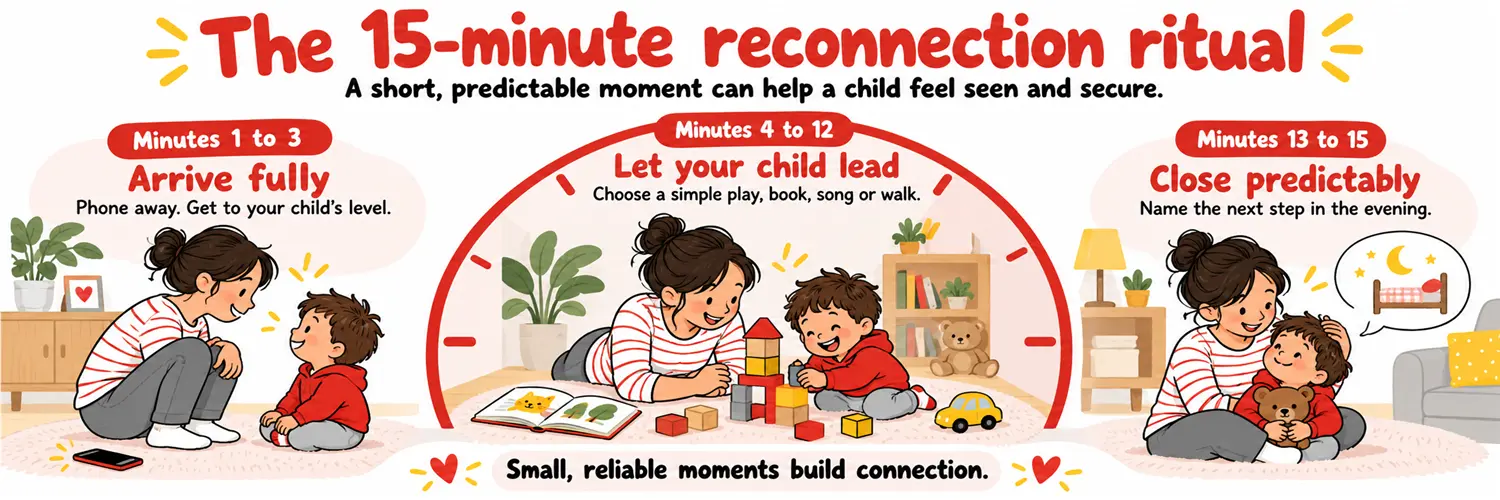
Choose a time that is realistic for your family. It may happen when you get home, after pickup, before dinner or after you change out of work clothes.
The order matters more than the activity.
Minute 1 to 3: Arrive fully
Put your bag down. Put the phone away or on silent. Get to your child’s level.
Try a consistent greeting:
- “I am happy to see you.”
- “I missed you today.”
- “Would you like a hug, high-five or to hold hands?”
- “I have fifteen minutes just for us.”
Some children want physical closeness. Others need a few quiet moments first. Offer, then follow their cue.
Minute 4 to 12: Let your child lead
- Blocks or cars
- Reading one short book
- Drawing together
- Pretend shop or café
- A balcony walk
- Looking at something they made
- Singing a favourite song
- A simple “show me your day” game
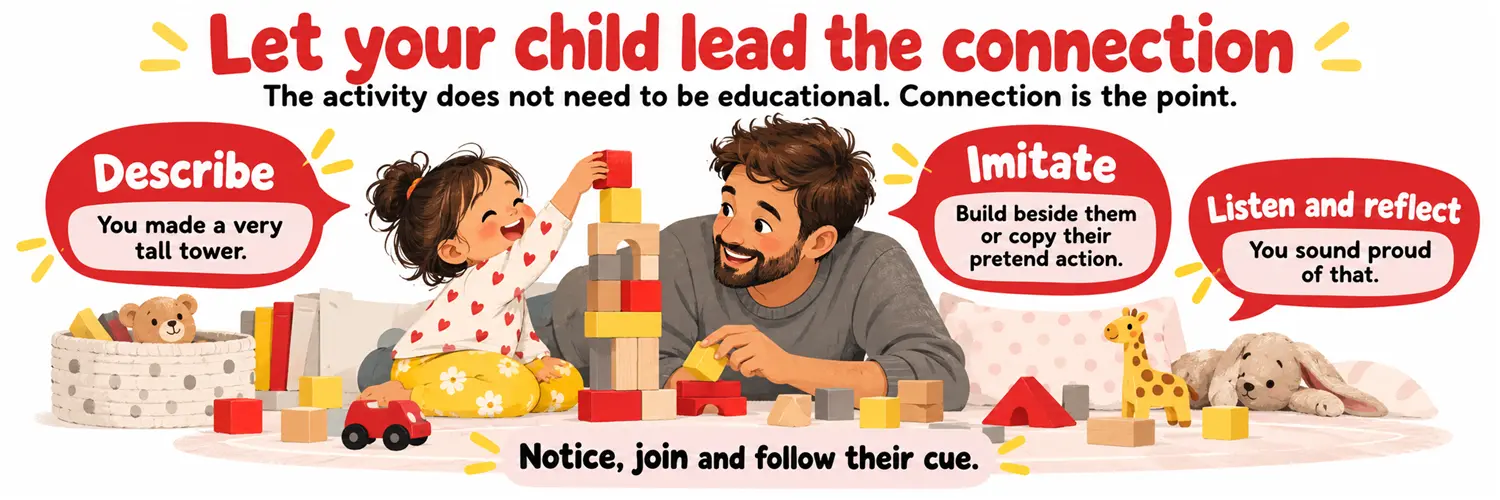
The activity does not need to be educational. Connection is the point.
Try using the three simple skills recommended in current parenting guidance:
- Describe what your child is doing: “You made a very tall tower.”
- Imitate their play: build beside them or copy their pretend action.
- Listen and reflect: “You sound proud of that,” or “That felt unfair.”
Avoid turning the moment into a lesson, a correction session or a review of every preschool activity.
Minute 13 to 15: Close predictably
Give a gentle warning before the ritual ends.
“Two more turns, then we wash hands for dinner.”
End with a small connection statement: “I loved playing with you. Tomorrow we can do this again.”
A clear ending helps children move into the next part of the evening without feeling suddenly pushed away.
The ritual works best when it is
- Short enough to keep consistently
- Child-led
- Screen-free for the parent
- Predictable in timing or sequence
- Followed by a clear transition
What if Your Child Won’t Leave You Alone After Work?
This is common, especially when a child has been at preschool, daycare or with another caregiver. They may want you to carry them, protest when you make dinner or reject the other parent.
First, acknowledge the feeling. “You wanted me today. I am here now.”
Then hold the evening boundary kindly. “We will have our special play first. After that, I will make dinner while you help me wash vegetables.”
The ritual is not a promise that you will be available every minute. It is a regular dose of full attention that makes the rest of the evening easier to understand.
What If You Get Home Late?
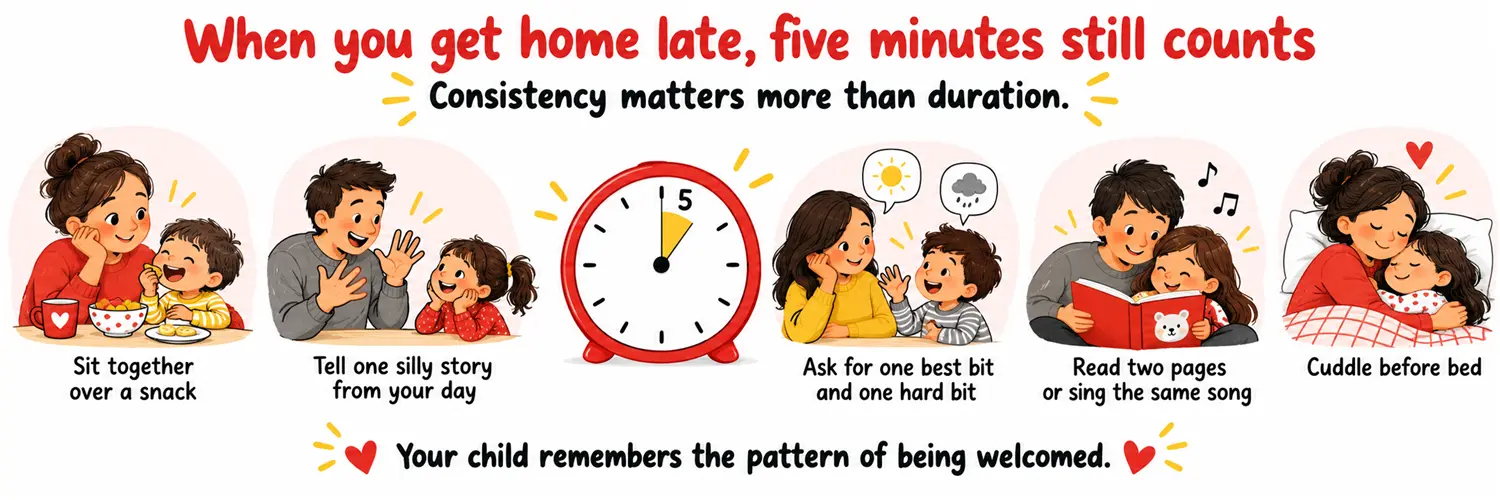
A fifteen-minute ritual is a useful goal, not a rule to feel guilty about.
On late days, create a five-minute version:
- Sit together while your child has a snack
- Tell one silly story from your day
- Ask for one “best bit” and one “hard bit”
- Read two pages of a book
- Cuddle and sing the same song before bed
Consistency matters more than duration. A child remembers the pattern of being welcomed, not whether you reached exactly fifteen minutes.
How Can Working Parents Spend More Meaningful Time With Their Children?
Many families are balancing long commutes, two working parents, grandparents, daycare pick-ups and evening home routines. Keep the ritual simple enough to survive a real Tuesday.
Try these practical adjustments:
- Keep a small “together basket” with crayons, a book, simple cards and blocks.
- Agree which parent owns the reconnection time on different days.
- Tell grandparents or caregivers the routine so they can help protect it.
- Prepare a simple snack before pickup if possible.
- Use the lift, car ride or walk from parking as the first three minutes of connection.
- If you work from home, create a visible end-of-work cue: close the laptop, wash hands, change clothes, then greet your child.
What Can Make Parent-Child Reconnection Harder?
Avoid these traps when possible
- Checking messages while your child is talking
- Asking too many questions in a row
- Beginning with corrections: “Why are your shoes there?”
- Promising time you cannot keep
- Making the ritual dependent on “good behaviour”
- Giving your child a screen while you scroll beside them
There will be evenings when you are exhausted, your child is upset and dinner burns. The ritual does not need to be beautiful every day. A simple, honest repair is enough: “I was distracted earlier. I am ready to listen now.”
How Dhruv Preschool Supports The Home-School Connection
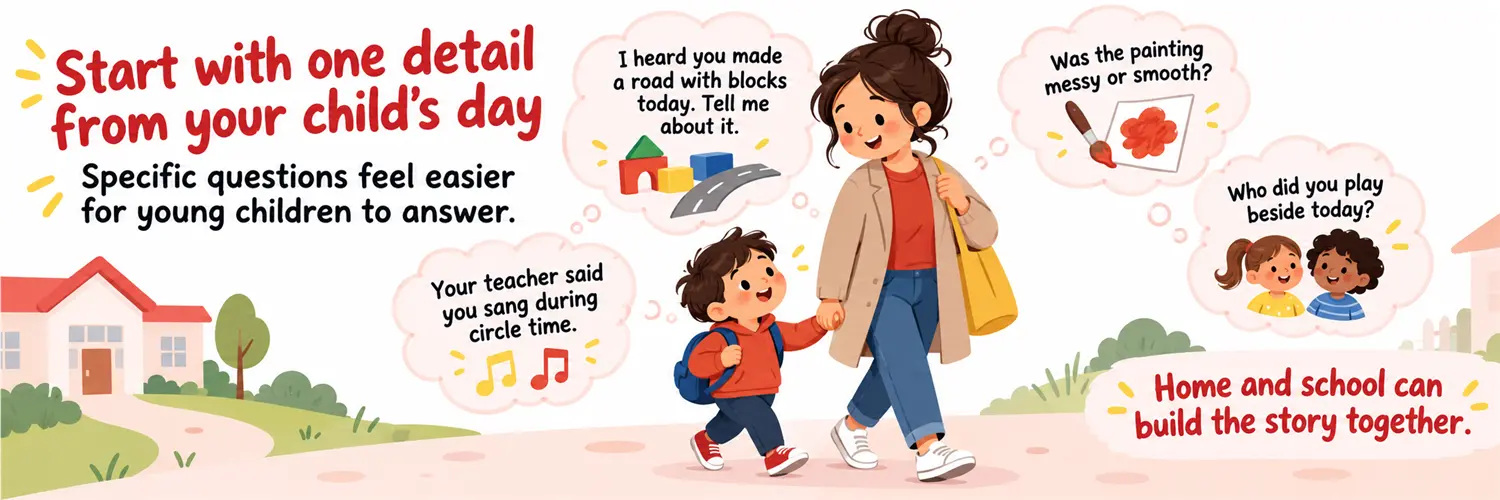
Children benefit when school and home communicate consistently. Teachers can share a small success, a favourite activity or a difficult moment from the day. Parents can use that detail to begin the ritual.
Instead of “What did you do at school?”, try:
- “I heard you made a road with blocks today. Tell me about it.”
- “Your teacher said you sang during circle time.”
- “Was the painting messy or smooth?”
- “Who did you play beside today?”
Final Thoughts
The most valuable part of the ritual is not the blocks, book or game. It is the message underneath: You matter to me even on busy days. Fifteen minutes will not remove every work pressure or parenting challenge. But it can become a steady bridge between your child’s day and yours.