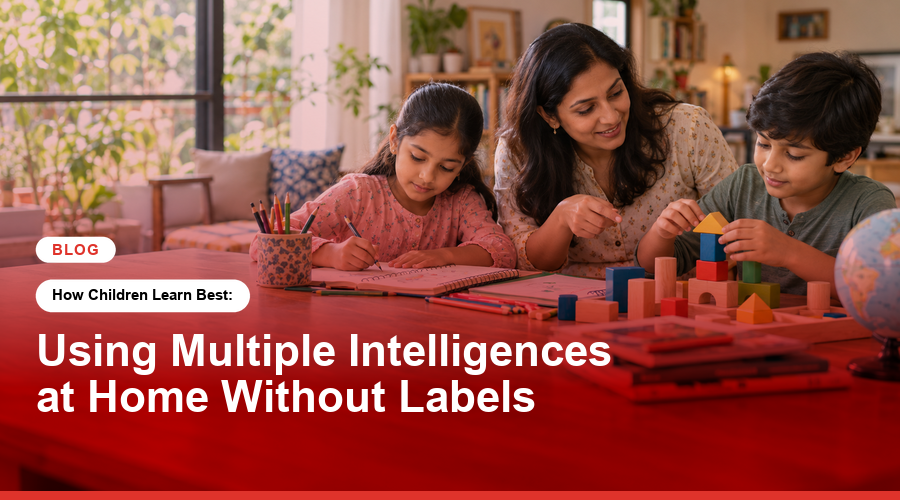
A child can spend twenty minutes staring at a maths page, then come alive while explaining a cricket score, building a fort or retelling a story. It is tempting to draw a quick conclusion: “She is not a numbers child,” or “He only learns by doing.” The conclusion feels kind because it appears to honour individuality. Yet it can quietly narrow a child’s world.
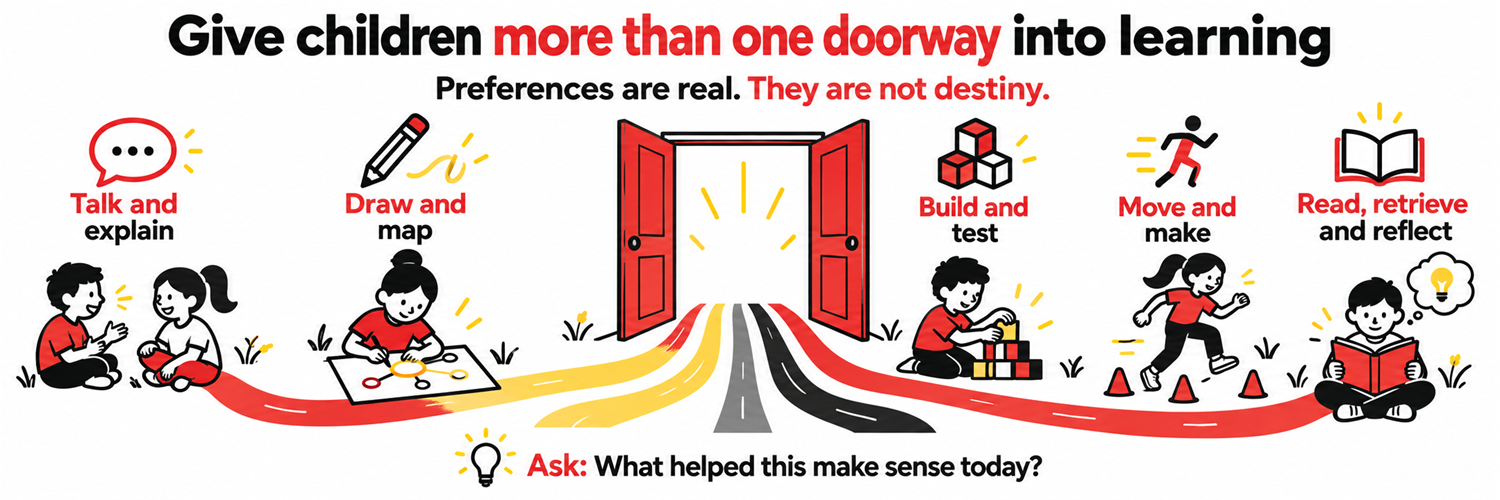
Children are not one thing. Their interest, confidence, prior knowledge, energy and the task in front of them all matter. A child who resists writing today may still love inventing dialogue. A child who finds a worksheet hard may understand the same idea after a conversation, a drawing, a practical example and a chance to practise. The point is not to identify a permanent type. It is to give children more than one doorway into learning.
That is where the language of multiple intelligences can be useful, if parents use it carefully. It can remind us to notice a wider range of human capabilities. It should never become a label that tells a child what they cannot become.
Quick answer: how can parents use multiple intelligences at home?
Use multiple intelligences as an invitation to vary experiences, not as a test that assigns a child one category. Offer chances to talk, read, draw, build, move, make music, work with others and spend time in nature. Then help your child reflect on what made a task clearer and what they might try next time. The evidence-informed goal is flexible learning: planning, monitoring and adapting strategies, not matching every lesson to a supposed “learning style”.
What Are Multiple Intelligences?
Howard Gardner’s multiple intelligences theory proposed that human capabilities extend beyond the narrow picture captured by conventional IQ-style measures. In educational discussion, the framework often names linguistic, logical-mathematical, spatial, bodily-kinaesthetic, musical, interpersonal, intrapersonal and naturalistic capabilities. Harvard Project Zero describes the theory as an account of several relatively distinct intellectual capacities, and it has influenced classroom thinking for decades.
Its most helpful home message is modest: children can show understanding in different ways, and rich learning often involves more than listening to an explanation. A history idea can be discussed, mapped, dramatised, read about and connected to a place. A science idea can be sketched, observed, tested and explained. Multiple routes can make a concept more meaningful.
But this is not the same as saying a child is permanently “a musical learner” or “a visual learner”. The American Psychological Association reports that there is no scientific evidence for the popular claim that children learn better when instruction is matched to a fixed learning style. Preferences are real. They are not destiny. A child may enjoy diagrams, for example, and still need to read, retrieve, practise and explain to learn securely.
Why Can Labelling a Child’s Intelligence Be Harmful?
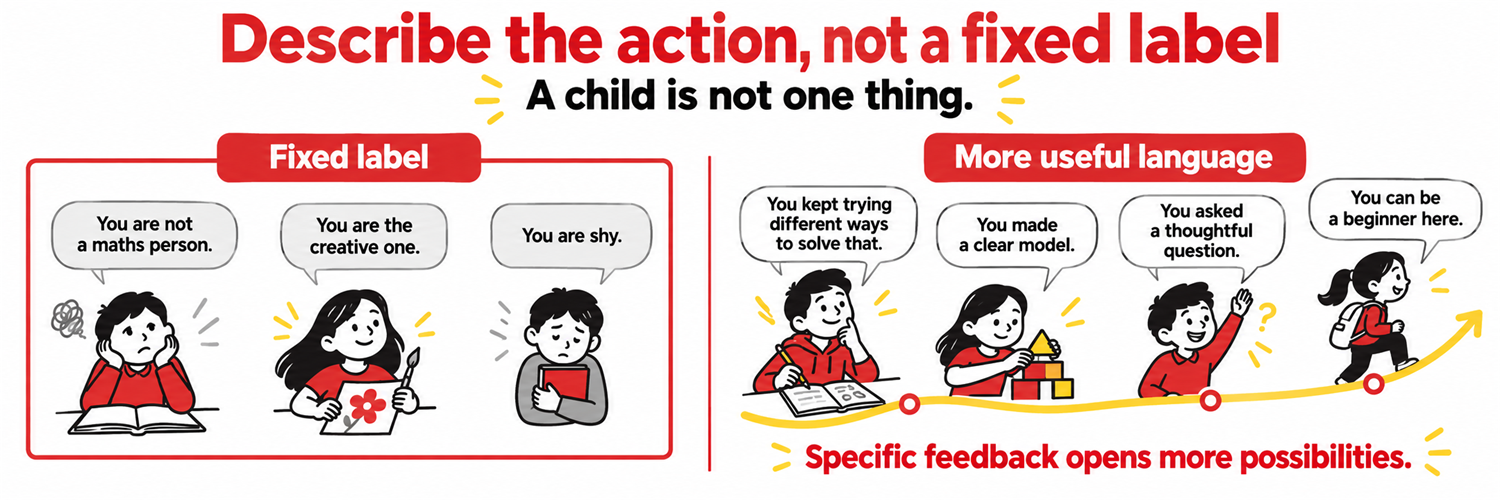
Labels often arrive with good intentions. “You are the creative one” can sound encouraging. “You are not a maths person” can sound like an explanation for a difficult evening. Yet children listen carefully to the identities adults offer them. Once a label becomes a reason to avoid a task, it stops being supportive.
The risk is not only academic. A child labelled “shy” may avoid leading. A child labelled “sporty” may hesitate to sing. A child called “the clever one” may fear mistakes. At home, the more useful language is specific and changeable: “You kept trying different ways to solve that,” “You noticed a pattern,” “You made a clear model,” or “You asked a thoughtful question.” This describes an action, not a ceiling.
Try replacing “What type of learner are you?” with “What helped this make sense today?” The first question searches for a box. The second opens a conversation.
How Can One Concept Be Taught in Different Ways?
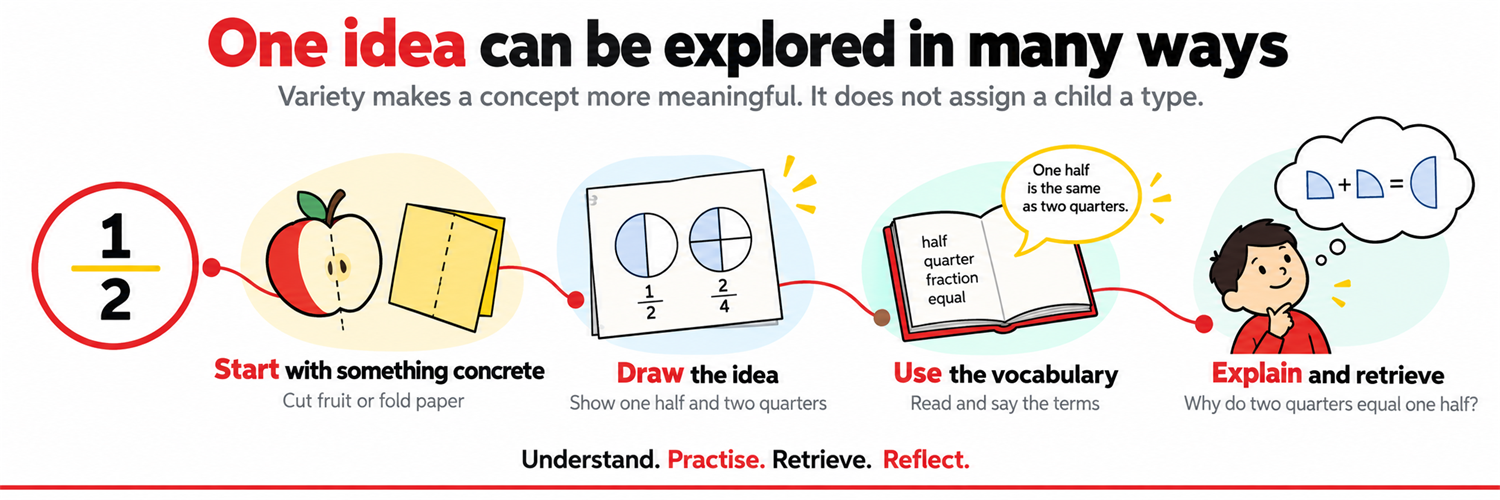
Variety is not entertainment for its own sake. It helps children connect an idea to different representations and contexts. The What Works Clearinghouse recommends combining graphics with verbal descriptions, connecting abstract and concrete representations, spacing learning over time and using active retrieval. These are useful principles for home learning because they shift a child from simply receiving information to working with it.
Consider fractions. A parent might begin by cutting fruit or folding paper, then draw the fractions, then read the vocabulary, then ask the child to explain why two quarters equal one half. None of these activities proves that the child has one “best” intelligence. Together, they build a richer understanding.
Or consider a new word. Your child might hear it in a conversation, see it in a book, use it in a sentence, draw a quick image for it and return to it two days later. The variety strengthens the idea. The later recall shows whether it stayed.
How Can Parents Use Multiple Intelligences at Home?
Notice the conditions that change learning. Does your child understand better after they have had time to talk? Do they need an example before trying independently? Are they comfortable beginning alone but more successful after a check-in? Do they rush because they want the answer, or pause because they need to organise their ideas? These observations are far more useful than a quiz result.
Also notice what the task demands. Learning multiplication facts is different from planning a story. A map may clarify geography, while a verbal explanation may clarify a sequence. The strategy should fit the content, not a permanent label attached to the child.
Keep a small family learning log for one week. Write only three things: the task, the strategy tried and what changed. This turns vague frustration into information. It also models that effective learners test approaches rather than waiting for motivation to arrive.
Simple Multiple Intelligence Activities to Try at Home
You do not need a special room or expensive resources. A few ordinary household routines already create rich opportunities. Cooking involves measuring, sequencing, reading and collaboration. A walk can become observation, vocabulary and natural science. A family story can become listening, questioning and writing. A board game can involve number sense, turn-taking and strategy.
Offer materials that invite action: pencils and plain paper, books at a reachable height, recycled boxes for making, a simple map, measuring tools, music, puzzles and time outdoors. Rotate rather than overload. The aim is not to create a constant programme. It is to make curiosity easy to act on.
One important condition is low stakes. If every activity becomes a performance, children protect themselves by choosing only what they already do well. Let some projects be messy. Let a model collapse. Let a story stop halfway through. Exploration needs room for revision.
What Do The Eight Areas Look Like In Ordinary Family Life?
Use the framework as a menu, not a scorecard. Linguistic opportunities include reading aloud, debates, jokes, letters and storytelling. Logical opportunities include sorting, estimating, comparing prices, puzzles and asking “what would happen if?” Spatial opportunities include maps, drawing, building and reorganising a room.
Bodily opportunities include gardening, making, sport, dance and acting out a process. Musical opportunities include noticing rhythm, creating a beat for a poem or listening for patterns. Interpersonal opportunities include planning a family task, helping a sibling and learning to negotiate. Intrapersonal opportunities include naming feelings, setting a small goal and reflecting on effort. Naturalistic opportunities include caring for a plant, noticing weather, categorising leaves and asking questions outside.
No parent needs to do all of this every day. Over a week, look for balance and genuine interest. A single strong experience is more valuable than eight rushed activities.
How Can Multiple Intelligences Help With Homework?
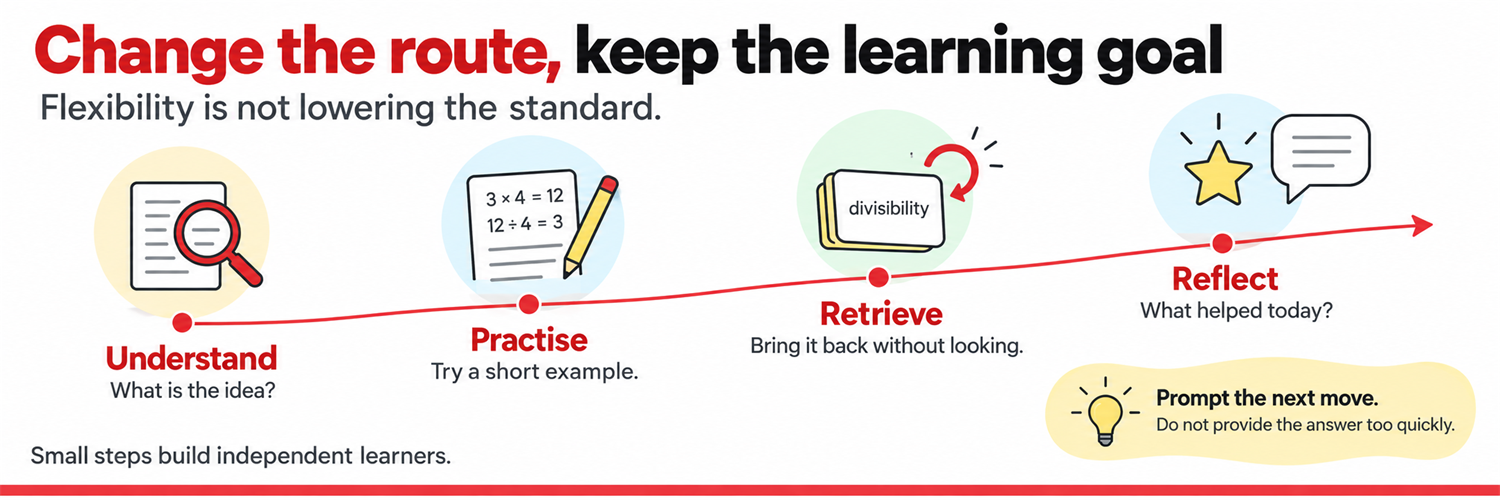
Flexibility is not lowering the standard. It is changing the route while keeping the learning goal clear. If the goal is to understand a paragraph, a child might first talk through it, draw the relationship between ideas or use a concrete example. They still need to read and answer questions. If the goal is to learn a spelling pattern, they can notice it in words, say it, write it and retrieve it later. They still need accurate recall.
A useful sequence is: understand, practise, retrieve, reflect. First help the child grasp the idea. Then give a short chance to use it. Later, ask them to bring it back without looking. Finally, ask, “What helped? What will you do differently next time?” The What Works Clearinghouse specifically recommends active retrieval and helping students judge what they know and what needs further study.
This is where a parent can be most helpful. Do not provide the answer too quickly. Prompt the next move: “Show me where you got stuck,” “What information do you already have?” or “Could you explain that in another way?”
How Does Dhruv Global School Approach Diverse Strengths?
Dhruv Global School uses Howard Gardner’s multiple intelligences as part of its educational philosophy alongside academics, sport, music, art, nature and yogic values. The purpose is not to divide children into types. It is to create varied opportunities through which children can participate, contribute and keep developing.
Families can extend that same spirit at home: see the child in front of you, offer more than one way into an idea and keep the expectation of growth intact.
Final Thoughts
The best question is not “What kind of learner is my child?” It is “What experiences will help my child become a more capable learner?” Children need chances to speak, think, move, make, notice, collaborate and reflect. They also need the freedom to be beginners in every one of those spaces. That is how interests become strengths and strengths keep growing.