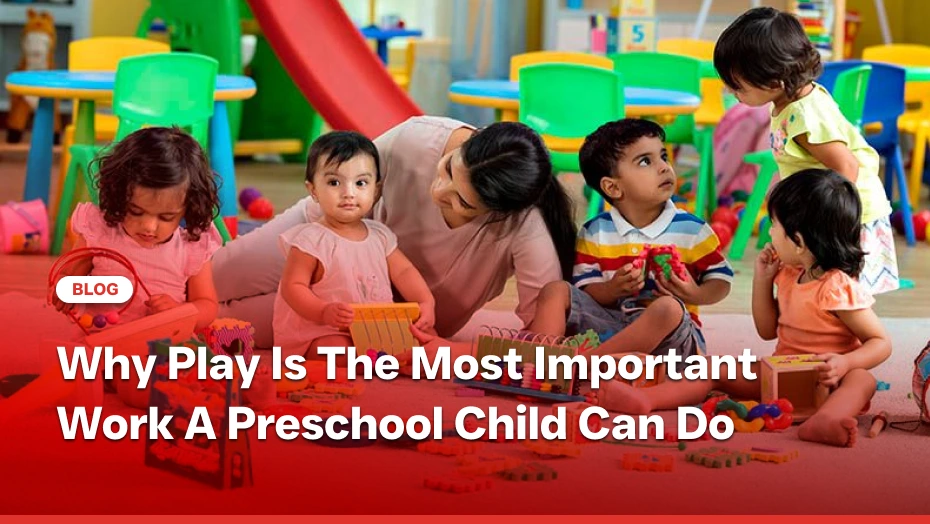
You collect your child from preschool and ask the question every parent asks: what did you do today? And they say: we played.
The first instinct for many parents, particularly in a culture that values academic progress, competitive preparation, and visible learning outcomes, is mild disappointment. Just played? The money, the commute, the settling-in tears, all for play?
This blog is the answer to that instinct. Because the research is unambiguous: for a child aged 2 to 5, play is not a break from learning. Play is the mechanism through which the most important learning of their entire life takes place. The child running the pretend bakery is practising planning, communication, numeracy, negotiation, and creative problem-solving simultaneously. The child in the sandpit is doing physics, measurement, and sensory regulation. The child arguing over the toy truck is learning conflict resolution, perspective-taking, and self-control.
None of this is visible on a worksheet. All of it is building the neural architecture that every subsequent learning, literacy, numeracy, academic thinking, social life depends on.
What Research Says About Play-Based Learning
The American Academy of Pediatrics published a landmark clinical report on play, reaffirmed in January 2025, concluding that developmentally appropriate play with parents and peers is a singular opportunity to promote social-emotional, cognitive, language, and self-regulation skills that build executive function and a prosocial brain. These are not peripheral benefits. Executive function, the ability to plan, focus, remember instructions, and manage impulses is the cognitive skill that most strongly predicts academic success at primary school and beyond.
The Harvard Center on the Developing Child (updated March 2025) describes how the timing and quality of early experiences shape brain architecture in ways that later experiences cannot easily replicate. The neural connections formed through rich, active, relational play in the early years are more durable and generative than connections formed through passive instruction, because play engages the whole child: body, emotion, imagination, and intellect at once.
The EPPE Project (UK), one of the largest longitudinal studies of early childhood education ever conducted found that children in play-rich classrooms achieved equal or higher academic outcomes than peers in direct-instruction programmes, with the added advantage of stronger motivation, engagement, and persistence. The Perry Preschool Study, which followed participants from age 3 to adulthood, found that play-based early learners showed greater persistence, problem-solving ability, and social confidence, qualities that predicted long-term success far more reliably than early academic drilling.
A 2025 study in the American Journal of Language, Literacy and Learning found a statistically significant positive relationship between guided play strategies and children’s cognitive-social developmental outcomes, measurable gains in reasoning, language, emotional intelligence, and cooperative behaviour. A 2024 study in Child: Care, Health and Development found that outdoor play specifically reduces emotional dysregulation in preschool children, one of the most practically important findings for parents of 3 and 4-year-olds.
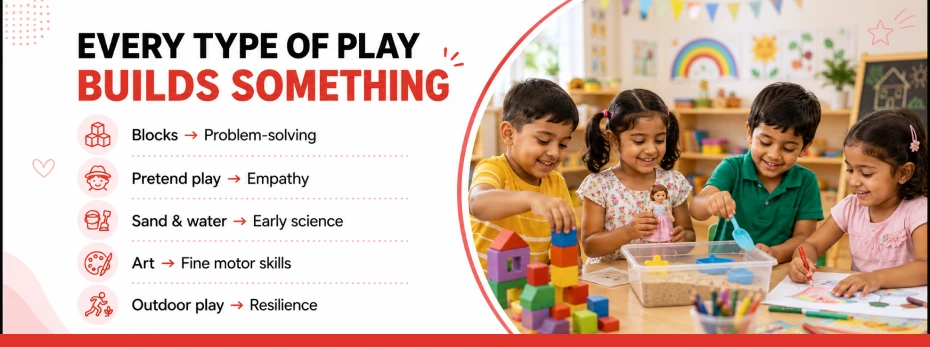
Types of Play and What They Teach Children
| Type of Play | What is Happening Developmentally | Long-Term Skills Being Built |
|---|---|---|
| Building Blocks | Spatial reasoning, cause-and-effect, physics, persistence | Maths concepts, engineering thinking, frustration tolerance |
| Pretend / Role Play | Language, story structure, empathy, perspective-taking | Literacy, emotional intelligence, social negotiation |
| Sand and Water Play | Scientific inquiry, measurement, sensory regulation | Early numeracy, calm focus, curiosity |
| Art and Clay | Fine motor skills, creative expression, decision-making | Writing readiness, aesthetic sense, self-confidence |
| Outdoor / Physical Play | Gross motor development, risk assessment, emotional regulation | Physical health, resilience, spatial awareness |
| Peer Play (Unstructured) | Turn-taking, conflict resolution, self-regulation, empathy | Social intelligence, communication, emotional literacy |
| Music and Movement | Rhythm, pattern recognition, body awareness, joy | Numeracy foundations, coordination, self-expression |
The Brain Science Behind Play-Based Learning
Understanding why play is so effective requires a brief look at how young children’s brains actually develop. By age three, a child’s brain is producing neural connections at a rate of up to one million per second. These connections are shaped and strengthened or weakened and pruned by experience. The richer, more varied, and more emotionally engaged the experience, the stronger the connections.
Play activates more of the brain simultaneously than any other activity available to a young child. It combines physical movement (motor cortex), social interaction (prefrontal cortex and limbic system), language (Broca’s and Wernicke’s areas), imagination (default mode network), and sensory input (sensory cortex), all at once. No worksheet, no structured lesson, no screen-based activity can replicate this full-brain engagement in a 3-year-old.
Neuroscience also tells us that learning under conditions of positive emotion: curiosity, joy, excitement is retained more deeply and for longer than learning under conditions of anxiety or compliance. Play is intrinsically motivating. A child who is absorbed in building a tower is not learning despite having fun, they are learning because they are having fun. The emotional engagement is the mechanism, not a side effect.
This is why the pressure to introduce formal academic instruction — worksheets, letters, numbers, to children under 4 is counterproductive. Not because the content is wrong, but because the method is misaligned with how the young brain is wired to learn. A 3-year-old forced to sit and copy letters is not learning literacy more quickly. They are learning that learning is uncomfortable, a far more damaging lesson.
The pressure to start academics early, what the evidence actually says
- In India's competitive educational environment, many parents feel pressure to enrol their children in preschools that introduce formal reading, writing, and arithmetic as early as possible, the logic being that an earlier start means a stronger foundation.
- The research does not support this. Studies consistently show that children who receive play-based early education and begin formal instruction later achieve equal or better academic outcomes by ages 7–9 than those who began formal instruction at 3 or 4.
- What early formal instruction does produce is measurably higher anxiety, reduced motivation, and a more fragile relationship with learning, because children who are pushed before readiness learn that effort leads to failure, not growth.
- NEP 2020 explicitly recognises this: the Foundational Stage (ages 3–8) is defined as play-based, with no formal written examinations. India's own education policy has arrived at the same conclusion as the research.
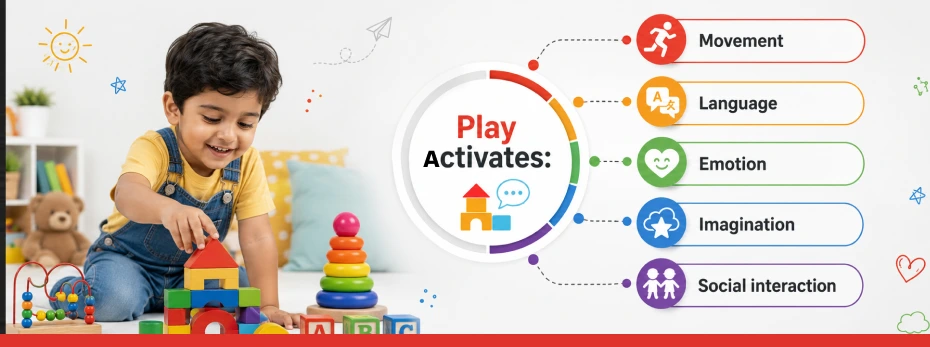
Free Play vs Guided Play: Why Children Need Both
Not all play is the same. Research distinguishes between free play, entirely child-initiated and child-directed, with no adult agenda and guided play, where a teacher or parent has a learning intention and creates the conditions for it, but leaves the child to explore within that space.
Both are essential, and both are different from directed instruction.
Free play
Free play is where children practice autonomy, creativity, and self-regulation in their purest form. There is no right answer, no failure, and no external evaluation. A child who decides to turn a cardboard box into a spaceship and then negotiates with a friend about who gets to be the pilot is exercising executive function, language, creativity, and social intelligence simultaneously and doing so entirely on their own terms. This self-direction is not just enjoyable; it is developmentally essential.
Research published by NAEYC shows that reducing free play time in favour of structured academic content, a trend seen in many preschools globally, directly reduces children’s self-regulation skills and independent problem-solving capacity. The irony is that the academic preparation parents seek is undermined, not advanced, by replacing play with worksheets.
Guided play
Guided play is where skilled early childhood teachers make their most significant contribution. A teacher who places a set of differently-sized containers near a water tray has created the conditions for a child to discover volume and measurement through play. A teacher who introduces new vocabulary during a building activity is scaffolding language acquisition through a context that makes it meaningful. The AERO studies (2023–24) confirm that intentional play-based learning, where teachers actively scaffold and extend children’s thinking produces the strongest outcomes for early literacy, numeracy, and executive function.
This is the critical distinction between a good preschool and a poor one: not whether children play, but whether the adults in the room understand what play is building and can create environments and moments that deepen it. Unguided play in a bare room is better than worksheets, but play in a richly designed environment, with attentive teachers who know when to intervene and when to step back, is the gold standard of early childhood education.
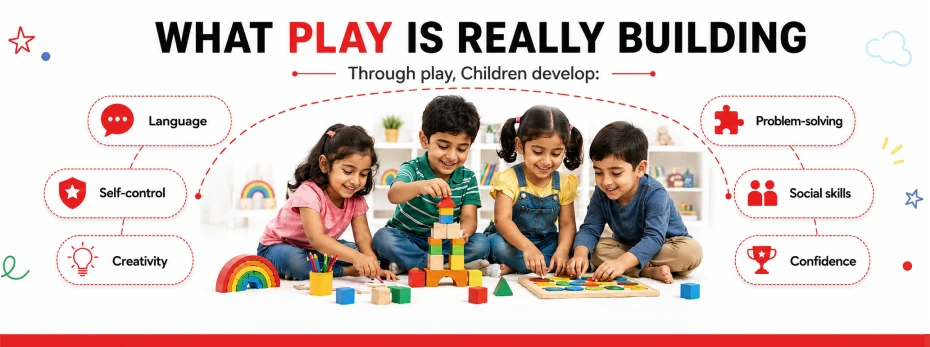
What Good Play Looks Like in a Preschool
- Children are visibly absorbed. Deep play has a distinctive quality, children are focused, unhurried, and self-directed. They are not looking at the teacher for approval; they are inside the activity.
- Teachers are observing, not managing. A good early childhood teacher during free play is watching, listening, occasionally extending, not directing, controlling, or moving children from activity to activity.
- The environment is rich and varied. Art materials, construction materials, sensory trays, books, props for role play, musical instruments, and outdoor space, all accessible, all rotated to sustain curiosity over time.
- Outdoor time is meaningful, not token. Physical play outdoors every day, not just a quick run between structured sessions. Climbing, digging, moving freely, exploring nature.
- Children have real choices. They are not all doing the same thing at the same time. Different children are in different spaces, following different interests, the hallmark of a genuinely child-centred environment.
- Mess is acceptable. Clay, paint, sand, water, loose parts, a preschool that never allows mess is a preschool that has prioritised adult comfort over child learning.
How Dhruv Preschool Approaches Play
At Dhruv Preschool, across our Aundh, Baner, Koregaon Park, and Mukundnagar branches in Pune, play is not a slot in the timetable. It is the primary mode of learning for every child in our care.
This means our classrooms are designed around children’s movement, exploration, and choice, not around rows and boards. Sand and water, clay and paint, blocks and construction, story corners and role-play spaces, music and movement, all present, all accessible, all intentional. The materials are rotated regularly to sustain curiosity. The spaces are designed so children can follow an interest deeply, not be hurried through a sequence.
Our teachers are trained early childhood educators who understand the developmental purpose behind every type of play, who know when a child stacking blocks needs to be left alone, when they need a new challenge, and when a well-placed question will extend their thinking without interrupting their flow. This knowledge is the difference between a classroom where children play and a classroom where children learn through play. Both look the same from the door. They are not the same.
Every child at Dhruv Preschool goes outside every day. Physical play, outdoor exploration, and the freedom to move are not weather-permitting extras, they are non-negotiable parts of the day. The research on outdoor play and emotional regulation is clear, and we take it seriously.
We also take seriously the conversation with parents about what play is building. When you pick up your child and ask what they did today, we want you to be able to hear ‘we played’ and know, not just believe, but know exactly what that means for who your child is becoming.
Final Thoughts
The word ‘just’ as in ‘just played’ is the most misleading word in early childhood education. It implies that play is a lesser activity, a placeholder, a concession to the fact that children cannot yet do the real work of learning.
The research, accumulated across decades and confirmed by the most rigorous longitudinal studies in child development, says something different: play is not what children do instead of learning. It is what learning looks like at ages 2, 3, 4, and 5. The child who played all day at preschool did more for their future than the child who filled in worksheets. The science is settled on this. The best preschools have always known it.