The National Education Policy 2020 is the most significant reform of India’s school education system in 34 years. The previous policy dated from 1986. In the decades between, the world changed completely, but Indian school education, in many of its structural features, did not.
NEP 2020 set out to change that. At 66 pages, it is an ambitious, carefully reasoned document covering everything from the structure of schooling to how teachers are trained, from the role of mother tongue in early education to the integration of vocational skills. It was approved in July 2020 and has been in gradual, phased implementation ever since.
For most Indian parents, NEP 2020 exists somewhere between vague awareness and active confusion. You know it is happening. You are not sure exactly what it changes, when, or what it means for your child’s specific grade. Phrases like “5+3+3+4”, “competency-based assessment”, “no rigid streams”, and “foundational literacy and numeracy” circulate in school WhatsApp groups without much explanation.
This blog explains clearly what NEP 2020 actually says, what has already changed in CBSE schools, what is still rolling out, and what it means practically for your child, at every stage of school.
What Is NEP 2020 and Why Was It Introduced?
The core diagnosis behind NEP 2020 is straightforward: India’s existing school education system was producing students who had been through school but were not adequately educated. ASER (Annual Status of Education Report) data had been showing for years that significant numbers of Indian children, even those who had attended school, could not read simple text or perform basic arithmetic by the end of primary school.
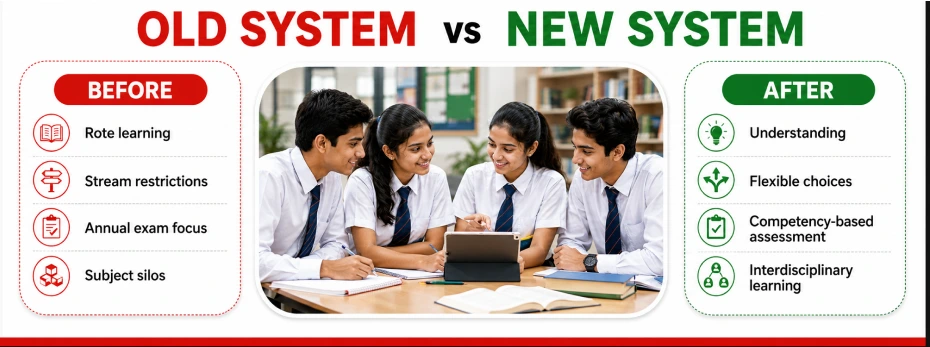
At the secondary level, the problem was different but equally significant: a system that rewarded memorisation over understanding, that forced children into rigid subject streams at age 16, that measured everything through a single annual examination, and that treated vocational education as a lesser path for students who had not succeeded academically.
NEP 2020’s vision is stated explicitly in the policy document: “to instil among students a deep-rooted pride in being Indian, a capacity and disposition to think critically, to develop and nurture creativity, and an ability to communicate well and work collaboratively”. In practical terms, this means a fundamental shift from a system designed to sort and rank children, to a system designed to educate them.
The New 5+3+3+4 School Structure Explained
The most talked-about structural change in NEP 2020 is the replacement of the old 10+2 system with a new 5+3+3+4 framework, four stages of schooling, each aligned with specific phases of child development rather than administrative convenience.
| Stage | Age Range | Classes | What It Means in Practice |
|---|---|---|---|
| Foundational | Ages 3–8 | Pre-school + Classes 1–2 | Play-based, activity-driven. Three-language exposure. No formal exams. 'Jaadui Pitara' material kit. Focus on joy, not testing. |
| Preparatory | Ages 8–11 | Classes 3–5 | New NCERT textbooks (released 2024). Experiential, inquiry-based learning. Coding introduced. Languages deepened. Reduced content load. |
| Middle | Ages 11–14 | Classes 6–8 | New NCERT books for Class 6 (2024). Vocational exposure: coding, agriculture, carpentry. Interdisciplinary projects. Subject specialisation begins. |
| Secondary | Ages 14–18 | Classes 9–12 | Flexible subject choice. No rigid Arts/Science/Commerce streams. Two-level Maths (2026–27). Competency-based board exams. AI compulsory. |
The most important thing to understand about this structure is that it is not just a renaming exercise. Each stage has a distinct pedagogical philosophy, a different theory of how children at that age learn best and the curriculum, textbooks, and assessment approach at each stage are designed around that philosophy.
The Foundational Stage (ages 3–8), for example, is explicitly play-based. The NCERT developed the ‘Jaadui Pitara’, a learning kit of toys, puzzles, puppetry, flashcards, and storybooks for this stage. Formal written exams are not part of this stage. The implication for parents: a good school implementing NEP 2020 at the Foundational Stage will look very different from a school that treats Class 1 and 2 as a scaled-down version of Class 5.
How NEP 2020 Is Changing CBSE Schools Right Now
NEP 2020 is being implemented in phases. Here is what has already happened, in confirmed, official sequence.
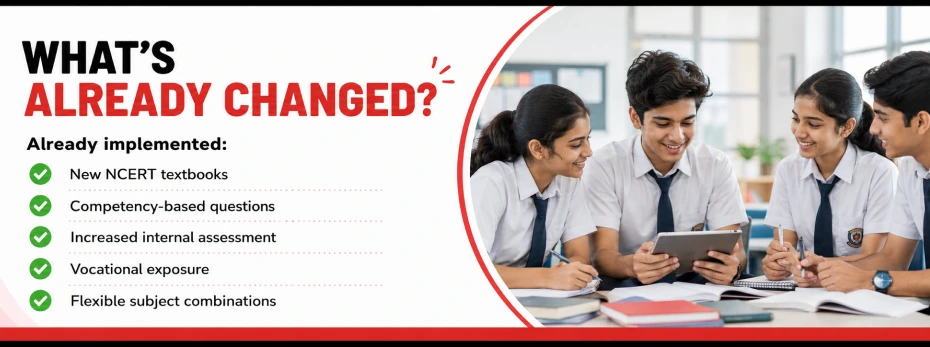
New NCERT textbooks for Classes 3 and 6 (2024)
In April 2024, NCERT released revised textbooks for Class 3, the first concrete curriculum output of NEP 2020 at the primary level. Class 6 textbooks followed in May 2024. These books are substantially redesigned: less content, more depth; inquiry-based rather than fact-delivery; interdisciplinary connections built in; and in Class 6, an introduction to coding, art integration, and the first vocational exposure activities.
CBSE has formally directed all affiliated schools to use these new textbooks for Classes 3 and 6 in place of the earlier NCERT editions. Updated books for Classes 4, 5, 7, and 8 are being developed and will roll out in 2025–26.
Assessment pattern changes at Class 10 and 12
CBSE has revised its Class 10 and 12 assessment patterns in line with NEP’s emphasis on competency-based evaluation. Internal assessment has increased in weightage; board exam questions increasingly test application and understanding rather than recall; and project-based and practical components have become more significant.
This is a meaningful change for students preparing for boards: questions now more frequently require a student to apply a concept to an unfamiliar situation rather than reproduce a definition they have memorised. Students who understand tend to perform better under this format than students who have only drilled.
No rigid Arts / Science / Commerce streams from Class 11 (2024–25 onwards)
One of NEP’s most significant changes at the secondary level is the elimination of rigid stream boundaries. From 2024–25, students in Class 11 can, in principle, combine subjects across the traditional Arts, Science, and Commerce streams, a student who wants to study Physics alongside History, or Economics alongside Biology, can do so. Implementation varies by school; parents should confirm with their school what combination options are available in practice.
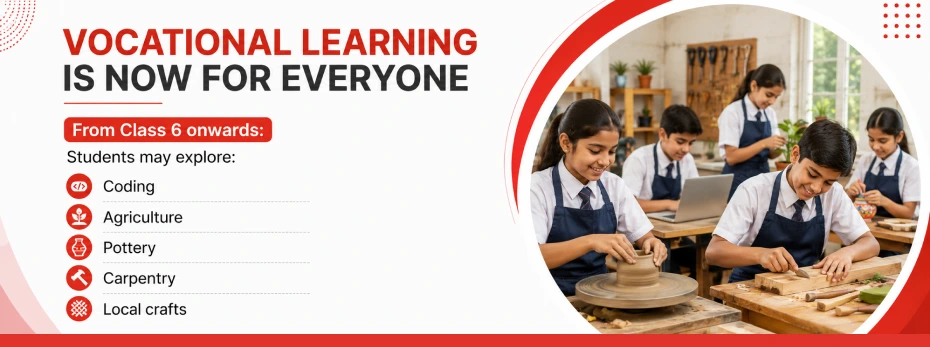
Vocational education in Classes 6–8
NEP 2020 introduced vocational exposure as a compulsory element from Class 6, covering areas like coding, agriculture, carpentry, pottery, and local craft traditions. This is not career training. It is exposure: a philosophical recognition that education should respect all forms of human skill and work, and that children benefit from understanding how things are made and how systems work. Some CBSE schools have implemented this substantively; others are still in early stages.
AI and Computational Thinking — compulsory from Class 3 (2026–27)
NEP 2020 Before and After: What Has Changed?
For parents who went through school under the old system, this table helps make the shift concrete.
What Changes Are Still Coming Under NEP 2020?
- NCERT textbooks for Classes 4, 5, 7, 8: In development; expected rollout in phases through 2025–26 and 2026–27.
- Two-level Maths and Science at Class 9 (Standard + optional Advanced): Confirmed from 2026–27. Standard paper unchanged; Advanced paper optional, with separate notation on mark sheet.
- Compulsory third language from Class 6: The three-language formula is being formalised from 2026–27, with board exam implications from 2028 onwards.
- PARAKH — national assessment body: The PARAKH Rashtriya Sarvekshan 2024 has already produced the first NEP-aligned national learning assessment. Its data will increasingly shape curriculum and school accountability.
- Teacher education reform: NEP calls for a four-year integrated B.Ed. as the standard teacher qualification by 2030. NCERT Bridge Programmes are already running in CBSE, KVS, and NVS schools to prepare teachers for the new pedagogical approaches.
- Flexible school timing and semester system: NEP recommends schools move toward a semester or trimester model with more flexible internal assessment cycles. Implementation is school-specific at this stage.
The honest truth about implementation, what parents should know
- NEP 2020 is a genuinely well-conceived policy. It is also a policy, not a classroom and the gap between what a policy says and what happens in any given school on any given Tuesday is still significant.
- Implementation across India's 1.5 million schools is uneven. Some CBSE schools in Pune and across urban India have embraced the spirit of NEP, inquiry-based teaching, flexible assessment, and interdisciplinary projects for years before the policy formalised it. Others have updated their textbooks while leaving their teaching methods unchanged.
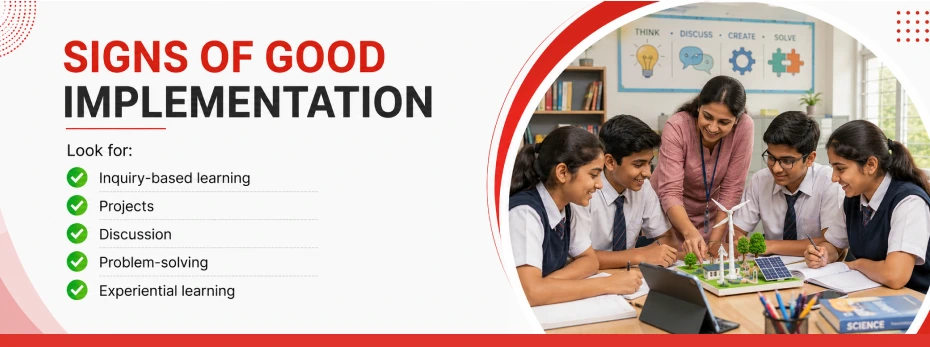
- The right question for parents is not 'is this a NEP school?' but: 'how is this school teaching?' A school that has always built understanding over memorisation, valued experiential learning, and taken assessment seriously as a tool for feedback rather than ranking is already a NEP school with or without the label.
What NEP 2020 Means for Your Child
If your child is in preschool to Class 2 (Foundational Stage)
This is the stage where NEP 2020’s changes are most visible in daily school life. Your child should be learning primarily through play, activity, and exploration, not through worksheets, copying from boards, or formal written tests. The ‘Jaadui Pitara’ material is designed for this stage. If your child’s school is implementing this well, school should feel joyful, curious, and social, not pressured or performance-oriented.
Ask your child’s school: what does a typical morning look like? How is progress assessed at this stage? The answers should reflect play-based, observation-based practice, not marks.
If your child is in Classes 3 to 5 (Preparatory Stage)
Your child is now using the new NCERT textbooks for Class 3 (and soon for 4 and 5). These books are different from what you may remember: less content, more inquiry, more connections between subjects. This is intentional. The goal at this stage is depth of understanding, not breadth of coverage.
Coding and basic digital literacy are now part of this stage. Experiential activities: projects, investigations, hands-on work, should be woven into the week, not just offered as extras.
If your child is in Classes 6 to 8 (Middle Stage)
This is where vocational exposure, interdisciplinary projects, and the new Class 6 textbooks come into play. Your child may be working on projects that connect subjects, a Science and Art integration, or a Social Studies and Language project. This is deliberate, not a distraction from ‘real learning’. The research on interdisciplinary learning consistently shows that connections across subjects produce deeper understanding in all of them.
This is also the stage where NEP emphasises experiential learning outside the classroom, school trips, community projects, craft exposure, and local heritage engagement. A school implementing NEP seriously will have a richer co-curricular programme at this level, not just an academic timetable.
If your child is in Classes 9 to 12 (Secondary Stage)
This is where the changes are most complex and most consequential for parents. The broad strokes: subject streams are no longer rigid (from 2024–25), board exams test more application and less recall, and new subjects, AI/CT, two-level Maths, compulsory Art and Physical Education are being phased in from 2026–27.
For students aiming at JEE or NEET: the optional Advanced Maths and Science papers in Class 9 (from 2026–27) are directly aligned with the conceptual and application-based reasoning these competitive exams demand. A student who has been educated in the spirit of NEP, building understanding over memorisation is better prepared for JEE and NEET than one who has only drilled, because both exams increasingly reward application.
How Dhruv Global School Is Implementing NEP 2020
At Dhruv Global School, many of the values at the heart of NEP 2020, experiential learning, holistic development, multiple forms of intelligence, the integration of arts and sport into daily school life were part of our educational philosophy before the policy gave them official backing.
The 5+3+3+4 structure formalises what we have always believed: that a six-year-old and a twelve-year-old are not simply different points on the same learning continuum but are in qualitatively different stages of development that require different environments, different approaches, and different kinds of challenge. Our curriculum planning and teacher training reflect this stage-awareness.
On the assessment changes: our classroom culture has consistently emphasised understanding over rote reproduction. As CBSE’s board exam questions shift toward application and competency, our students are not adjusting to a new format, they are answering in the way they have always been taught to think. This is a meaningful advantage at the Class 10 and 12 boards.
On subject flexibility: we support students in making thoughtful subject combinations at Class 11, not defaulting to the traditional stream labels but considering what the student actually wants to understand and where they want to go. Our counselling process at this stage is active, not administrative.
On vocational and experiential learning: our campuses include facilities that most schools describe in NEP documents and struggle to deliver in practice, carpentry-adjacent workshops, design spaces, sports infrastructure, music studios, and outdoor learning environments. The policy says children should learn with their hands and bodies alongside their minds. We have always built that into how school works.
NEP 2020 is, at its core, an argument that the purpose of education is to develop a whole human being, curious, capable, confident, and connected to the world they will live in. That is the argument Dhruv Global School was founded on. The policy has given it national voice. We are glad.
A Final Word
NEP 2020 is not a finished product. It is a direction and a genuinely good one. The shift from memorisation to understanding, from rigid paths to flexible ones, from single annual exams to continuous holistic assessment, from content-heavy syllabi to depth and experiential learning, all of this reflects what the best educational research has been saying for decades.
The question for parents is not whether NEP is a good policy. It is whether the school they choose is implementing its spirit, in the classroom, in the timetable, in how teachers teach, and in what the school ultimately believes education is for. The policy sets the direction. The school determines whether your child actually gets there.