Choosing a preschool in Pune is one of the most significant decisions parents of young children make and one of the least clearly guided. Every school has cheerful photographs, a warm-sounding mission statement, and a reassuring admissions conversation. The differences that actually matter are almost never visible on a website.
Pune is one of India’s strongest cities for early childhood education. The combination of an educated, informed parent community, a competitive school ecosystem, and a genuine culture of caring about child development means that the quality bar is higher here than in most Indian cities. But quality is uneven, and the gap between a preschool that is merely adequate and one that is genuinely excellent is significant, particularly for children aged 1.5 to 5, whose development during this window will shape everything that follows.
This guide is built around one central question: what should a Pune parent actually check before enrolling their child in a preschool? It draws on early childhood research and the experience of working with hundreds of Pune families across our four Dhruv Preschool branches, Aundh, Baner, Koregaon Park, and Mukundnagar.
Why Choosing the Right Preschool Matters More Than Parents Realise
The temptation is to treat the preschool choice as lower stakes than primary or secondary school. The research says otherwise. By age three, approximately 80% of a child’s brain architecture is already in place. By age five, it reaches 90%. The neural connections forming during this window, through relationships, language, play, and early experience, shape cognitive ability, emotional regulation, and social development in ways that are genuinely difficult to compensate for later.
UNICEF India’s research on early childhood education is unambiguous: quality early learning programmes directly improve outcomes in literacy, numeracy, emotional health, and long-term school performance. A 2025 Indian birth cohort study published in Scientific Reports found that structured early learning at ages 2–4 was associated with significantly higher cognitive scores at both age 5 and age 9, even after controlling for socioeconomic factors.
The preschool is not a holding space while children wait to start ‘real school.’ It is the most developmentally consequential learning environment your child will ever occupy. The environment you choose, the teachers your child encounters, and the peer community they are placed in during these years matter profoundly.
What Makes a Preschool Genuinely Excellent
Before arriving at the practical checklist, it helps to understand what the research says distinguishes an excellent early childhood programme from an average one. The findings are consistent across decades and geographies.
Teacher quality above everything else
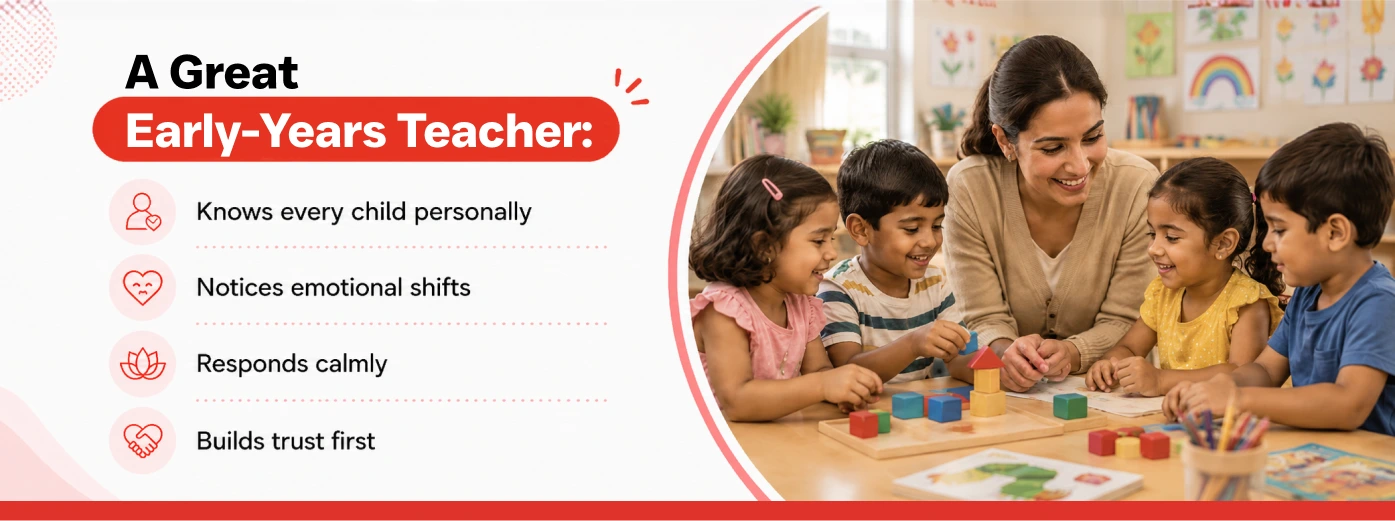
The single most important variable in any preschool is the teacher. Not the building, not the curriculum framework, not the activities listed on the brochure. Research from the NAEYC (National Association for the Education of Young Children) consistently shows that warm, trained, responsive teachers are the defining factor in early childhood outcomes, more than facilities, fees, or programme name.
A warm teacher means one who knows each child by name and by temperament, who notices when a child is quiet in a way that is unusual, who greets them at the door by name every morning, who responds to distress with calm presence rather than managed efficiency. This warmth is not a personality bonus. It is a developmental necessity. Children aged 2 to 5 learn through relationships first, content second.
Play — the primary curriculum
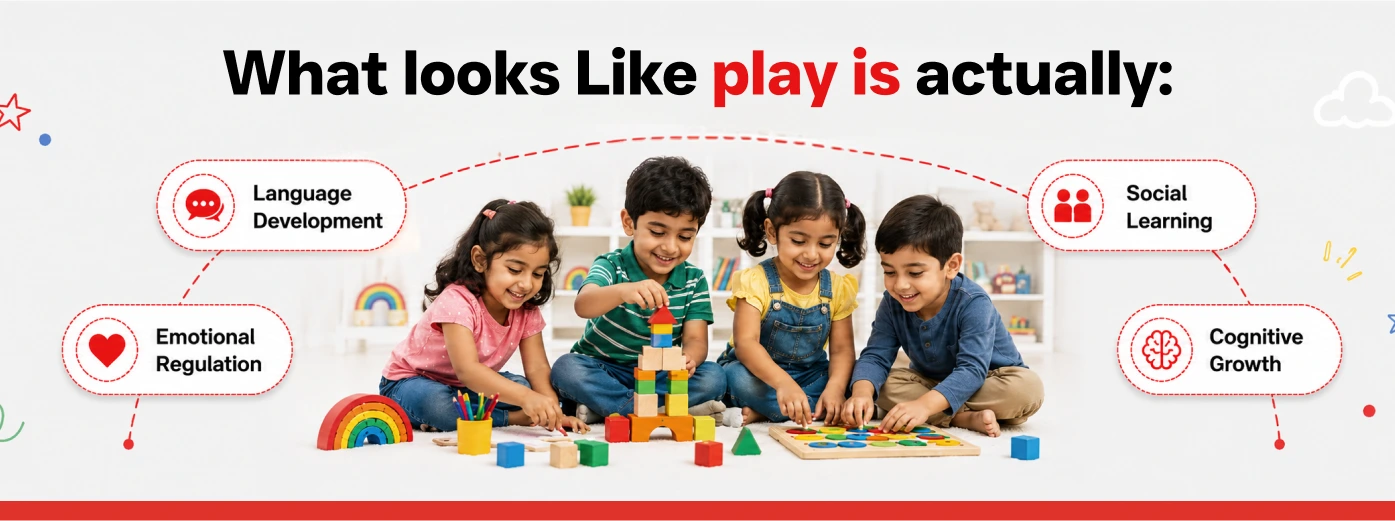
The American Academy of Pediatrics’ landmark paper on the power of play, and decades of supporting research, is unambiguous: play is not a break from learning at this age, it is the mechanism of learning. A preschool that fills its days with worksheets, rote activity, and adult-directed tasks at the cost of free play is working against how 2–5-year-old brains actually develop.
What should play look like in a quality preschool? It should include meaningful periods of both free (unstructured, child-initiated) play and guided (teacher-facilitated but child-led) play. It should happen indoors and outdoors. It should involve peers, because a 2024 longitudinal study from the University of Cambridge found that the quality of peer play at age 3 was a significant predictor of mental health outcomes at age 7.
Small groups and individual attention
Emotional safety before academic readiness
The most academically ambitious preschool in Pune is not the best preschool in Pune if the child is anxious, unsettled, or unhappy. A child who feels safe learns. A child who does not, does not, regardless of the curriculum. Emotional safety, the felt sense that this place is good, these adults are trustworthy, and it is okay to be here is the prerequisite for all other learning.
Preschool Checklist for Parents: 9 Things to Check Before Enrolling
Take this framework to every preschool you visit. Ask each question directly. The specificity and confidence of the answer tells you as much as the answer itself.
How to Evaluate a Preschool During a Campus Visit
Every admission tour is, to some degree, a curated experience. The way you get past the curation is to look at what the school is like when it is not performing for you.
Arrive a few minutes early — watch the arrivals
Watch children come in. Do they move toward the classroom with ease, or do they hang back? Do teachers greet them by name and crouch to their level? Do you see genuine joy from any child, a run toward a favourite teacher or a favourite toy? The arrival routine reveals more about a school’s emotional environment than any presentation.
Ask to observe a session
Check the outdoor space and whether children actually use it
A well-resourced outdoor area that children visit for twenty minutes a week is not a meaningful outdoor programme. Ask specifically: how much time do children spend outdoors each day? What does outdoor time look like, free exploration, structured games, or supervised sitting? For children aged 2 to 5, daily outdoor play is not optional.
Bring your child if possible
Red flags to watch for on a preschool visit
- ✗ Worksheets or writing tasks for children under 3, developmentally inappropriate
- ✗ Very large groups with a single teacher, insufficient individual attention
- ✗ Teachers who do not engage individually with children during the visit
- ✗ A rigid, quiet classroom where children seem constrained rather than engaged
- ✗ No structured settling-in programme described, separation managed as a matter of routine
- ✗ Reluctance to let you observe a real session
- ✗ Vague or deflecting answers to specific safety or hygiene questions
- ✗ High teacher turnover, "we have mostly new staff this year"
Preschool Admissions in Pune 2026: When Parents Should Apply
- October–November 2026: Visit shortlisted schools, meet teachers, observe sessions
- November–January 2027: Submit applications to your preferred choices
- January–February 2027: Confirm enrolment, pay registration fee
- March–April 2027: Attend settling-in visits and orientation (most good schools offer these)
- Mid-year admissions: Available at Dhruv Preschool, contact us directly if you have missed the main cycle
About Dhruv Preschool Pune
Dhruv Preschool is part of the Dhruv Group of Schools, founded in 2005, with a track record spanning preschool through Class 12 across Pune and Sangamner. Our preschool programme serves children aged 1.5 to 5 years across Playgroup, Nursery, and Preschool (LKG) and operates from four branches across Pune: Aundh, Baner, Koregaon Park, and Mukundnagar.
What distinguishes Dhruv Preschool within Pune’s early childhood landscape is not a particular brand or franchise model. It is a set of commitments that we hold across all four branches, and that we believe a parent has every right to verify when they visit.
Our Four Branches — Where to Find Us in Pune
| Branch | Area of Pune | Neighbourhoods Served |
|---|---|---|
| Aundh | Northwest Pune | Ideal for families in Aundh, Parihar Chowk, DP Road, and surrounding areas. Well-connected to Baner and Sus Road. |
| Baner | Northwest Pune | Convenient for families in Baner, Balewadi, Pashan, and the Baner–Sus corridor. Easy access from the IT hub and new residential societies. |
| Koregaon Park (KP) | Central-East Pune | Serves families in Koregaon Park, Kalyani Nagar, Viman Nagar, and Kharadi. Central location with easy access across east and central Pune. |
| Mukundnagar | Central-South Pune | Ideal for families in Mukundnagar, Sadashiv Peth, Swargate, and Bibwewadi. One of Pune’s most established residential localities. |
What Dhruv Preschool Does and Why
Play-based learning, genuinely implemented
Small classes — teachers who know your child
Our class sizes are deliberately managed to ensure that every teacher genuinely knows every child in their group. Not just their name, their temperament, their attachment style, who they gravitate toward, what calms them, what excites them. This knowledge is the foundation of everything else we do. It is only possible in a small group, with a stable teacher, over time.
Structured settling-in for every new child
ECE-qualified teachers, not just carers
Every teacher in our preschool programme holds early childhood education qualification — NTT, ECE, or equivalent. This is not a paper credential. It means our teachers understand developmental milestones, know how to read and respond to children’s emotional states, and can distinguish between normal developmental variation and a child who genuinely needs additional support. At this age, the teacher’s skill is the programme.
Active home-school partnership
We believe parents are partners, not bystanders. You will hear from us about your child’s day, not just on report day. If something concerns us, we tell you. If something delights us, we tell you that too. The connection between home and school is especially important at this age, when everything your child experiences in one environment affects how they show up in the other.
Part of a school group that thinks long-term
How Dhruv Preschool answers our own nine-point checklist
- ✓ Teacher qualification: All teachers hold ECE/NTT or equivalent early childhood qualification
- ✓ Teacher-child ratio: Deliberately small groups, ask us the specific number for your child's age
- ✓ Teacher stability: Low turnover; relationships built over full academic years
- ✓ Settling-in: Graduated, parent-supported programme for every new child
- ✓ Safety: CCTV, visitor protocols, documented emergency and illness procedures across all branches
- ✓ Curriculum: Play-based; no worksheets for under-3s; developmentally appropriate structure for 3–5
- ✓ Free play: Meaningful indoor and outdoor free play built into every session, every day
- ✓ Communication: Regular, specific updates to parents — not only at end of term
- ✓ Fee transparency: Full annual cost breakdown provided at enquiry stage — no surprises
Final Thoughts
Pune has excellent early childhood education options. But excellence at this age is not about facilities, curriculum branding, or fee level. It is about the quality of the human relationships your child will be in every morning, the warmth of the teacher, the safety of the environment, the richness of the play, and the consistency of the care.
Use the nine-point checklist when you visit any school. Ask the specific questions, not the general ones. And trust what you observe in the first ten minutes over everything you read on any website, including ours.
The right preschool for your child is the one where they want to walk in. Where the teachers already know their name before they’ve settled in. Where what looks like playing is, in fact, the most important work of their young life.