What is the Right Age for Boarding School?
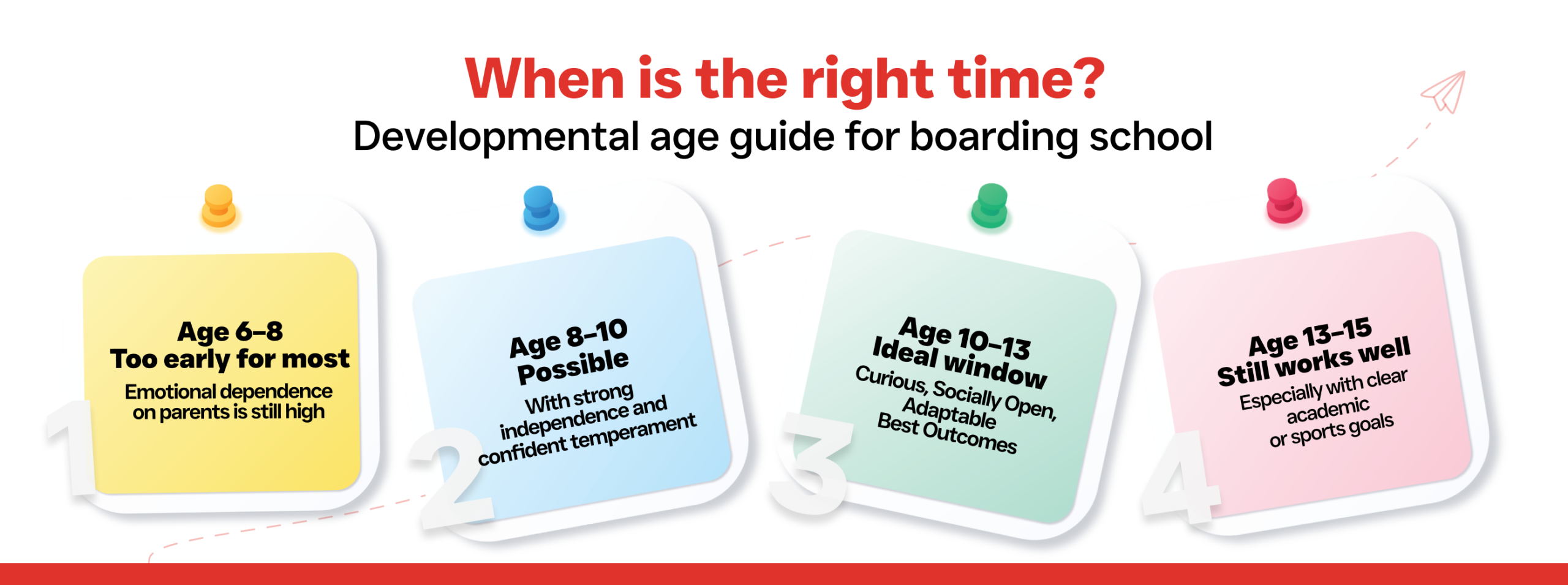
Child development experts and leading boarding schools in India generally agree that ages 8 to 13 form the ideal window for starting residential school. Here is why this range makes sense developmentally.
Before age 8, most children are still deeply attached to their primary caregivers. They rely on parents to co-regulate their emotions, meaning they often cannot manage stress, frustration, or homesickness on their own. Sending a child to board at this age is not impossible, but it requires exceptional emotional support from the school.
After age 13, children have often formed strong social habits and friend groups at their current school. Adjusting to an entirely new environment, new classmates, new routines, new adults can be harder. Emotional maturity develops well in these years, but so does resistance to change.
The sweet spot tends to be around Class 5 to Class 8, roughly ages 10 to 13 when children are curious, socially open, and starting to enjoy independence, but still adaptable enough to settle into a new home away from home.
Factors to Consider Before Sending Your Child to Boarding School
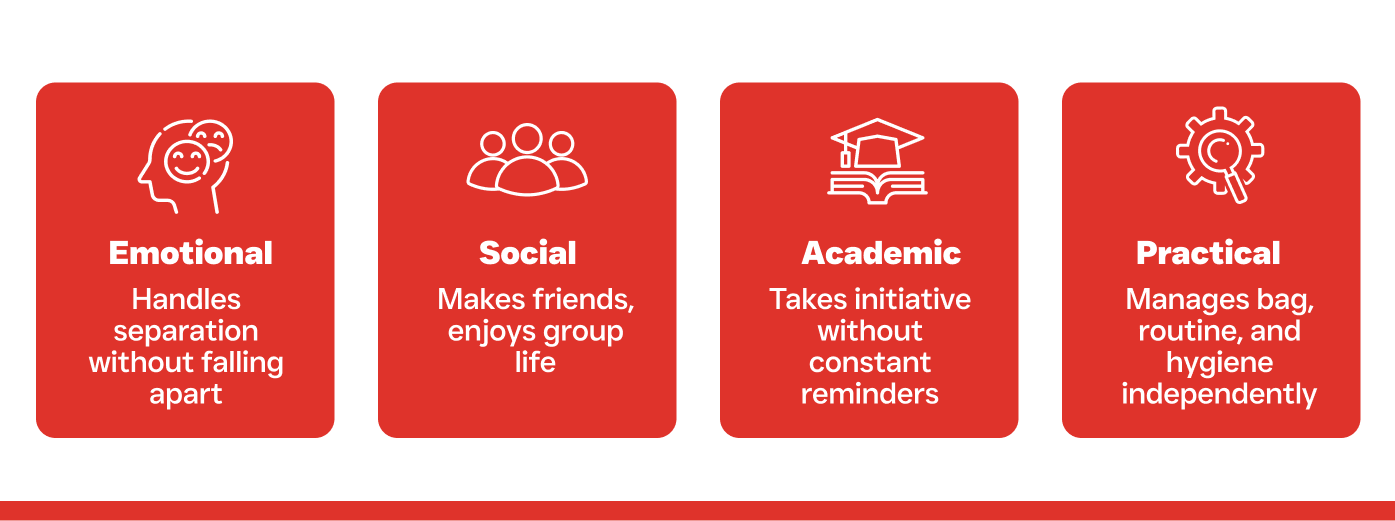
Age is a useful guide, but child readiness for boarding school depends on much more than a birthday. Two children of the same age can be in very different places emotionally and socially. The question to ask is not just ‘How old is my child?’ but ‘How ready is my child?’
Here are the four areas of readiness that matter most:
1. Emotional Readiness
A child who is emotionally ready for boarding school can manage feelings of homesickness and stress without falling apart. They do not need a parent present to feel okay. They can ask an adult for help when they need it and bounce back after a hard day.
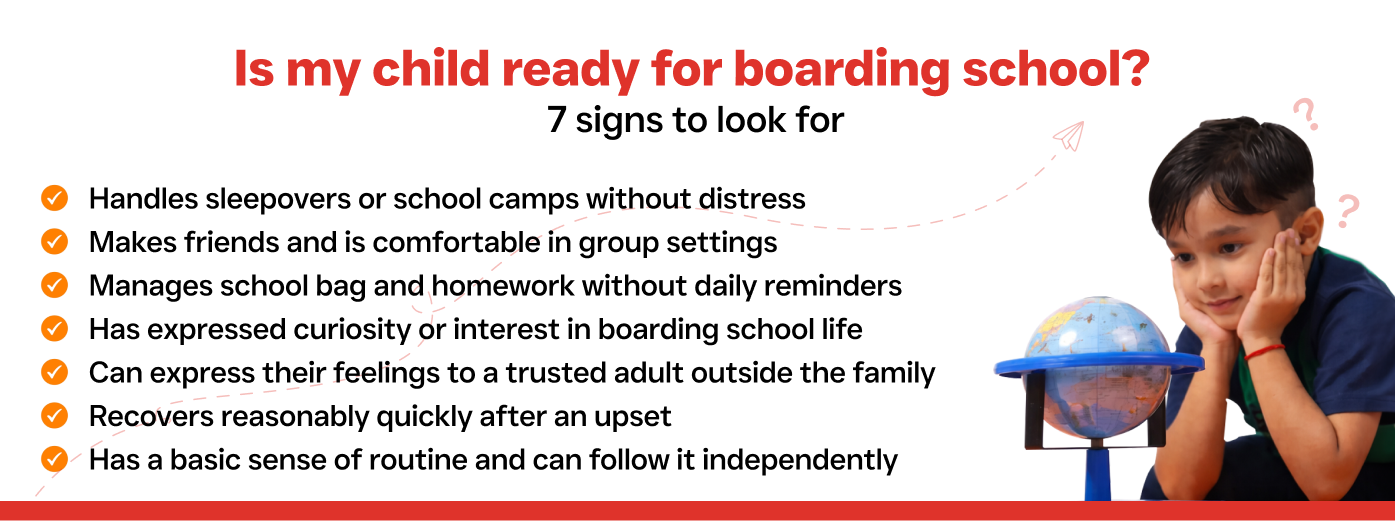
Signs to look for: your child handles short separations (like sleepovers or school camps) well, can express their feelings in words, and generally has a stable, positive mood even in unfamiliar situations.
2. Social Readiness
Children who enjoy meeting new people and thrive in group settings usually adapt faster to residential school life. Boarding school is, at its core, a deeply social experience. Children share rooms, eat together, study together, and spend most of their time in the company of peers.
Signs to look for: your child makes friends relatively easily, enjoys group activities, and does not rely entirely on one or two friends for their sense of belonging.
3. Academic Readiness
Boarding schools are structured learning environments. Children are expected to attend classes, complete homework, manage their own study schedules, and take responsibility for their academic progress without a parent reminding them every evening.
Signs to look for: your child can follow multi-step instructions, organises their schoolwork reasonably well, and takes some initiative with studies without being constantly pushed.
4. Practical Independence
Day-to-day life at a boarding school involves managing your own belongings, following a daily routine, maintaining personal hygiene, and making small decisions independently. This is often called self-discipline in boarding school, and it is one of the biggest benefits but the child needs some foundation of it already in place.
Signs to look for: your child can pack their own bag, remember their responsibilities without reminders, and manage simple tasks like tidying up or getting ready on time.
Is My Child Ready for Boarding School?
What the Research Says About Early Independence
Studies on children who attend well-run residential schools consistently show positive long-term outcomes, particularly when the transition is made at the right time and with the right school.
- Students from boarding schools tend to develop stronger life skills: time management, self-regulation, and resilience, compared to peers in day schools.
- Children who board during their middle school years (Class 5–8) adapt more smoothly than those who join in Class 9 or 10, when academic pressure is already high.
- Research indicates that peer learning, a natural outcome of residential living, significantly accelerates social and cognitive development.
- Schools with a structured routine and strong pastoral care reduce the effects of homesickness in children significantly within the first 4–6 weeks.
What About Children Who Are Shy or Introverted?
This is one of the most common concerns parents bring up. Many assume that boarding school is only for outgoing, confident children. That is not true.
In fact, many quieter children thrive in boarding environments because the school becomes a safe, predictable world they can learn to navigate on their own terms. The key is the quality of pastoral care at the school, having house parents and school counselors for boarding students who check in regularly, notice when a child is struggling, and act quickly.
If your child tends to be shy, it is worth visiting the school and specifically asking: Who notices if a child is having a hard time? What does the support system look like in the hostel?
The Biggest Mistake Parents Make
Most parents focus almost entirely on the age question. The bigger mistake, however, is not thinking enough about which school you are choosing.
A child at the right age but in the wrong school will struggle. A child in the right school, one with excellent pastoral care, a warm hostel environment, trained staff, and a structured but nurturing routine will almost always find their feet, even if they are younger than the “ideal” age window.
Before you ask ‘Is my child ready for boarding school?’ also ask: Is this school ready for my child?
How Dhruv Global School Sangamner Supports This Transition
At Dhruv Global School’s residential campus in Sangamner, Maharashtra, the boarding experience is built around one central belief: every child needs to feel at home before they can grow.
The school follows a structured daily routine that builds self-discipline naturally through predictability. Students wake up, study, eat, play, and rest at consistent times. Within weeks, most children stop counting the days until they go home and start engaging fully with the life in front of them.
The Sangamner campus offers open-plan learning spaces, dedicated sports infrastructure, and a yogic values framework that grounds students in calm and self-awareness. House parents and counselors are present around the clock not just during school hours, so no child is navigating the adjustment alone.
Parents who visit often say the same thing: the campus does not feel like an institution. It feels like a community.
Children who join in Class 5 or 6 typically show the smoothest transitions, but the school’s support structure is designed to welcome students at Class 7 or 8 as well, with dedicated orientation programmes and buddy systems that make day one feel less overwhelming.
Final Thoughts
The right age for boarding school is not a number, it is a moment of readiness. It is when your child is curious enough to explore, independent enough to manage, and supported enough by the school to feel safe while doing it.
If your child is between 10 and 13, shows reasonable independence, and you are considering a school with genuine pastoral warmth, this is likely the moment. Trust what you observe in your child, not just what the calendar says.
And if you are still not sure, the best next step is a campus visit. See the hostel. Meet the house parents. Watch how the existing students carry themselves. That will tell you more than any checklist.