Your child asks a chatbot why volcanoes erupt. Within seconds, it delivers a tidy explanation, a few examples and a confident conclusion. It may even sound more polished than a textbook. That is the moment many parents now recognise: useful, impressive and slightly unsettling.
The question is no longer whether children will meet AI. They already do thorough search, learning apps, voice assistants and chatbots. The more useful question is how we help them stay thoughtful when a machine sounds sure of itself. A recent parent described their ten-year-old turning in homework that sounded unlike her usual writing. Another worried that an AI tool had become a shortcut for every small question. Those concerns are reasonable.
Quick answer: AI literacy at home means helping children use AI with judgement, not fear. Teach them to pause, check sources, protect private information, notice what may be missing and do their own thinking first. Parents do not need to be technical experts; shared exploration and clear family boundaries are enough to begin.
Why does AI literacy matter for school-age children?
AI can help a child brainstorm questions, practise a language, explain a difficult idea or receive feedback on a draft. But generative AI can also produce incorrect details, invented sources and confident-sounding guesses. UNICEF encourages families to explore AI together and talk about what it can and cannot do. UNESCO also calls for human-centred, age-appropriate use in education.
That makes AI literacy a learning skill, not a software skill. Children need to ask better questions, compare information and decide when a tool is not the right place to turn. The goal is not to make every child suspicious. It is to make them careful and capable.
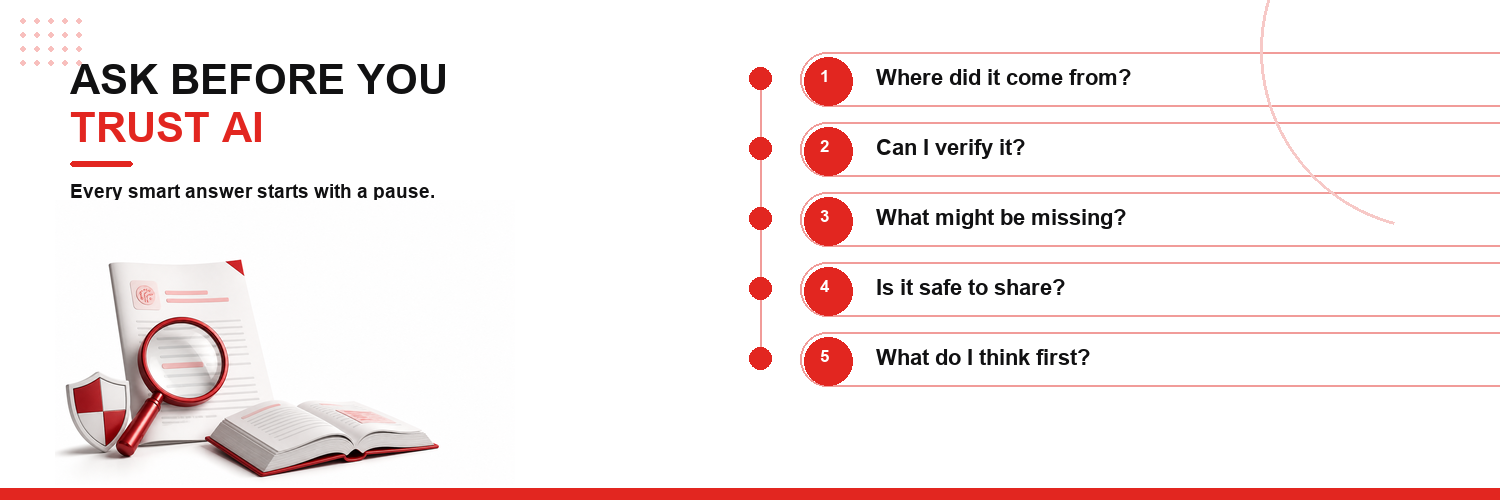
Question 1: Where did this information come from?
The first question is simple: “What is the source?” A chatbot may not show where an answer came from. It can combine patterns from many texts, and it may present a made-up reference with the same confidence as a real one.
At home, choose one low-stakes question, perhaps a science fact or a historical event. Ask the tool for an answer, then ask your child to find the same information in a reliable book, museum, university or official education website. The point is not to catch the tool out. It is to practise tracing a claim back to evidence.
Question 2: Can I verify it somewhere reliable?
One source is rarely the finish line. Show children how to compare a chatbot response with two credible sources. They can check the author, date and purpose of a page. They can also ask whether the answer gives evidence, or simply sounds persuasive.
This is a useful habit far beyond AI. It strengthens research, reading and writing. If a source disagrees with the chatbot, do not rush to declare a winner. Ask: “What is different here? Which source explains its evidence?” That is real learning.
Question 3: What might be missing, outdated or biased?
Every answer has limits. A tool may leave out local context, simplify a debate or repeat a common assumption. This matters especially when children ask about current events, people, health or culture.
Encourage a short pause after an answer: “Whose point of view is missing?” “When was this information last checked?” “Would a different person describe it differently?” UNICEF notes that children can be curious and capable co-learners in these conversations. Curiosity is the skill to protect.
Question 4: Is it safe to share this detail?
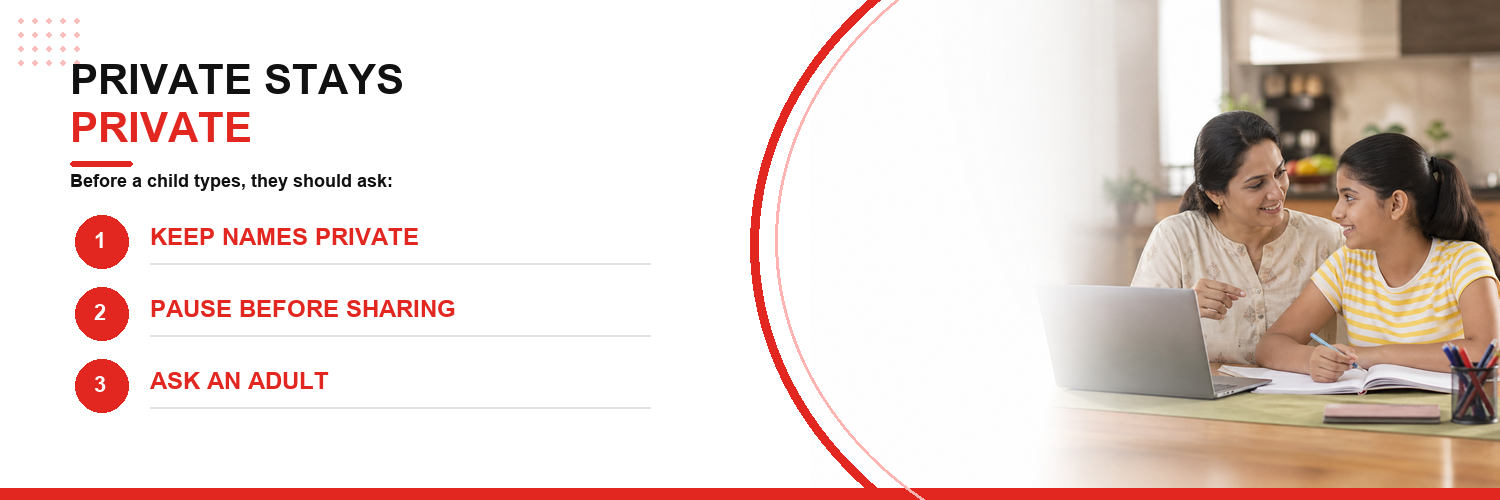
Keep the rule practical. If the prompt would feel uncomfortable on a classroom wall, it should not be typed into a tool. For school work, children should follow their teacher’s guidance and use approved tools where those are available.
Question 5: What is my own thinking before I use this answer?

This is the question that protects learning. A child can begin with their own rough idea, then use AI to ask for an example, an explanation at a different level, a quiz or feedback on a draft. They should not ask it to complete the thinking for them.
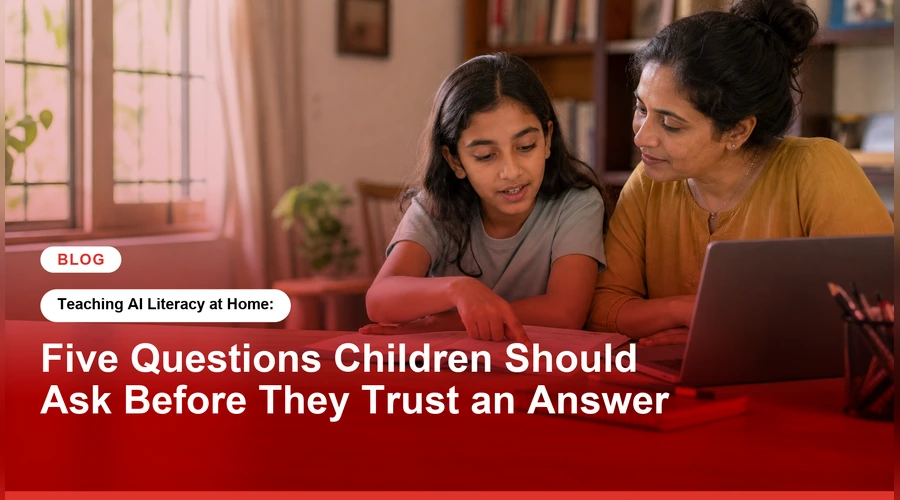
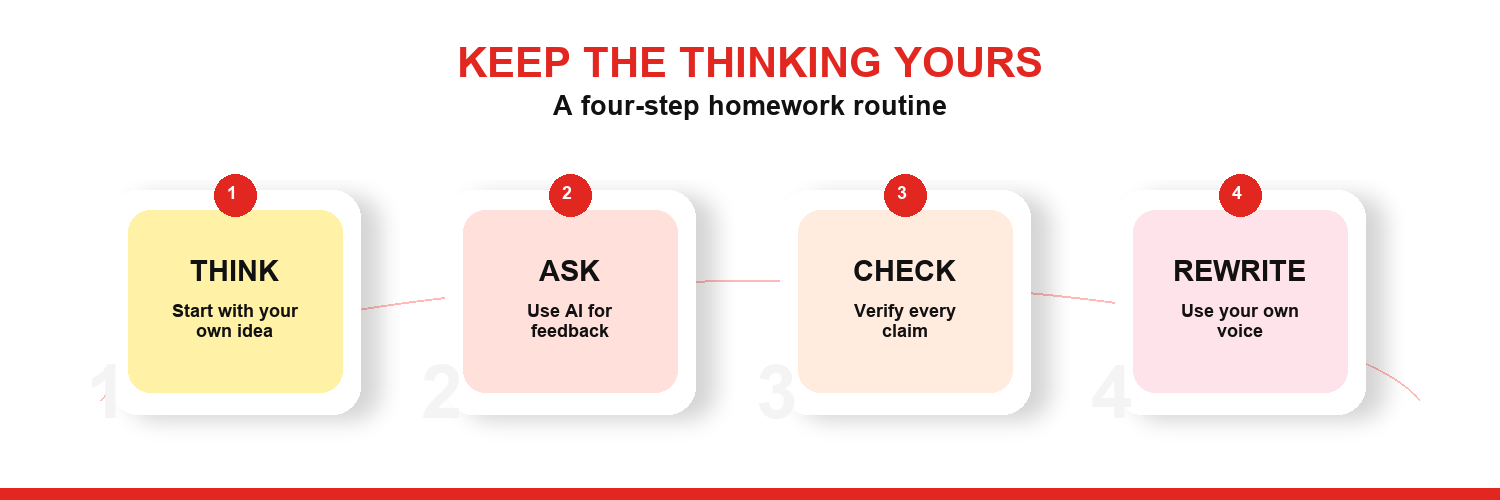
Try a family homework routine: first attempt, then tool, then check, then rewrite in the child’s own voice. If AI helped, encourage honesty about how it was used. The finished work should still show the child’s understanding.
What are the common mistakes parents can avoid?
Many parents understandably assume the only options are a total ban or total freedom. Neither creates much practice. A better approach is guided use: short shared sessions, clear privacy rules and conversations about when AI is helpful.
Avoid treating every AI question as a test of your own knowledge. Say, “Let’s find out together.” Children learn more from seeing adults check, revise and admit uncertainty than from receiving a perfect answer.
How can schools and families work together on AI literacy?
Dhruv Global School, a CBSE school with campuses in Nande, Undri and Sangamner, sees future-ready learning as more than using the newest tool. It is the ability to think critically, communicate clearly and use technology responsibly. The CBSE has also shared Computational Thinking and AI resources for Classes III to VIII, making family conversations especially timely..
Ask your child’s teacher how AI is approached in class, which tools are approved and what good use looks like for a particular assignment. Then keep the same language at home: think first, verify carefully and protect privacy. Small routines create strong judgement.
Final Thoughts
AI will be part of children’s learning lives, but it does not need to replace curiosity, effort or independent judgement. The most valuable family rule is simple: pause before you trust an answer.
When children learn to ask where information came from, check it carefully, protect their privacy and add their own thinking, they gain skills that matter far beyond any one tool. A few calm conversations at home can help them become confident, responsible and thoughtful users of technology.