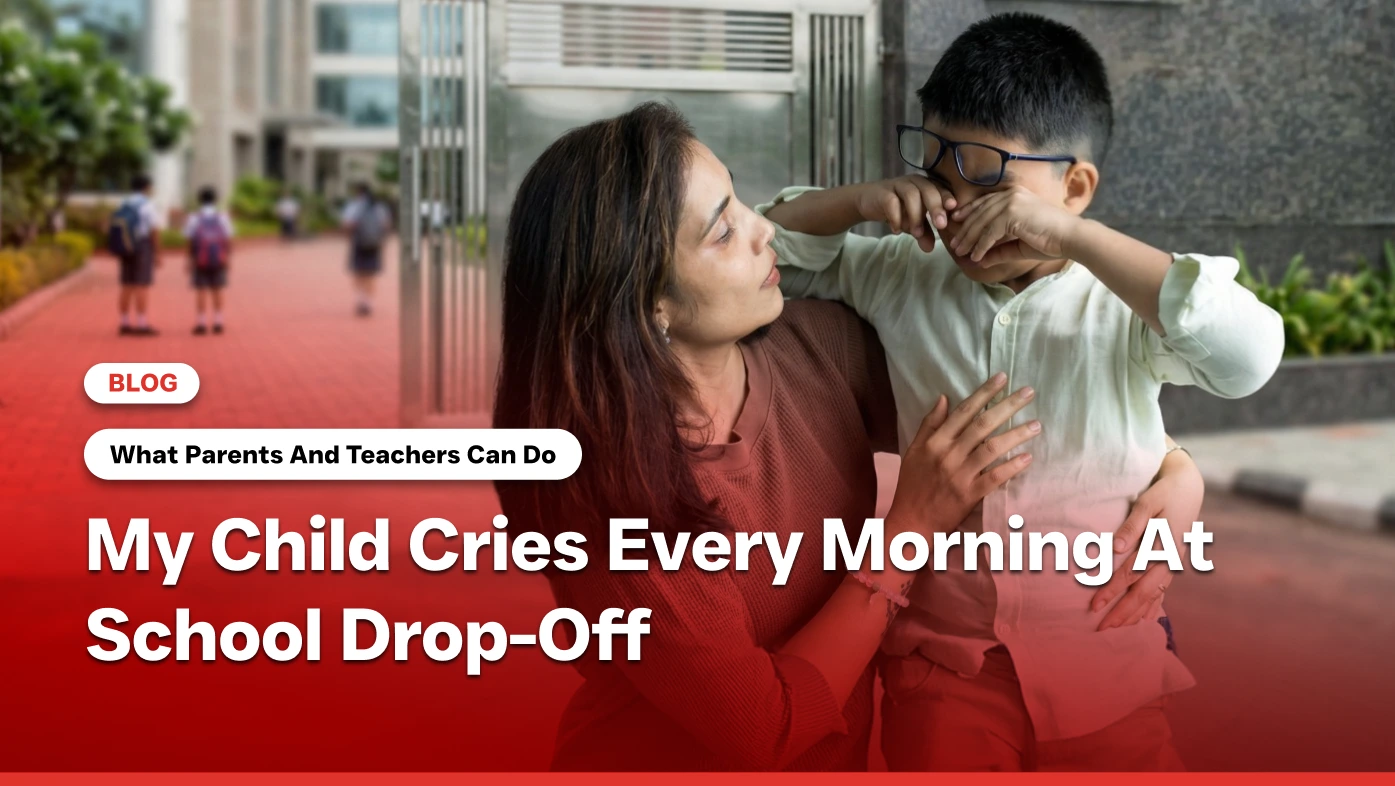
You unbuckle the seatbelt. You walk to the classroom door. You crouch down, say your goodbye and then it starts. The bottom lip trembles. The arms wrap around your leg. The crying begins. And five minutes later, you are sitting in your car in the school car park wondering whether you have done something terrible.
If this is your morning, you are not alone. Drop-off tears are one of the most searched parenting concerns every June and July across India, right as the new school year begins. And they are one of the things that teachers at Dhruv Preschool see most frequently in the first weeks of term.
Here is the most important thing to know before reading any further: in almost every case, your child stops crying within minutes of you leaving. The tears at the door rarely tell the full story of what happens inside the classroom. This blog will help you understand why drop-off distress happens, what you can do about it, and when, if ever, it is time to be concerned.
Why Children Cry at Drop-Off and Why It Is Actually a Good Sign
The scientific term for what your child is experiencing is separation anxiety and it is a completely normal part of early childhood development. According to Stanford Medicine, separation anxiety typically begins around 10 to 18 months and is most intense between ages 2 and 3. For many children, it shows up again or intensifies at the start of preschool, which often falls right in this developmental window.
Here is the reason it happens, explained simply: young children do not yet have a reliable sense that things and people continue to exist when they cannot see them. When you leave, their brain does not yet fully trust that you will come back. Crying is not manipulation. It is not a sign that something is wrong with your child or with the school. It is their nervous system responding to what feels, in that moment, like a genuinely big deal.
And here is the reassuring part: the fact that your child is distressed when you leave is a sign that a healthy attachment has formed between you. Children who have never formed strong bonds with a caregiver often do not cry at separation at all. The tears, as hard as they are to witness, are evidence that your relationship with your child is secure.
What Parents Can Do: Before, During, and After Drop-Off
The way you handle drop-off has a significant impact on how your child experiences it and how quickly it improves. Here are the strategies that early childhood experts consistently recommend.
Before drop-off: set the morning up well
Rushed, chaotic mornings make drop-off harder. When a child is already dysregulated from a stressful morning: late wake-up, skipped breakfast, hurried dressing, they have fewer emotional resources available to handle the goodbye.
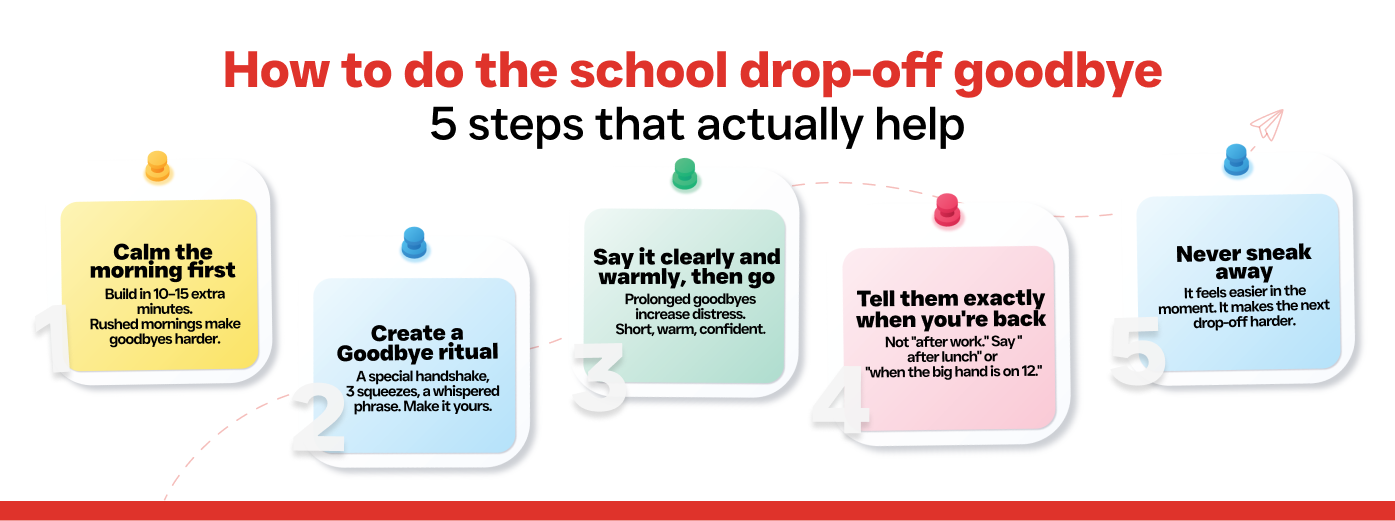
- Build in 10–15 extra minutes so mornings feel calm rather than pressured.
- Keep a consistent morning routine. Predictability is calming for young children, the brain finds comfort in knowing what comes next.
- In the car or just before arrival, use positive, honest language not over-the-top enthusiasm. ‘You’re going to have a great day. You’ll paint and play with your friends, and I’ll pick you up after lunch.’ Simple and true is better than performing excitement.
- Avoid asking ‘Are you nervous?’ or ‘Are you going to cry today?’ These plant the idea that distress is expected.
At the door: the goodbye that actually helps
This is the moment that matters most. Child psychologists and early childhood educators agree on a clear set of principles for the goodbye itself:
- Keep it short and warm. A drawn-out goodbye makes anxiety worse, not better. Research consistently shows that prolonging the farewell increases distress for the child and the parent. Say your goodbye clearly, warmly, and with confidence. Then go.
- Keep a consistent morning routine. Predictability is calming for young children, the brain finds comfort in knowing what comes next.
- Create a goodbye ritual. A special handshake, a forehead kiss, three squeezes of the hand, a whispered phrase, something that belongs only to the two of you. Rituals signal to a child’s nervous system: this is familiar, this is safe, this is how goodbye goes. Children who have a consistent goodbye ritual settle faster.
- Tell them exactly when you are coming back in terms they understand. Not ‘after work’ but ‘after lunch’ or ‘when the big hand is on the 12.’ Concrete time markers reduce the open-ended uncertainty that fuels anxiety.
- Never sneak out. It is tempting when the crying starts, but leaving without saying goodbye makes the next drop-off harder. It teaches your child that you can disappear without warning, which is far more frightening than a tearful goodbye.
- Project calm, even if you do not feel it. Children read parental anxiety with remarkable accuracy. If you look tearful or guilty as you leave, your child registers it and becomes more distressed. Take a breath. Smile. Walk away with your shoulders back
After drop-off: what to do with your own feelings
Many parents spend the first hour after drop-off unable to concentrate, convinced their child is still crying. This is understandable, but almost always inaccurate.
If you are genuinely worried, call the school 15–20 minutes after drop-off and ask how your child is doing. In the vast majority of cases, teachers will tell you that your child settled within minutes of you leaving and is now happily absorbed in an activity. Hearing this once is often enough to break the cycle of parental worry that actually without meaning to prolongs the drop-off pattern at home.
Pick up on time, every day. Being late for pick-up can undo weeks of progress. It confirms the fear that you might not come back. If something changes and you will be late, ask the school to let your child know.
What Teachers Can Do: The First Few Minutes After the Parent Leaves
The transition from parent to classroom is the most important moment in a preschool child’s day. What happens in the first two to three minutes after a parent leaves determines how the rest of the morning goes.
At Dhruv Preschool, our teachers are trained in what early childhood professionals call transition support, a set of active, relationship-based strategies that help children move from distress to engagement. These are not tricks. They are rooted in how the young brain actually works.
Meet the child at the door
Offer a specific, immediate invitation
Broad statements like ‘come and play!’ are too open-ended for an anxious child. A specific, concrete invitation works better: ‘Come and see what we have in the water table today’ or ‘Riya is waiting for you at the art corner.’ A child who has something specific to go to has somewhere to put their attention, which is exactly what is needed in that moment.
Use a comfort object as a bridge
A comfort object from home, a small toy, a photo of the family, and a little something from a parent’s bag can be enormously helpful in the early weeks. It gives the child something tangible that connects them to home while they are at school.
Breathing and calm-down tools
Communicate with parents briefly but reliably
A quick message to a parent 15 minutes after drop-off, ‘She settled beautifully and is painting with her friends’, does more to ease the morning-drop-off pattern than almost anything else. When parents know their child is genuinely okay, they carry less anxiety into the next morning. And less parental anxiety means a calmer drop-off. It is a positive feedback loop that teachers can actively create.
Things that feel helpful at drop-off but often make it harder
- Sneaking away without saying goodbye, increases unpredictability and fea
- Returning when the child cries after you've said goodbye, teaches that crying brings you back
- Repeatedly reassuring and prolonging the goodbye, escalates, not reduces, distress
- Saying 'don't cry' or 'big children don't cry', dismisses the feeling without addressing it
- Asking 'are you okay?' in a worried tone, signals to the child that they should not be okay
- Peeking through the window after leaving, children who see a parent hovering become more distressed
How Long Does This Usually Last?
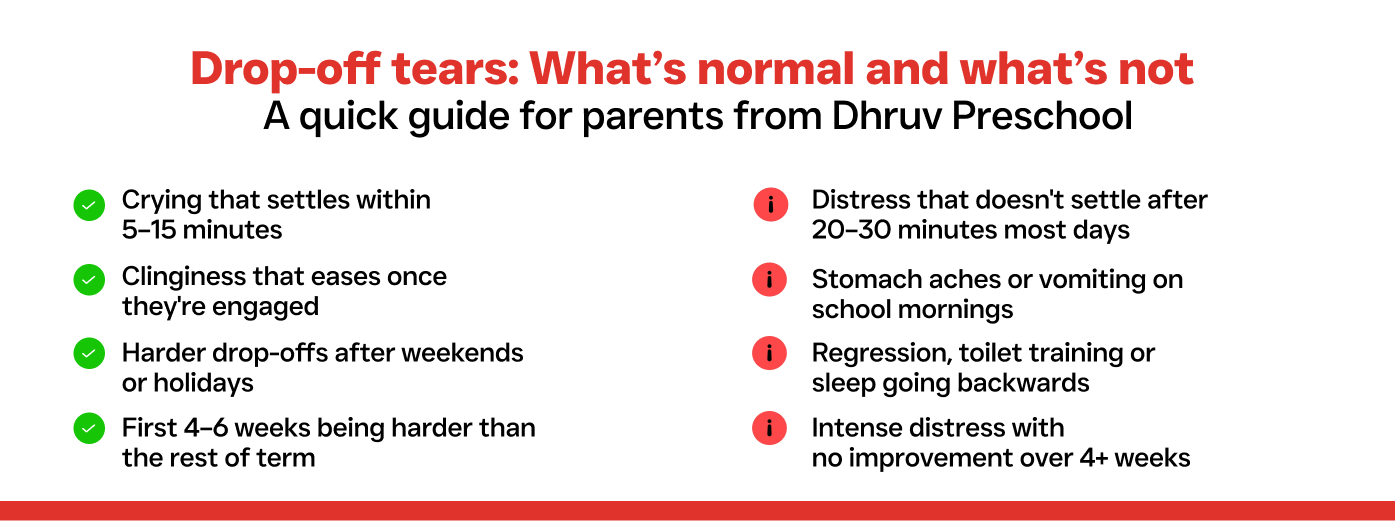
Most children who experience drop-off distress show meaningful improvement within two to four weeks, provided the strategies above are being applied consistently. The first week is almost always the hardest. By week three or four, most children are walking into school with little or no protest, even if they had been inconsolable on day one.
Some children take six to eight weeks to fully settle and that is still within the range of normal. The children who take longer are often those who are naturally more sensitive, those who had no prior experience of being away from a parent, or those who started preschool at a younger age.
The one thing that reliably extends the settling-in period is inconsistency from either side. Drop-offs that vary wildly in how they are handled, or days where parents give in and take the child home, reset the process and make it harder the following day. Gentle, warm consistency is the single most important ingredient in a successful settling-in period.
How Dhruv Preschool Supports Families During Settling-In
At Dhruv Preschool in Aundh, Pune, we know that drop-off is not just the child’s experience, it is the whole family’s. The parent walking back to the car with a heavy heart needs as much support as the child standing at the classroom door.
In the first two weeks of term, our teachers are specifically positioned at the entrance for drop-off. Every child is greeted by name. Every parent who looks worried is given a brief, honest update. We do not offer generic reassurance, we tell you what your child is actually doing in the classroom.
Our classrooms are designed to make the transition as gentle as possible. Children arrive to find familiar activities already set out, things they have done before and feel confident with. This means there is something welcoming and manageable waiting for them from the first moment they walk in, before the uncertainty of a new day has a chance to take hold.
We also work with parents individually when settling-in is taking longer than expected. If your child is still finding drop-off very difficult after three weeks, we will sit down with you, not to worry you, but to look together at what adjustments might help. You are a partner in this process, not just a bystander.
A Final Word for the Parent in the Car Park
If you are reading this sitting outside school, wondering whether you have made a mistake, you have not. The tears at the door are not a verdict on your parenting, your child, or your school. They are a brief but loud chapter of a story that almost always ends well.
Your child is learning something genuinely hard: that the people they love can go away, and come back. That the world is safe enough to explore without you right there. That they are capable of more than they think. These are not small lessons. They are the foundations of confidence and independence.
Stay consistent. Trust the process. And if you are not sure, talk to your child’s teacher. That is exactly what we are here for.