It is 8:10 in the morning. One shoe is on. The other has disappeared. Your preschooler wants the red cup, not the yellow one. You have already said that the red cup is in the sink, and now the crying has filled the kitchen.
Many parents know this moment well. It can leave you wondering whether your child is unusually sensitive, whether you are being too soft, or whether every morning is going to feel this hard.
Here is the most important thing to know before reading any further: emotional regulation is not a skill preschoolers are expected to have mastered. It is a skill they learn slowly through repeated, supportive everyday experiences.
What Is Emotional Regulation in Preschoolers?
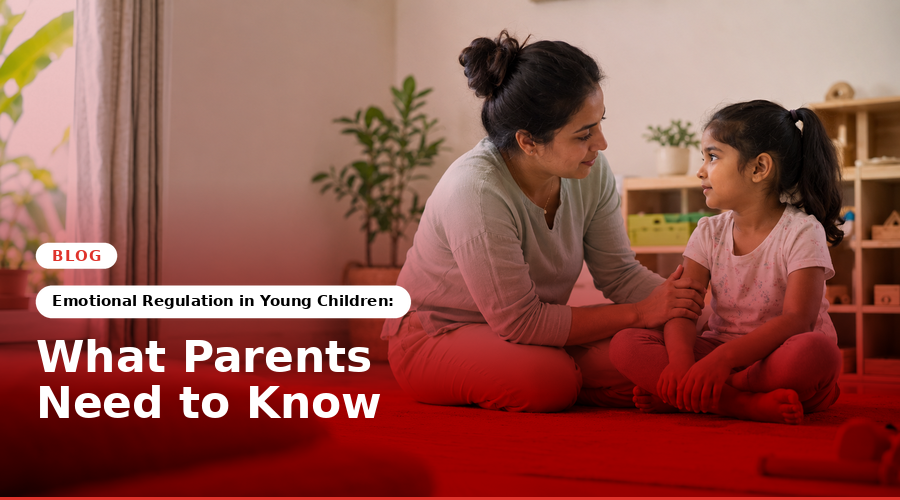
Emotional regulation means noticing a feeling, settling the body enough to respond, and eventually choosing a safer or kinder action. For a three- or four-year-old, this usually happens with an adult nearby. A child borrows your calm before they can create much of their own.
Routines help because they make the day easier to predict. When children know that breakfast comes after getting dressed, that a story comes after bath time, or that Mummy returns after snack time, they do not need to solve the whole day at once. Their body receives a small message of safety: I know what is happening next.
The routine itself does not remove disappointment. Your child may still protest the yellow cup. But a familiar sequence gives you a calmer place from which to meet the protest.
What emotional regulation looks like in the early years
- A toddler cries, then accepts a cuddle and returns to play.
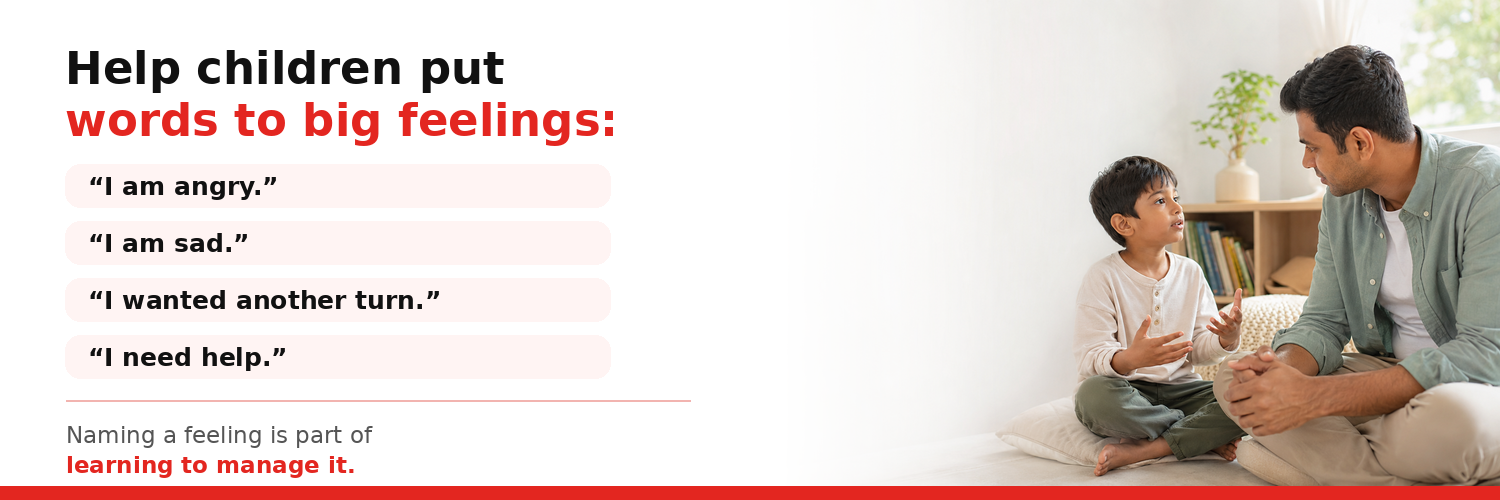
- A preschooler says “I am angry” after being given words for the feeling many times.
- A child waits briefly for a turn with teacher support.
- A child begins to use a familiar strategy: belly breathing, a quiet corner or a comfort object.
Why Do Preschoolers Have Such Big Emotional Reactions?
Preschoolers have strong wishes and a growing sense of independence. They can imagine the red cup, the extra cartoon or the first turn on the swing very clearly. Yet their ability to pause, manage disappointment and find a different plan is still developing. That gap is why a small change can look like a very large reaction. A tired child who cannot find a favourite sock is not usually trying to make the morning difficult. They may be overwhelmed by a problem that feels bigger than their current coping skills.
That gap is why a small change can look like a very large reaction. A tired child who cannot find a favourite sock is not usually trying to make the morning difficult. They may be overwhelmed by a problem that feels bigger than their current coping skills.
The American Academy of Pediatrics describes the sudden crying, hitting or shouting often seen around age two as part of children learning to control impulses, feelings and their bodies. The task is not to make every feeling disappear. It is to help the child experience the feeling safely and learn what comes next.
This is also why comparison can be misleading. One child may speak beautifully but struggle at separation. Another may run into class happily but fall apart after a busy birthday party. Regulation grows unevenly, and it changes with sleep, hunger, illness, new siblings, travel and the ordinary demands of the day.
How Morning Routines Can Help Preschoolers Manage Big Feelings
Mornings are often the hardest time to be patient. Adults are watching the clock. Children are moving from sleep into action. For a preschooler, each instruction can arrive as another demand before their body has caught up.
A simple, repeated sequence can lower the number of decisions: wake up, toilet, clothes, breakfast, shoes, goodbye. A picture cue can help children who are not yet reading. So can one short sentence: “First socks, then we choose the song for the car.”
Try to leave room for one small choice inside a non-negotiable routine. “Blue T-shirt or green T-shirt?” is easier for a child to manage than “What do you want to wear?” The child gets agency without carrying the whole decision.
A calmer morning script
- Name the feeling: “You wanted the red cup. You are disappointed.”
- Hold the limit: “The red cup is being washed. Today we have yellow or steel.”
- Offer the next step: “You can choose. I will help you carry it.”
- Keep your voice low and your words short. Long explanations rarely land during a meltdown.
How Everyday Activities Build Self-Control
Emotional regulation is often built in the least glamorous moments. Waiting for a turn with the serving spoon, putting away blocks before another activity, hearing “five more minutes” at the playground: these are small rehearsals for coping with a limit.
The key is not perfect behaviour. The key is practice with support. You might say, “You are still playing. Stopping is hard. Two blocks can go in the basket, then I will do two with you.” The child learns that a difficult feeling can exist alongside a manageable action.
Giving children a small role also matters. A three-year-old can put napkins on the table. A four-year-old can carry a plastic cup or choose which two books go back on the shelf. When children feel included in a routine, they have a little more ownership of the transition around it.
At home, parents and grandparents may each have different ways of responding. The goal is not identical language. It is a shared basic message: feelings are allowed, hurting people is not, and adults will help the child find a safer next step.
Why Transitions Are Difficult for Preschoolers
Transitions are the moments between one thing and another: leaving a grandparent’s house, turning off a screen, moving from play to bath, or walking through the preschool gate. They can be difficult because the child is asked to let go of something they are enjoying before they can fully picture what comes next.
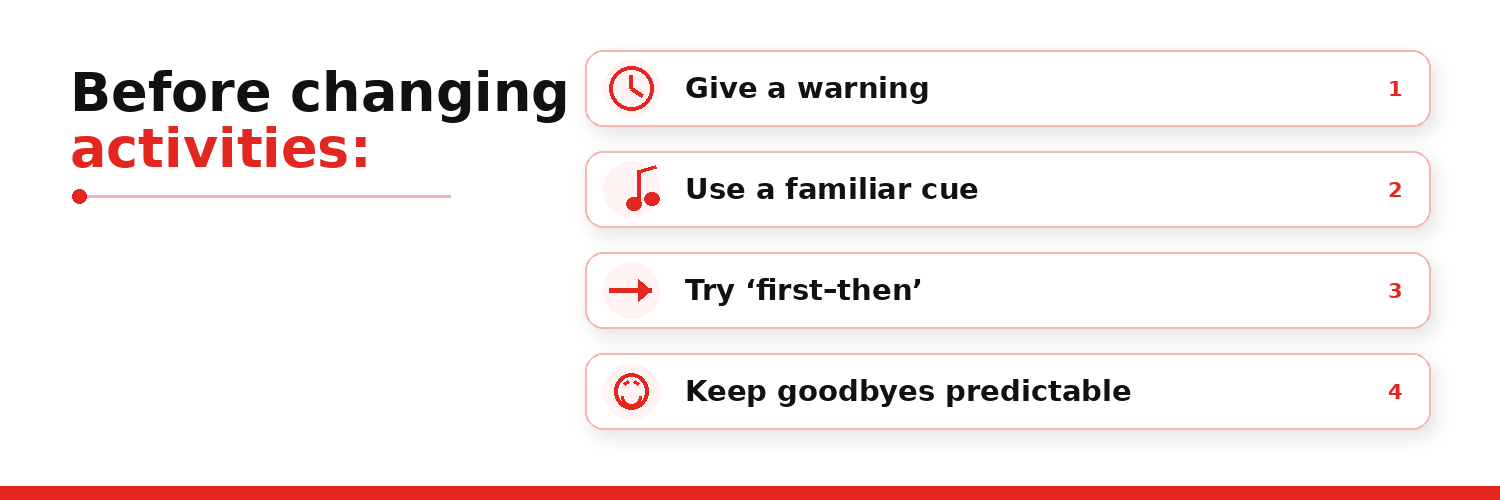
Prepare early when you can. A two-minute warning, a favourite clean-up song, or a visual “first–then” cue gives the child time to shift gears. Keep the message honest. Do not promise “just one minute” if it will be ten.
At drop-off, a predictable goodbye is often kinder than a long negotiation. “One hug, one wave, then your teacher will show you the blocks” gives the child a clear path. Many children need time to settle. The aim is not no tears; it is a growing experience of separation followed by safe reconnection.
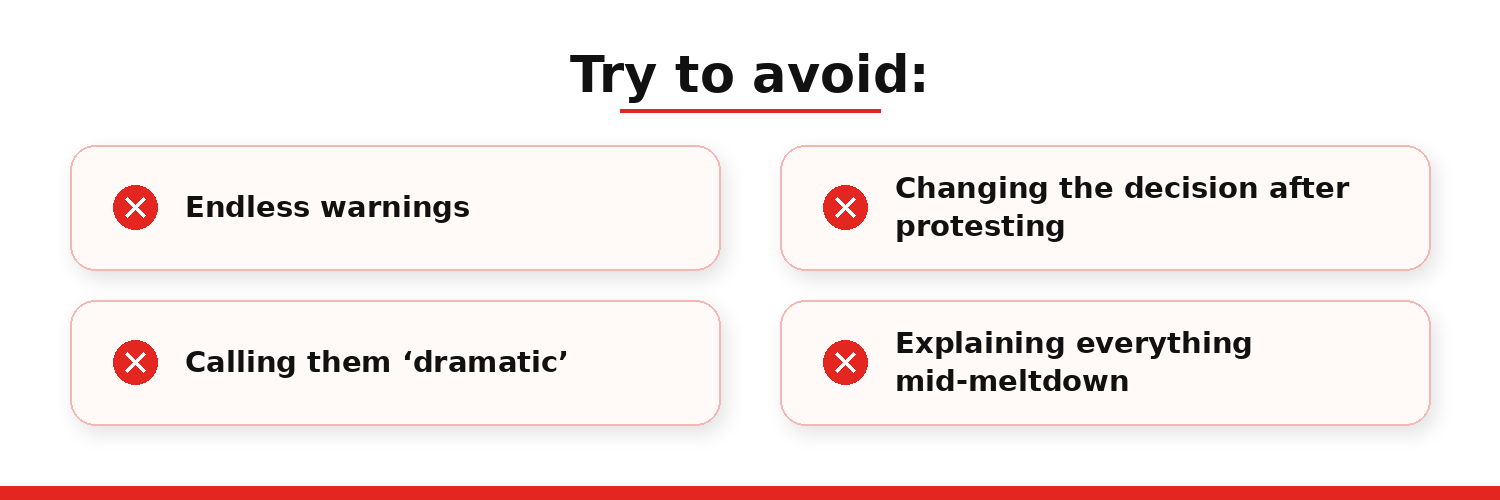
Things that feel helpful but can make transitions harder
- Reopening a decision after the child protests for a long time.
- Giving many warnings with no clear ending.
- Calling a child “naughty” or “dramatic” for being overwhelmed.
- Discussing major routine changes for the first time when the child is already upset.
How Bedtime Routines Support Emotional Regulation
A bedtime routine is not magic, but it is one of the clearest daily opportunities to practise winding down. The sequence can be very small: bath, pyjamas, brush, book, cuddle, bed. What matters is that it is familiar enough for your child’s body to recognise the signal.
If the day has been busy, the first few minutes may still be noisy. Rather than treating this as failure, give the child a bridge. A quiet book, a familiar lullaby, dimmer lights, or a short recap of the day can help them move from activity to rest.
For families with a mix of Marathi, Hindi, English or another home language, use the words that feel most natural when naming feelings. “You are cross”, “tumhe gussa aa raha hai”, or the home-language equivalent all help when said with warmth and clarity. The useful part is not the exact word. It is the repeated connection between body, feeling and support.
How Preschool Routines Support Emotional Regulation
Dhruv Preschool, part of the Dhruv Group of Schools, with branches across Pune, builds emotional learning into ordinary parts of the day: arrival, free play, group activities, snack, outdoor time and goodbye. Teachers create predictable rhythms, notice when a child needs support and offer language for what is happening.
A child may need a teacher nearby before joining a group. Another may need help waiting for a turn. A third may need a quiet moment after a busy activity. These are not interruptions to learning. They are the conditions that make learning possible.
Home-school communication helps here. When parents share that a child has slept poorly, is adjusting to a change at home or is especially attached to a comfort object, teachers can respond with more understanding. The child receives a more consistent emotional message across both worlds.
When To Seek Additional Support
Most big feelings are part of early development. But it is reasonable to seek advice if you are worried about a sudden loss of skills, frequent aggression that is hard to keep safe, distress that does not ease with support, or changes in sleep, eating or connection that concern you. Your paediatrician can help you think through what you are seeing.
You do not have to wait until a problem feels enormous. A short conversation can give you useful language, reassurance or a plan.
Final Thoughts
A child who can feel their feelings without being destroyed by them, who can name what is happening inside them, who can take a breath before they react, and who can come back to connection after a rupture — this child has something that will serve them across every domain of life, in every relationship they will ever have.
This does not happen because we tell children to calm down. It happens because the adults around them model it, name it, practise it, and hold the space for it — calmly, consistently, and with enormous patience, thousands of times before it becomes the child’s own. That is the work. It is unglamorous, repetitive, and one of the most important things you will ever do as a parent.