Education in India is vast and diverse, with numerous boards shaping how students learn, think, and grow. These types of school boards in India differ in curriculum design, academic focus, assessment style, and long-term learning pathways. As we move into 2026, Indian education boards continue to evolve with global trends, digital learning, and the goals of the National Education Policy (NEP) 2020, which promotes flexible education systems, skill-based learning, creativity, and student-centric education.
This 2026 guide on different types of education boards in India explains national and international education boards in India, highlights their features, and helps parents choose the best education board in India based on learning style and future goals.
Why Do Education Boards Matter?
- What your child learns
- How the learning is assessed
- Skills and competencies built along the way
- Recognition of their qualification for college or future careers
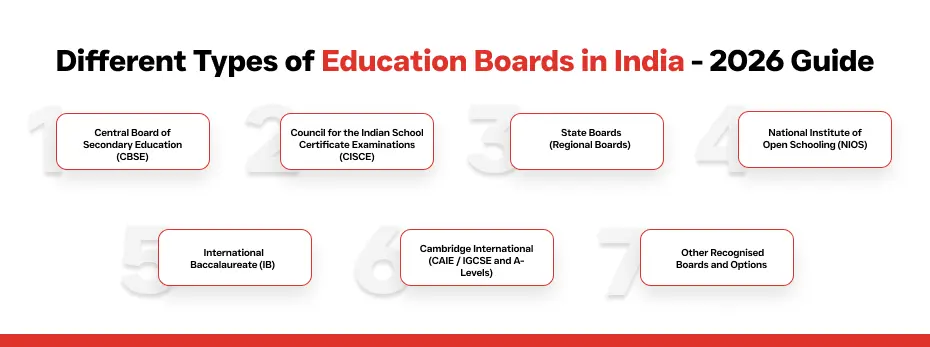
1. Central Board of Secondary Education (CBSE)
The Central Board of Secondary Education is the most widely followed national education board in India. It is governed by the Government of India and is perhaps the most common board in Indian schools. It sets a uniform curriculum that many schools across India follow.
Key Features
- CBSE certificates are accepted across India and in many countries abroad.
- NCERT-based curriculum, which makes learning structured and aligned across schools.
- The approach encourages conceptual understanding rather than rote memorisation.
- Continuous and comprehensive evaluation includes projects and internal assessments, reducing exam pressure.
Best Suited For
- Families who relocate often since CBSE is widely adopted in India.
- Students aiming for national competitive exams like JEE and NEET, as the curriculum aligns with such preparation.
Considerations
While CBSE is flexible and nationally standardised, how well it’s implemented can vary between schools, making school quality as important as board choice itself.
2. Council for the Indian School Certificate Examinations (CISCE)
The CISCE is a private national board in India that offers the ICSE (Class 10) and ISC (Class 12) examinations. It’s known for its rigorous and balanced curriculum.
Key Features
- Balanced syllabus with strong emphasis on languages, sciences, and expressive skills.
- Encourages analytical thinking and detailed understanding of concepts.
- Projects, assignments, and internal assessments are important.
Best Suited For
Students who enjoy deeper academic exploration and strong language learning.
Considerations
Syllabus volume may feel extensive, so students typically benefit from good reading and comprehension support.
3. State Boards (Regional Boards)
Every Indian state has its own education board such as the Maharashtra State Board, Uttar Pradesh Board, or Bihar School Examination Board. These boards design syllabi that reflect local language, culture, and educational priorities.
Key Features
- The syllabus focuses on regional context and local relevance.
- The medium of instruction often includes the state language along with English.
- Commonly followed by state-run and private schools within the state.
Best Suited For
- Families settled in one state long-term.
- Students preparing for state-level competitive exams.
Considerations
Recognition and transferability across states may vary, and curriculum style can differ significantly from national and international boards.
4. National Institute of Open Schooling (NIOS)
The NIOS is India’s largest open schooling board, offering students flexible learning pathways. It is ideal for learners needing personalised pacing or alternatives to traditional classroom schooling.
Key Features
- Flexible model – students can choose when and how to study.
- Offers secondary and senior secondary certifications.
- Students can take exams at time slots best suited to them.
Best Suited For
Learners who need alternative pacing, such as athletes, performers, or students with special learning needs.
Considerations
Though recognised, students should check how specific universities and competitive exams accept NIOS qualifications.
5. International Baccalaureate (IB)
The International Baccalaureate is a globally recognised international education board. It focuses on inquiry-based learning, intercultural understanding, and holistic development.
Key Features
- Programmes for Primary Years (PYP), Middle Years (MYP), and Diploma Programme (DP), spanning age 3 to 19.
- Emphasis on critical thinking, creativity, and research skills.
- Projects, portfolios, and internal assessment play a major role.
Best Suited For
Students aiming for international higher education and those who thrive with exploratory, discussion-based learning.
Considerations
IB programs are often more expensive and require specially trained teachers. They also follow a different pedagogical style that may feel unfamiliar to students used to traditional Indian classrooms.
6. Cambridge International (CAIE / IGCSE and A-Levels)
Cambridge Assessment International Education (CAIE) offers internationally benchmarked programmes like IGCSE (Class 10) and A-Levels (Class 12). These are widely recognised around the world.
Key Features
- Flexible subject choices with broad assessment styles.
- IGCSE focuses on interactive, global curriculum while A-Levels promote specialisation.
- Strong emphasis on English and analytical skills.
Best Suited For
Students preparing for international colleges and those who prefer diverse options in subject combinations.
Considerations
Like IB, these curricula are resource-intensive and may not be available in all cities.
7. Other Recognised Boards and Options
While the boards above cover major pathways, India has many specialized or less common boards, such as the Indian Board of School Education (IBOSE) and other regional councils. These may cater to specific needs or local educational goals.
Emerging international curricula like Western Australian Certificate of Education (WACE) are also beginning to enter the Indian market, expanding forward-looking learning choices.
Comparing Boards: What Makes Each Unique?
| Board | Curriculum Focus | Assessment Style | Recognition | Best Fit |
| CBSE | Concept-based, national | Board exams with projects | National + widely global | Competitive exam preparation |
| CISCE (ICSE/ISC) | Balanced depth with language | Detailed written + oral | National + international | In-depth academics |
| State Boards | Local culture & language | State exams | State-specific | Regional focus |
| NIOS | Flexible pace | Self-paced exams | National | Alternative learners |
| IB | Inquiry & global themes | Portfolios + projects | Global | International universities |
| Cambridge (IGCSE/A-Levels) | Global content | Component-based | Global | Flexible subject choice |
1. CBSE vs ICSE: The Most Common Question
CBSE (Central Board of Secondary Education)
CBSE follows a nationally uniform curriculum designed around NCERT textbooks. It emphasizes concept clarity, especially in Mathematics and Science, and aligns well with competitive exams such as engineering and medical entrance tests.
Key Advantages:
- Widely available across India
- Easier transfer between cities
- Less syllabus load compared to ICSE
- Increasing focus on skill-based and experiential learning
Things to Consider:
- Teaching quality varies by school
- Some schools remain exam-oriented rather than application-focused
ICSE / ISC (CISCE)
ICSE is known for its detailed syllabus and strong language focus. Students study a wider range of topics with emphasis on written expression, analysis, and internal assessments.
Key Advantages:
- Excellent English language development
- Balanced focus on arts, science, and humanities
- Encourages analytical and descriptive answers
Things to Consider:
- Syllabus can feel heavy for some students
- Requires strong reading and writing skills
In simple terms:
- CBSE suits students who prefer structured learning and exam alignment
- ICSE suits students who enjoy depth, reading, and expressive learning
2. CBSE vs State Boards
State boards are designed by individual states and often include regional history, language, and cultural context.
State Boards
Key Advantages:
- Familiar learning environment
- Focus on local context and state-level exams
- Often less academically intense in early years
Things to Consider:
- Curriculum quality varies between states
- Limited national or international mobility
Comparison Insight:
CBSE offers greater national flexibility, while state boards provide strong regional grounding. Families planning long-term settlement in one state often find state boards practical.
3. National Boards vs International Boards
IB (International Baccalaureate)
IB focuses on how students think, not just what they memorize. Learning is inquiry-based, discussion-driven, and connected to real-world issues.
Key Advantages:
- Global recognition
- Strong focus on research, reflection, and critical thinking
- Encourages independent learning
Things to Consider:
- Academically demanding in a different way
- Higher cost and workload
- Requires adjustment for students used to rote learning
Cambridge (IGCSE / A-Levels)
Cambridge offers flexibility in subject selection and assessment. Students can specialise earlier, especially at A-Level.
Key Advantages:
- Globally accepted qualifications
- Flexible assessment methods
- Strong foundation for international universities
Things to Consider:
- Limited availability in some cities
- Requires disciplined self-study
4. NIOS vs Traditional School Boards
NIOS (National Institute of Open Schooling)
NIOS is a non-traditional board offering flexible education for students who need customized learning schedules.
Best suited for:
- Competitive sports students
- Performing artists
- Children with medical or learning needs
- Students who benefit from self-paced study
Key Difference:
NIOS focuses on access and flexibility, while traditional boards focus on classroom-based learning.
How to Choose the Right Board for Your Child
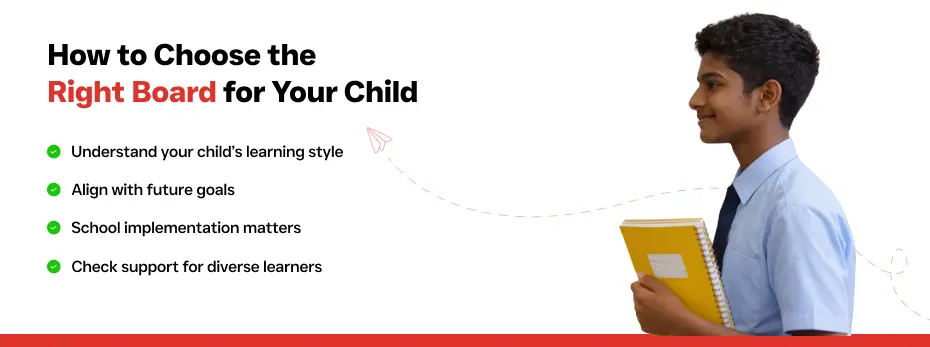
Selecting a board is less about “which is best” and more about what fits your child. Here’s a practical approach:
- Understand your child’s learning style
- Do they love exploration and projects? IB or Cambridge might suit.
- Do they prefer structured learning and exam rhythm? CBSE or ICSE could work well.
- Align with future goals
- Aiming abroad? International boards help.
- Planning state-based exams? State boards are beneficial.
- School implementation matters more than board name
The same board can be delivered differently in different schools. Quality of teaching, mentoring, and support matters most. - Check support for diverse learners
Inclusive facilities and tailored support systems (like remedial help, counsellors) amplify a child’s success irrespective of board choice.
Final Thoughts
In 2026, Indian education offers flexibility, global exposure, and personalised learning opportunities through a range of boards. Whether your child thrives in structured national frameworks or in dynamic international systems, understanding each board’s strengths helps you make a balanced choice.
The best board is the one that supports your child’s curiosity, confidence, and potential in a school that values both academic excellence and holistic growth.