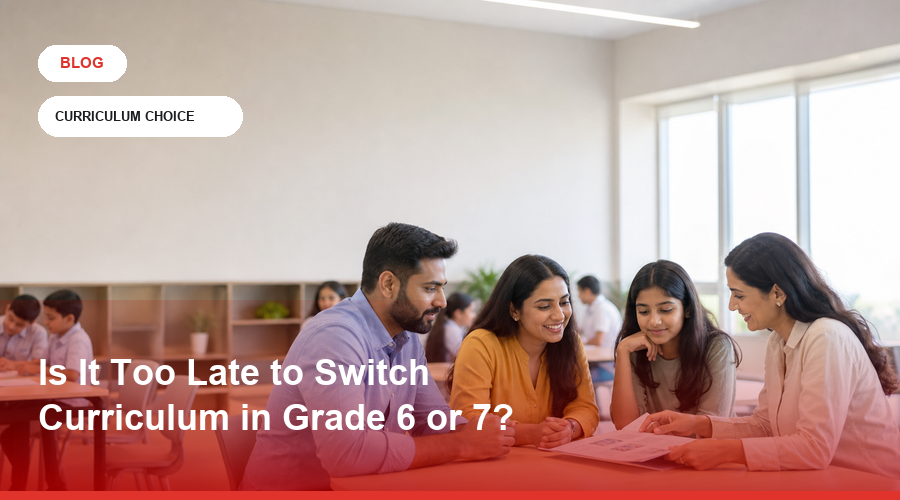
The short answer is yes, a child can move from CBSE to IGCSE. It happens regularly, it can be done well, and for some families it is the right decision. But it is not a simple administrative switch. It involves a genuine curriculum shift, careful timing, documentation, and a clear-eyed understanding of what it means for the road ahead, particularly for families with plans around JEE, NEET, or Indian university admissions.
This guide covers everything an Indian parent considering this transition needs to know: how the two curricula actually differ, the right time to move, the documents required, what happens to Indian university eligibility, and the honest trade-offs on both sides.
An Education World survey from 2025 found that 68% of parents who chose IGCSE cited holistic development as the primary reason, the inquiry-based, application-focused, internationally portable curriculum that Cambridge offers. But holistic development is not the only consideration. This guide helps you weigh all of them.
What Is IGCSE and How Is It Different from CBSE?
IGCSE stands for International General Certificate of Secondary Education. It is offered by Cambridge Assessment International Education (CAIE), part of the University of Cambridge. It is typically studied from Class 9 (Grade 9) to Class 10 (Grade 10) and is the international equivalent of India’s Class 10 board year, followed by Cambridge A Levels (Class 11–12) or other pathways.
IGCSE is not simply a ‘better’ or ‘worse’ curriculum than CBSE. It is a different one, with different strengths, different trade-offs, and different implications depending on what a family’s specific goals are.
| Feature | CBSE | IGCSE (Cambridge) |
|---|---|---|
| Governing body | CBSE – Central Board of Secondary Education, India | CAIE – Cambridge Assessment International Education, UK |
| Recognition | National (India) + CBSE schools globally | International – recognised in 160+ countries |
| Curriculum focus | Structured, NCERT-based, content-heavy. | Inquiry-based, application-focused, broader subject flexibility. |
| Assessment | Annual board exams; internal assessments | Coursework + practical + written papers; no single annual exam |
| Subject flexibility | Defined subject groups; streams from Class 11 | Wide subject choice; student designs their combination |
| JEE/NEET alignment | Direct – NCERT syllabus matches exam content | Possible but requires additional NCERT-based coaching |
| AIU equivalency needed | Not required – CBSE is an Indian board | Required for most Indian university admissions |
| Language of instruction | English and Hindi | English primarily |
| Global portability | Strong within India; recognised internationally | Highly portable – widely accepted by global universities |
The most important practical difference for Indian families: CBSE is an Indian national board, and its credentials are automatically recognised by all Indian institutions. IGCSE is an international qualification, and Indian university admissions require an AIU (Association of Indian Universities) equivalency certificate, an additional step that CBSE students do not face. More on this below.
Why Do Parents Switch Their Child from CBSE to IGCSE?
1. Relocation or international plans
2. Pedagogical preference
3. Child struggling in CBSE
Occasionally, a child who is genuinely capable but not thriving academically in CBSE’s format performs significantly better in IGCSE’s more varied assessment model, where coursework, practicals, and project components allow different forms of ability to register. This is not universal, but it is real.
4. International school environment
In cities like Pune, Bangalore, Hyderabad, and Mumbai, many international schools offer IGCSE alongside or instead of CBSE. Families whose work environments or social circles are international often choose these schools for the cultural fit and IGCSE is the curriculum that comes with that environment.
What Is the Best Time to Switch from CBSE to IGCSE?
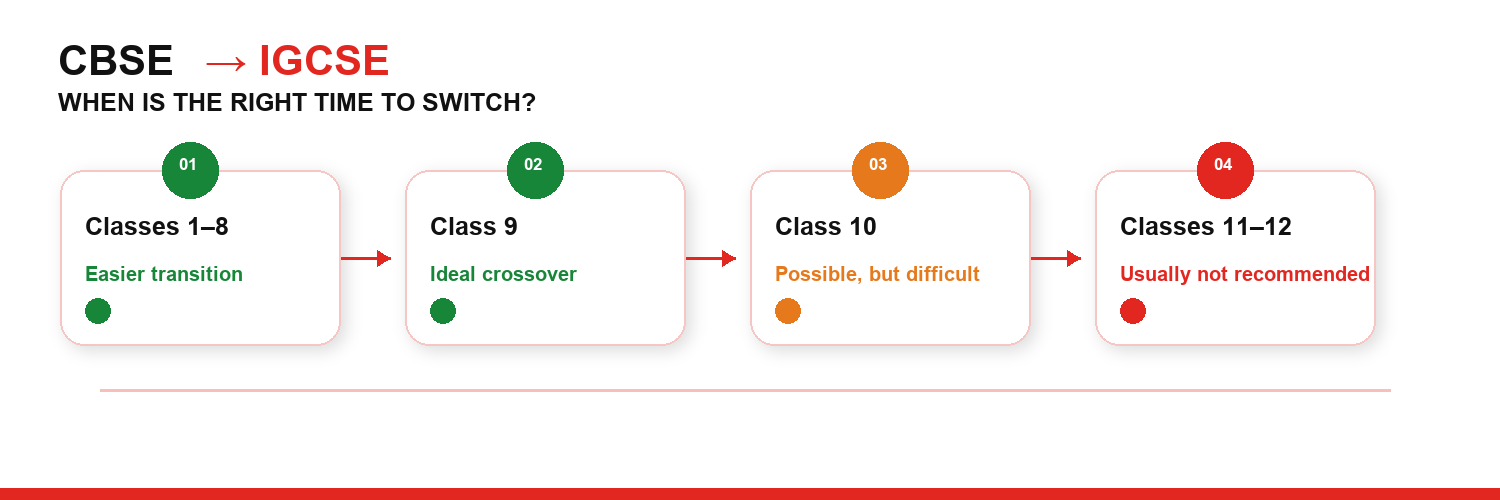
Timing is the single most important factor in making a CBSE-to-IGCSE transition work well. Moving at the wrong point in a child’s schooling creates curriculum gaps, assessment disruption, and unnecessary stress. Here is a clear guide to what each transition point means.
| When | Difficulty | What to Expect |
|---|---|---|
| Classes 1–8 | Most straightforward | Smoothest adaptation. Children are younger, more flexible, and have not yet entered board exam preparation. Curriculum gaps are manageable with targeted catch-up. |
| Class 9 | Ideal crossover point | IGCSE typically begins at Class 9. This is the most natural entry point, structured catch-up possible; two years before IGCSE exams to settle. |
| Class 10 | Possible but tight | Mid-way through the IGCSE cycle. Requires strong prior academic foundation and a school willing to do careful subject-by-subject gap assessment. |
| Class 11–12 | Very difficult | At this stage, the boards have fundamentally different structures. IGCSE has already concluded; A Levels begin. Entry mid-cycle is exceptional and usually not recommended. |
The consensus across education experts, school counsellors, and parents who have made this move: Class 9, the start of the IGCSE cycle, is the optimal transition point. It is late enough that the child has a solid academic foundation from CBSE. It is early enough to properly settle into a new curriculum before high-stakes examinations.
What Changes When a Child Moves from CBSE to IGCSE?
1. From content coverage to application and analysis
2. From annual exams to coursework and practicals
In CBSE, the board examination is the culminating, high-stakes assessment. In IGCSE, assessment is spread across written papers, coursework components, and practicals, depending on the subject. A student moving from CBSE will need to adjust to managing ongoing coursework deadlines alongside preparation for written papers, which requires different time management skills.
3. From defined subject groups to flexible combination
CBSE organises subjects into defined groups for Class 9 and then streams (Science, Commerce, Arts) for Class 11. IGCSE offers significantly more flexibility; a student can take between 5 and 14 subjects in a combination of their choosing from a menu that includes sciences, languages, humanities, arts, and vocational subjects. For a child with interests that cross traditional subject boundaries, this is genuinely liberating.
4. Language adjustment
IGCSE is conducted primarily in English. For children whose CBSE education has involved significant Hindi-medium instruction, or who have relied on Hindi as a support language in Maths or Science, this can be an adjustment. Most IGCSE schools in India deliver primarily in English, but it is worth asking specifically about the school’s language approach for the subjects your child will study.
What Documents Are Required to Transfer from CBSE to IGCSE?
The transfer from CBSE to IGCSE involves paperwork at both ends. Here is what is generally required:
- Transfer Certificate (TC): Issued by the current CBSE school. For State Board or CBSE-to-IGCSE transfers, this must be signed and stamped by the principal.
- Migration Certificate: Certifies that the student has completed their coursework with the previous board. Required for students who have appeared for any CBSE board examination.
- Mark sheets: Report cards and examination results from the previous school. Most IGCSE schools ask for the last 2–3 years.
- Birth certificate: For age verification.
- Aadhar card: Identity verification.
- Medical certificate: Some international schools require a basic health certificate.
- Passport-size photographs: Typically 4–6 copies.
Individual school requirements may vary. Always confirm the exact documentation list with the specific IGCSE school before beginning the process.
Can IGCSE Students Appear for JEE and NEET?
This is where many families pause and rightly so. If there is any possibility of JEE or NEET in your child’s future, the curriculum choice has significant implications.
The direct answer
The practical reality
Both JEE and NEET are deeply aligned with the NCERT syllabus. An IGCSE/A Level student sitting these exams is not just studying a different syllabus, they are studying a different kind of syllabus. JEE in particular tests specific problem-solving patterns built around NCERT Maths and Physics content. An A Level Physics course will produce conceptually strong students, but they will need significant additional NCERT-based coaching alongside their A Level preparation. This is an additional commitment that CBSE students do not face.
The conclusion: if JEE or NEET is a primary goal, CBSE remains the more direct, less complex pathway. IGCSE is not a barrier, but it creates additional work that parents should factor in honestly before making the switch.
What about other Indian university admissions?
For general undergraduate admissions to Indian universities, through CUET or direct applications, IGCSE students need the AIU equivalency certificate. This is issued by the Association of Indian Universities and confirms that the IGCSE/A Level qualification is equivalent to the Indian 10+2. As of September 2025, the Ministry of Education transferred formal responsibility for this equivalency from AIU to NCERT (through its assessment centre PARAKH), this transition is still settling in practice, and families should check current guidance directly with AIU before proceeding.
The AIU certificate is valid for life and costs approximately ₹12,000 for an undergraduate-equivalent qualification. Many private universities now process IGCSE admissions with familiarity, though it is advisable to have the certificate ready.
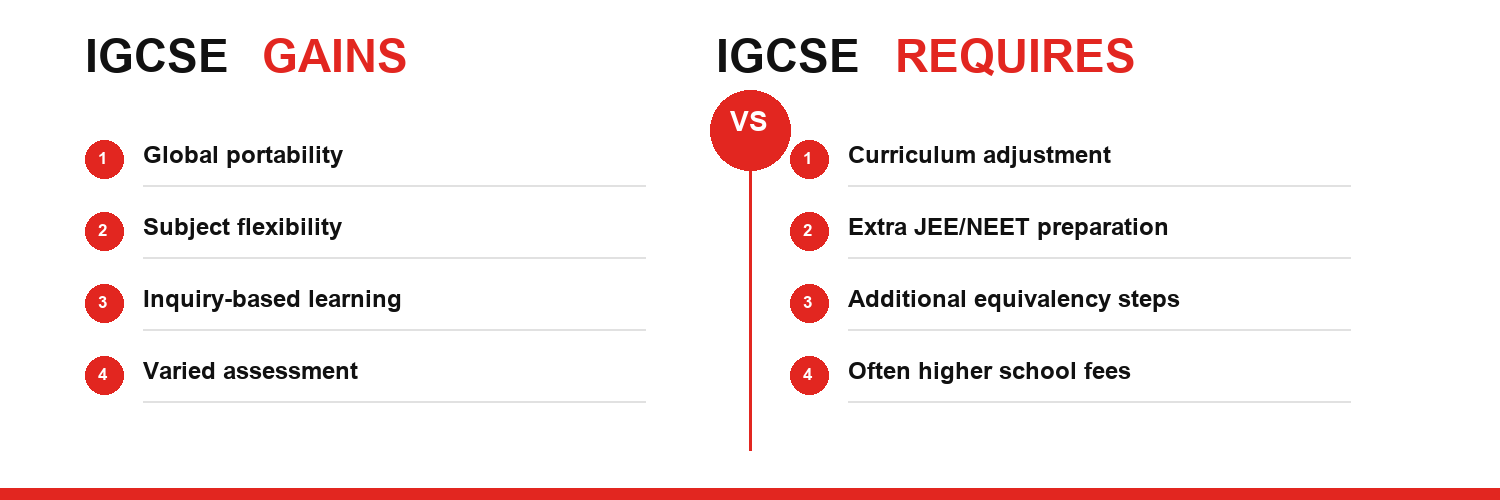
The honest trade-offs — what IGCSE gains and what it costs
IGCSE gains:
- International portability — widely recognised in 160+ countries
- Broader subject flexibility — students design their own combination
- Inquiry and application focus, better suited to analytical, independent learners
- Varied assessment — coursework and practicals alongside written papers
- Potentially stronger preparation for global university applications
IGCSE costs:
- JEE/NEET requires additional NCERT coaching, more work, not less
- AIU equivalency certificate required for Indian university admissions
- Curriculum adjustment takes time, typically 6–12 months to fully settle
- IGCSE schools in India often carry higher fees than CBSE schools
- The September 2025 AIU-to-PARAKH transition means equivalency guidance is still evolving, verify current requirements before committing
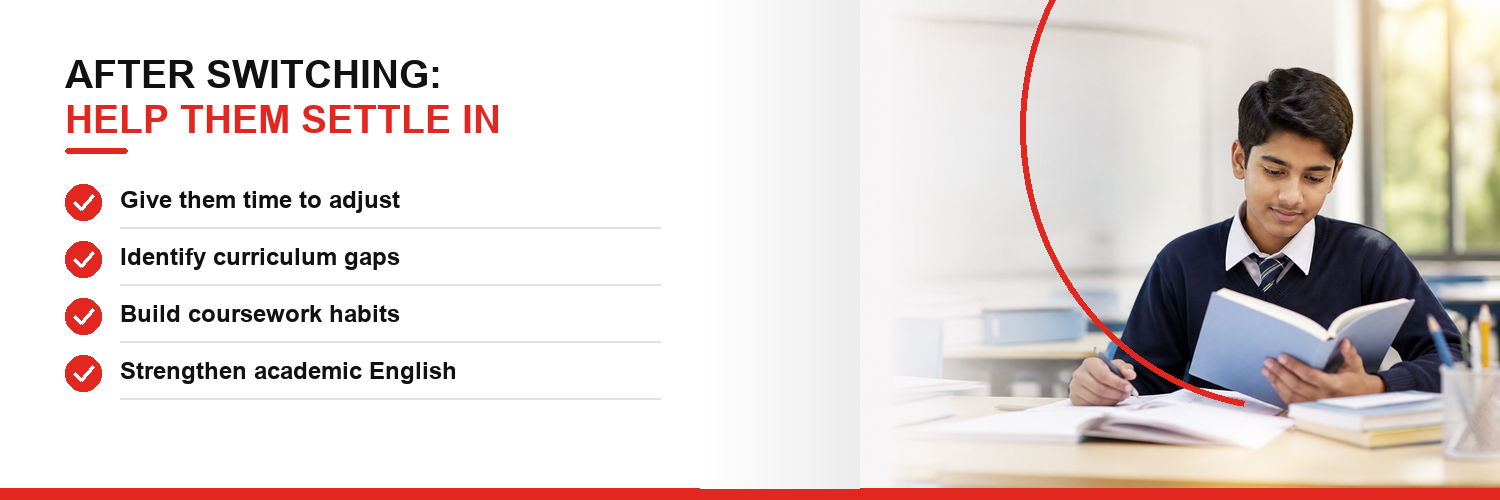
How to Help Your Child Adjust from CBSE to IGCSE
Give it at least a full term
Most parents who have made this move report that their child needed a full term, sometimes longer, to genuinely settle into IGCSE’s approach. The instinct to compare with CBSE peers during this period can create unnecessary anxiety. The curricula are different enough that direct comparisons are misleading.
Address the specific gap areas proactively
A good IGCSE school will conduct a subject-by-subject gap assessment on admission. Work with the school on this. Targeted academic support in the first term is far more effective than generic catch-up, identify exactly which topics need bridging and address them specifically.
Help your child adjust to coursework management
CBSE-trained students are accustomed to a clear annual exam cycle, study hard, perform, and do well. IGCSE’s ongoing coursework requires a different kind of discipline: consistent effort across the year, meeting regular internal deadlines, and managing multiple pieces of work simultaneously. Help your child build a workflow early, before coursework pressure accumulates.
Maintain language confidence
The Dhruv Global School Perspective: Why We Remain Committed to CBSE
At Dhruv Global School, we follow the CBSE curriculum and we do so not by default, but by deliberate conviction. CBSE is not simply the path of least resistance for an Indian school. It is the board that best serves the majority of Indian families’ actual goals, national and international university access, JEE and NEET preparation, curriculum continuity across relocations, and a qualification that requires no additional equivalency steps.
We also believe, and our results reflect, that the perceived gap between CBSE and IGCSE in terms of teaching quality and learning experience is not a function of the board, it is a function of the school. A CBSE school that teaches conceptually, develops inquiry and critical thinking, and treats learning as more than marks preparation delivers every benefit that draws parents to IGCSE, within a curriculum that carries fewer trade-offs for families whose future remains in India.
NEP 2020 and CBSE’s evolving assessment framework: competency-based questions, flexible subject streams, compulsory AI and Computational Thinking, two-level Maths, are moving the CBSE system deliberately toward exactly the qualities that IGCSE is valued for. The gap is narrowing from the curriculum side too.
For families genuinely considering IGCSE, particularly those with international relocation plans, children targeting global universities, or children who would demonstrably thrive in a different assessment model, we think the decision deserves honest consideration, not dismissal. This guide is intended to give you the information to make that decision well.
For families who are content in India long-term, whose children may pursue JEE or NEET, or who value curriculum continuity and portability within the Indian system: CBSE, done well, is the stronger choice.
Final Thoughts
The CBSE-to-IGCSE question does not have a universal answer. It has an answer that depends on your child’s specific learning profile, your family’s geographic and career plans, your child’s potential university destinations, and whether JEE or NEET is a realistic or desired path.
What is clear: it can be done, it requires planning, the timing matters enormously, and the implications for Indian university admissions, particularly competitive entrance exams, need to be understood clearly before the decision is made. This is a decision worth taking six months to make properly, not one worth rushing.