Every June, millions of Indian parents sit down with spreadsheets, school rankings, and WhatsApp group opinions, all trying to answer the same question: which school is best for my child?
The rankings are useful for narrowing down your list. They tell you which schools have good board results, reputable infrastructure, and satisfied parents. What they do not tell you and cannot tell you is whether a particular school is right for your child.
A school ranked number one in your city may be exactly wrong for a child who learns best by moving, building, and doing. And a school ranked much lower may be precisely the right environment for that same child. The difference lies not in the school’s reputation, but in how well the school’s approach matches your child’s learning style.
This blog will help you understand what learning styles are, how to identify your child’s, and what specific things to look for when you walk into a school, beyond the brochure.
What Is a Learning Style and Why Does It Matter?
In the early 1980s, developmental psychologist Howard Gardner proposed what many parents intuitively already sensed: different children learn in fundamentally different ways. A lesson that works beautifully for one child in a classroom may barely register for another sitting two desks away, not because one is more intelligent, but because they process information differently.
The most widely used framework identifies three primary learning preferences: visual, auditory, and kinesthetic, though most children are a blend of all three, with one tending to be stronger than the others. India’s National Education Policy 2020 explicitly calls for schools to recognise and respond to these differences, marking a formal shift away from one-size-fits-all instruction.
Understanding how your child learns is not about labelling them. It is about knowing what kind of environment helps them feel confident, curious, and engaged and finding a school that can provide it.
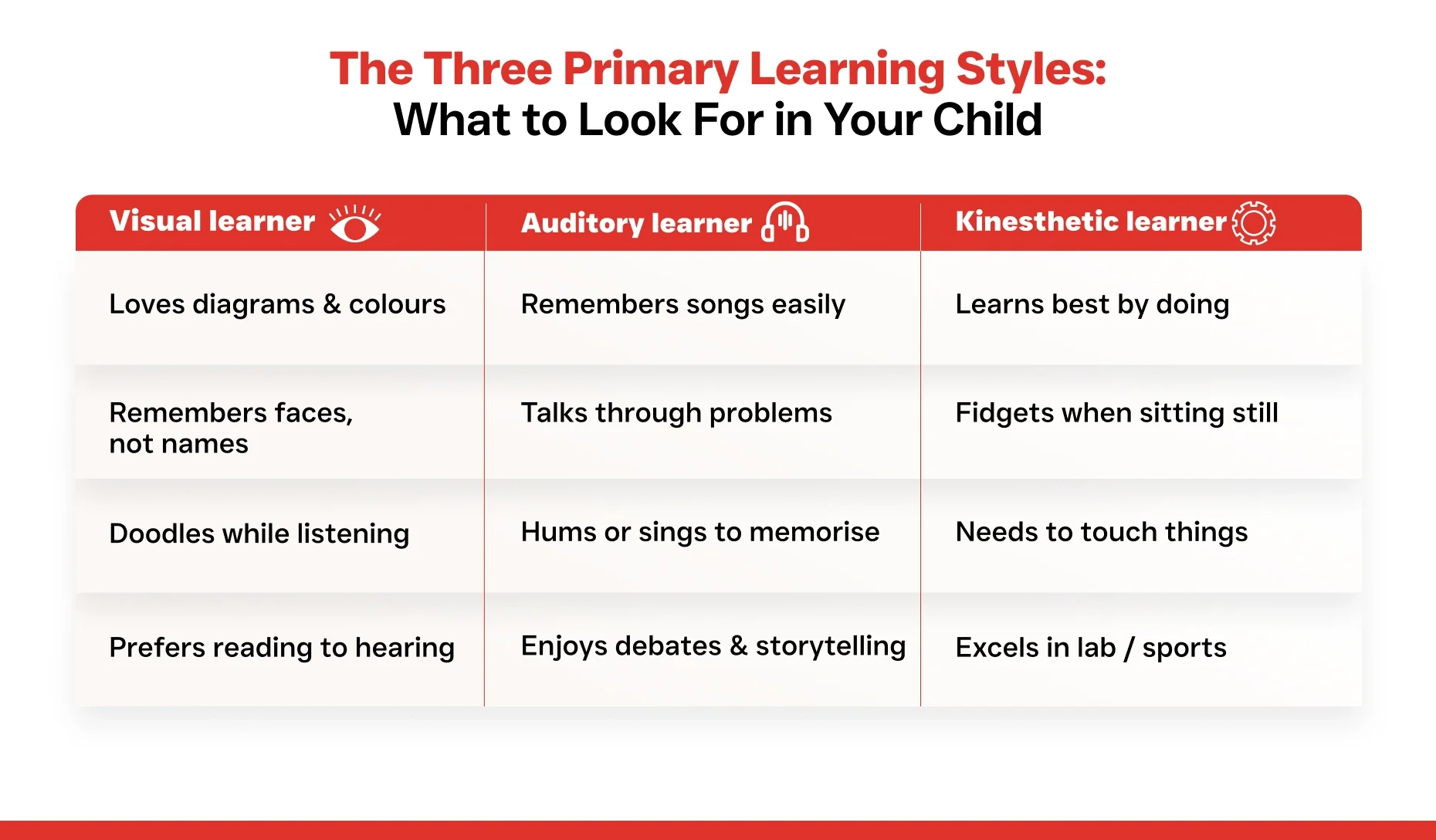
The Three Primary Learning Styles: What to Look For in Your Child
How to Spot Your Child's Dominant Learning Style
Watch how they study for a test
Does your child instinctively reach for coloured pens and draw mind maps? That points to visual learning. Do they read notes out loud, or talk through concepts to themselves? That is auditory. Do they pace around, use their fingers to count, or need to physically act something out? That is kinesthetic.
Notice what frustrates them
Try the teach-back method
What School Rankings Cannot Tell You
School rankings in India, including the widely cited Education World India School Rankings, assess schools across parameters like academic results, teacher quality, infrastructure, and extracurricular programmes. These are genuinely useful metrics. But no ranking system tells you how a school teaches on an ordinary Tuesday afternoon.
A school with outstanding board results may achieve those results through intensive drilling and test preparation, which works very well for some children and very poorly for others. A school ranked lower may use project-based, discussion-heavy teaching that produces slightly lower average exam scores but far higher engagement, creativity, and long-term learning in children who lean toward kinesthetic or auditory styles.
As one education guide puts it plainly: boards matter, but implementation matters more. A well-run school on any board is better than a poorly implemented one with a prestigious label.
The ranking tells you where to start looking. It does not tell you where to stop.
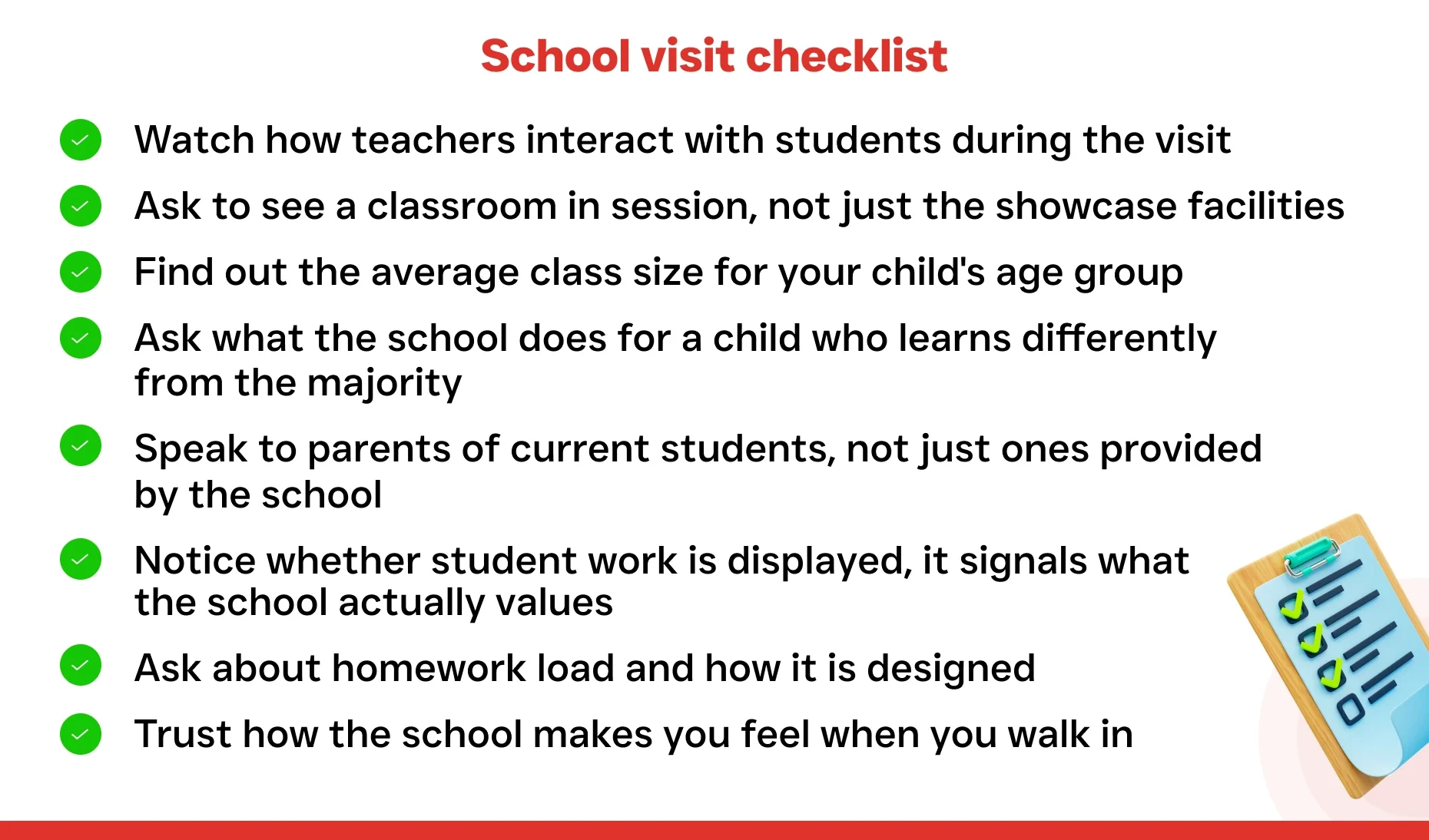
What to Actually Look for When You Visit a School
For a visual learner — ask and observe:
- Are classroom walls covered with student work, diagrams, and visual prompts or are they bare?
- Do teachers use whiteboards, charts, visual timelines, and colour to explain concepts?
- Are there maps, diagrams, and illustrated textbooks rather than purely text-heavy materials?
- Ask: “How does the school present a complex concept like fractions or the water cycle?”
For an auditory learner — ask and observe:
- Does the classroom have discussion time built in, or is it mostly silent individual work?
- Are students given opportunities to present, debate, or explain concepts to peers?
- Is there music, drama, or storytelling integrated into learning?
- Ask: “How much group discussion and oral participation happens in a typical lesson?”
For a kinesthetic learner — ask and observe:
- Are there labs, maker spaces, art rooms, or outdoor learning areas that children use regularly?
- Is project-based learning part of the curriculum, not just as an occasional activity, but as a core method?
- Do children get to move around during lessons, or are they expected to sit still for long periods?
- Ask: “Can you give me an example of a topic that was taught through hands-on activity rather than a textbook?”
One question that reveals a school's teaching approach
- When you visit, ask any teacher or the principal this:
- "If a child is bright and understands things well verbally, but consistently scores lower on written tests, what does your school do for that child?"
- A school that has genuinely thought about learning diversity will give you a specific, confident answer. A school that hasn't will give you a vague one.
Beyond Learning Style: Other Things That Matter for Your Child
Personality and class size
Extracurricular fit
Values alignment
Your gut feeling on the visit
How Dhruv Global School Approaches This
At Dhruv Global School, the understanding that every child is a different kind of learner is not a policy statement, it is the framework that shapes how teaching actually works in our classrooms.
Our approach draws on Howard Gardner’s theory of multiple intelligences, the framework that recognises linguistic, musical, spatial, kinesthetic, interpersonal, and logical-mathematical intelligence as equally valid ways of being smart. This means that a child who does not shine on a written test may be the most capable student in the room when it comes to music, physical skill, spatial reasoning, or leading a group.
Our classrooms are designed to give all three types of learners regular, meaningful opportunities. Visual learners work with diagrams, charts, and open-plan learning spaces. Auditory learners have structured discussion time, debate, music, and drama. Kinesthetic learners have access to badminton courts, a football field, an Olympic-size swimming pool, a dance and gymnastics hall, and a recording studio because movement and physical mastery are not extras at Dhruv. They are part of what we mean by education.
Our teacher recruitment also reflects this. The five qualities we seek: vision, passion, integrity, connectivity, and intelligence are chosen because they describe educators who can respond to a child, not just deliver a curriculum. Two-way learning, where teachers learn as much from students as the other way around, is something we actively build into how school life works.
When you visit Dhruv Global School, bring your list of questions. We welcome them. The right school for your child should always be able to answer: how do you teach the child who learns differently?
Final thoughts
The best school for your child is not the one with the highest ranking. It is the one where your child’s way of learning is understood, respected, and actively catered for. Rankings tell you a school is good. Only a visit and the right questions tell you it is good for your child specifically.
Start with the ranking list. Then go and watch the classrooms. The answer is not in the number, it is in the room.