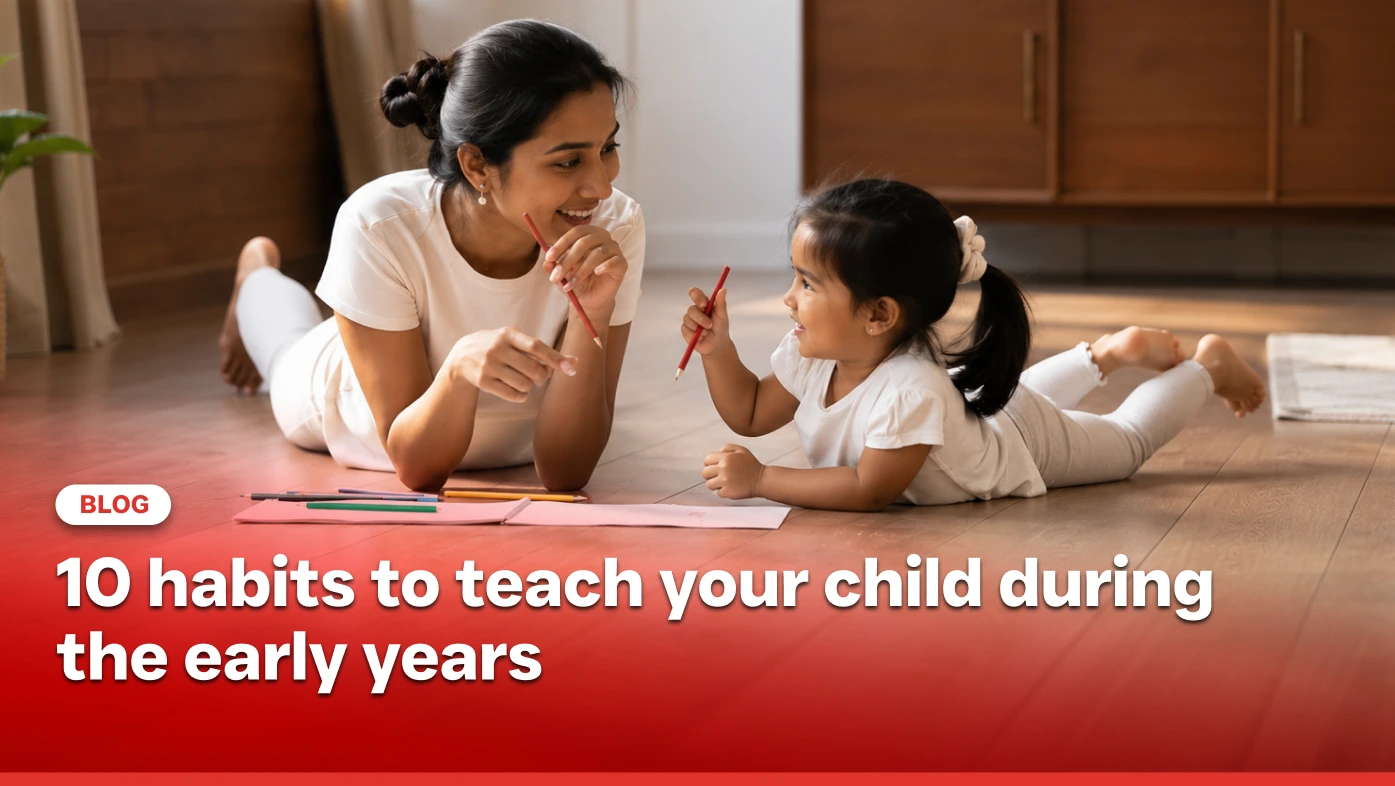
Every parent wants their child to grow up responsible, kind, curious, and capable. Most parents are also aware, somewhere in the back of their minds, that wanting these things and actually building them are two very different endeavours.
The difference between a child who has these qualities and one who does not is rarely talent or temperament. It is almost always habit. The small, repeated, eventually automatic behaviours that a child practises so consistently that they stop requiring effort and simply become part of who they are.
Habits are not built in a single conversation. They are not built by telling a child what to do. They are built by doing the same things, in the same way, enough times that the behaviour becomes the default, not a decision, but a reflex.
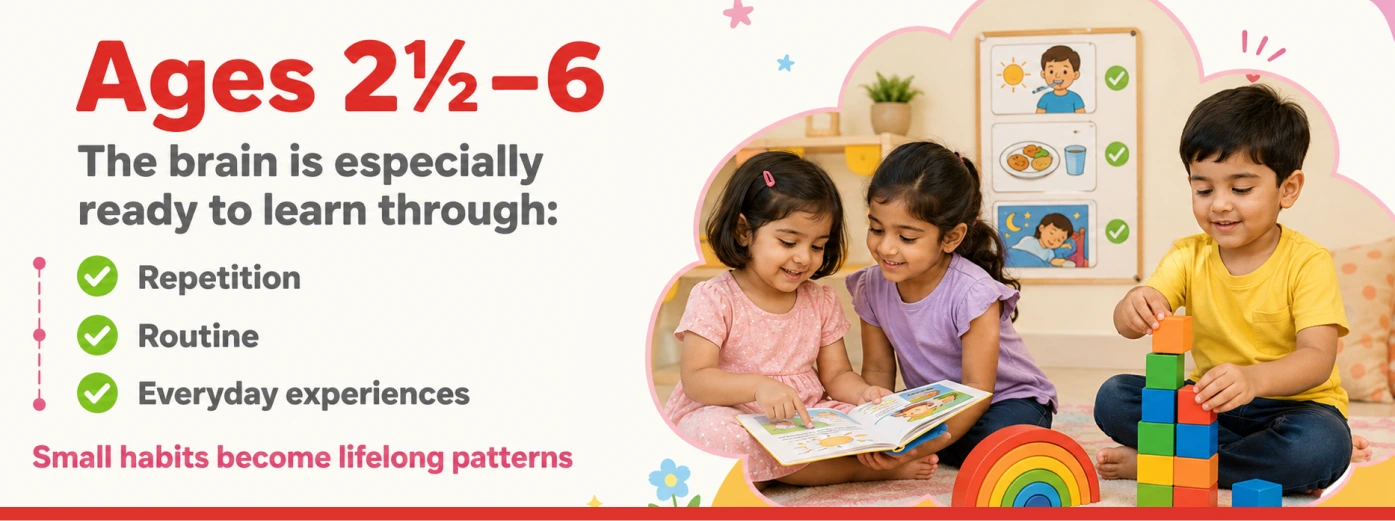
And the window in which habits form most readily, most deeply, and most durably is the one your child is in right now. The preschool years, roughly two and a half to six are when the brain is most plastic, most receptive, and most shaped by repetition. The habits formed in these years do not just influence the child’s behaviour at three or four. They set the template for how that child will approach learning, relationships, and themselves for decades.
This is not pressure. It is possibility. Here are the habits worth starting now.
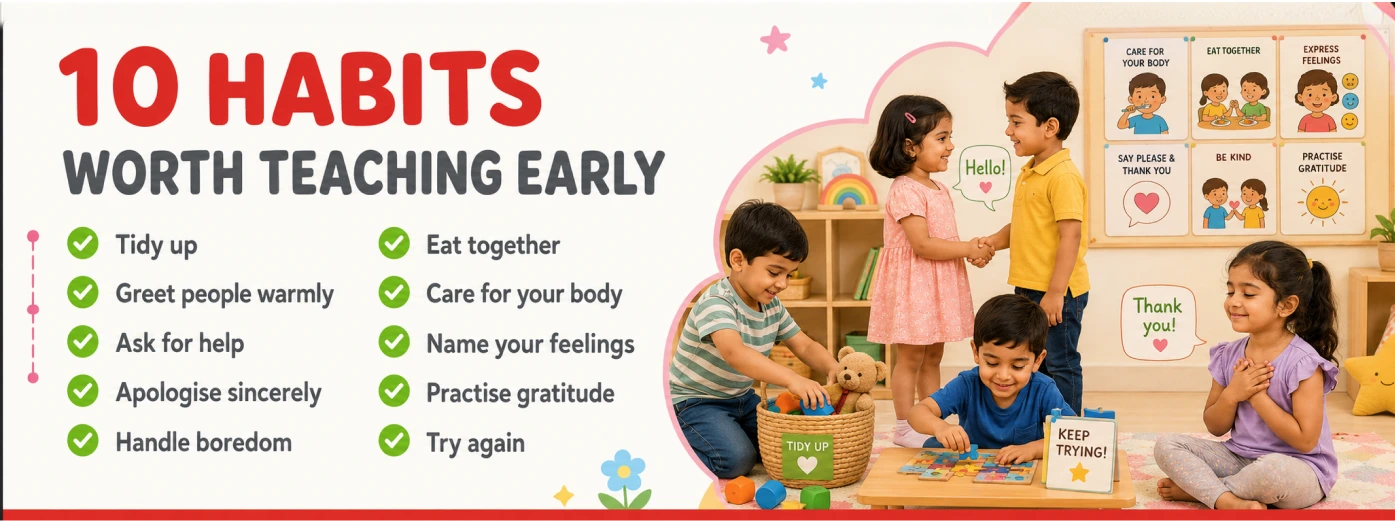
10 Good Habits Every Preschool Child Should Learn
1. Tidying Up After Themselves
This is the habit most parents attempt and most inconsistently follow through on and the one with the most direct developmental payoff if it is actually embedded.
A child who puts their toys away before getting new ones out, who places their shoes by the door, who carries their plate to the sink after a meal, is doing something more significant than keeping the house tidy. They are practising the cognitive skill of completing a loop, of understanding that an action has a beginning, a middle, and an end, and that the end matters.
This loop-completion habit is the foundation of every executive function skill the child will need throughout their academic and professional life. Finishing what you start. Following through. Not leaving things half-done and moving on.
Start small. One thing at a time. Make it a routine rather than a request, after play, we tidy. Always. Not sometimes. Not when you remind them. Every time, as a matter of course.
2. Greeting People by Name
Teach your child to look at someone when they speak to them and to use their name.
Not say hello to aunty. But: look at Mrs Sharma and say good morning.
This is not a social nicety. It is the foundation of the most important professional and social skill a person can have: the ability to make another person feel genuinely seen.
A child who has practised this from three years old arrives in every social situation, at school, at a friend’s home, in a room full of strangers, with a specific, small tool that almost nobody else their age has. They know how to begin. And beginning, in almost every human interaction, is the hardest part.
3. Asking for Help Before Giving Up
Most young children do one of two things when they encounter difficulty: they persist in mounting frustration until the frustration explodes, or they simply walk away.
The habit worth building is neither of these. It is the middle path: noticing that you are stuck, naming it, and asking for help before the frustration becomes overwhelming.
I am finding this hard. Can you help me?
This sounds simple. It is not simple. It requires a child to have enough self-awareness to notice what they are feeling, enough emotional regulation to pause before the feeling takes over, and enough trust in the people around them to ask rather than collapse.
Build it by modelling it yourself. When you are struggling with something in front of your child, a heavy bag, a stuck jar, a problem you cannot solve, say out loud: I am finding this hard. I am going to ask for help. Then ask. Let them see the whole process.
4. Saying Sorry and Meaning It
This is one of the most important habits of early childhood and one of the most frequently performed incorrectly.
A forced apology, say sorry to your sister, teaches a child that sorry is a word that ends conflict. It does not teach them what sorry means. What sorry means is: I understand that what I did affected you. I care about that. I will try to do differently.
That understanding cannot be coerced. It has to be grown.
Grow it by talking about the other person’s experience before asking for the apology. Look at your brother’s face. How do you think he is feeling right now? What happened to make him feel that way? Give the child time to actually connect with the impact of their action. Then the apology, when it comes, has something behind it.
This is a long practice. It will not be perfect at three. It will not be perfect at six. But the child who has been genuinely guided through this process repeatedly arrives at adolescence with a relationship to accountability, honest, non-defensive, genuinely reparative, that is extraordinarily rare and extraordinarily valuable.
5. Sitting With Boredom
This is the habit that modern parenting most consistently prevents children from developing and the one whose absence is most visible in schools.
Boredom is not a problem. It is a condition. And it is a condition that, when it is not immediately relieved by a screen or an activity or a parent who swoops in with something to do, produces something remarkable: the child’s own imagination, activated.
Children who have learned to sit with a moment of I don’t know what to do, who have been through that feeling enough times to know it passes, and that what comes after it is usually something they thought of themselves, develop creative thinking, intrinsic motivation, and the capacity to entertain themselves that is one of the foundations of genuine intellectual independence.
The habit to build is simple and uncomfortable: do not fill every moment. Leave gaps. Resist the impulse to provide an activity. Let the boredom arrive and trust what comes after it.
6. Handling Food Well
The habits formed around food in the early years, the willingness to try new things, the ability to sit at a table, the understanding that mealtimes are a shared experience rather than a fuelling stop, are far more consequential than most parents realise.
A child who has been expected, gently and consistently, to try at least one bite of everything on their plate is a child developing openness to novelty. A child who sits at the table until the meal is finished is developing the ability to be present in a shared experience. A child who helps set and clear the table is practising contribution.
None of these are about food. They are about the habits of participation, openness, and responsibility that the dining table, approached consistently, builds every single day.
7. Looking After Their Own Body
Teeth brushing, hand washing, dressing themselves, drinking water, these are the habits most parents are trying to build, with varying degrees of success and varying degrees of battle.
The key that most parents miss is that the goal is not compliance but ownership. A child who brushes their teeth because they will be in trouble if they don’t is not building a habit. A child who brushes their teeth because they understand that their body belongs to them and they are responsible for it is building something that will last.
Talk about why, not just what. Not brush your teeth or they will fall out, which is a threat. But brushing your teeth is how you take care of yourself. Your body is yours and you are learning to look after it.
The language of ownership and responsibility, applied to body care from the earliest years, builds a relationship with self-care that extends far beyond the bathroom.
8. Noticing and Naming Feelings
A child who can say I am frustrated rather than throwing something has accessed a cognitive process, the labelling of an emotional state, that actually reduces the physiological intensity of that state. Brain imaging studies show that naming an emotion activates the prefrontal cortex and reduces activation in the amygdala, the brain’s threat-response centre.
In plain language: naming feelings helps regulate them. And regulation is the skill that underpins everything else, the ability to learn, to socialise, to persist through difficulty, to behave in accordance with one’s own values rather than in the grip of an unmanaged feeling.
Build this habit through daily, casual narration of emotional experience. You seem frustrated. Is that what you are feeling? I notice I am feeling tired and a bit grumpy. That looked like it made you feel proud. The vocabulary builds gradually. The habit of pausing to name before reacting builds alongside it.
9. Gratitude as a Daily Practice
Not the performative kind, say thank you to Grandma for the gift. The genuine kind. The habit of noticing, at the end of a day, one specific thing that was good.
This does not require a gratitude journal or a formal ritual. It requires a question, asked consistently, that directs a child’s attention toward what was positive in their day before sleep.
What was one good thing today?
The specificity matters. My friend saved me a seat at lunch. We saw a dog on our walk. The story we read had a funny part. Small things, noticed precisely, trained into a habit of attention that is one of the strongest predictors of sustained wellbeing across a lifetime.
10. Trying Again After Getting It Wrong
This is the habit that everything else depends on.
A child who has learned that getting something wrong is information, not a verdict, not a humiliation, not a reason to stop, is a child who will keep trying. And a child who keeps trying is a child who will, eventually, get most things right.
The habit is built not through motivational speeches but through the way adults in a child’s life respond to failure. Calmly. Specifically. With curiosity rather than disappointment.
That didn’t work. What do you think happened? What could we try differently?
Three questions. Asked every time. With genuine curiosity rather than disguised judgment. The child who grows up hearing these questions begins to ask them of themselves and that internal voice, curious and persistent rather than self-critical and defeated, is the most important habit any child can carry into everything that follows.
How Dhruv Preschool Helps Children Build Positive Habits
At Dhruv Preschool, we think about habits the same way we think about everything else in early childhood: as something that is built in the small moments, not the grand ones.
The way we handle tidying up in the classroom. The way we respond when a child gets something wrong. The way we talk about feelings, model asking for help, and create the space for children to sit with something difficult without rushing to rescue them.
Teach your child the correct anatomical names for all body parts, including genitals. Penis. Vulva. Bottom. This is not about being clinical or uncomfortable. It is about giving your child accurate language that will serve them in two critical ways.
These are not dramatic interventions. They are daily practices and daily practices, repeated consistently enough, are what habits are made of.
We also know that the habits we build here are only as strong as the environment that surrounds them. Which is why we talk to parents, not to tell you what to do at home, but because the habits that form most deeply are the ones that a child encounters in the same form in both the places that matter most to them.
Come and visit us at Dhruv Preschool and see the daily habits we are building together.